
Roth Solo 401k Contributions

There are two types of Roth solo 401k contributions–designated employee Roth solo 401k contributions and designated employer Roth solo 401k contributions.
Designated employee Roth solo 401k contributions were first allowed with the passage of the Economic Growth and Tax Relief Reconciliation Act of 2001 (EGTRRA) and codified under IRC Sec. 402A.
Designated employer Roth solo 401k contributions were first available in 2023 with the passage of SECURE ACT 2.0.
Both Roth solo 401k contribution types are required to be separately tracked in separate holding accounts (bank or brokerage accounts) under the solo 401k plan and for each participant. Visit here to learn more about separate holding accounts for each source and participant.

- Both types are always 100 percent vested when made to the solo 401k plan.
- Only the employee Roth solo 401k contributions may be treated as catch-up contributions.
- Both may be used toward the solo 401k participant loan.
- Both may be transferred to a Roth IRA or to another Roth 401k once the participant reaches age 59 ½ or is no longer self-employed.
- Both are not subject to required minimum distributions (RMDs).
The following funds can be contributed to a Roth Solo 401k:
- Elective salary deferrals (employee contributions–$23,000 for 2024; for 2025 the employee elective deferral limit increased to $23,500)
- Catch-up contributions (age 50 or over–$7,500 for 2024); For 2025, if you are aged 50 or older, the employee Roth solo 401k contribution increased to $31,000 ($23,500 + $7,500). However, if you are age 60, 61, 62 or 63 in 2025 the catch-up contribution increases to $11,250 from $7,500 for tax year 2025.
- Roth Employer Profit Sharing Contributions effective for 2022 and later years per SECURE Act 2.0.
- Conversions (rollovers) from IRAs or other (non-Roth) employer plans (unlimited amounts)
- Rollovers from other Roth 401k plans, Roth 403b, Roth 457 and Roth TSP (unlimited amounts). See the following.

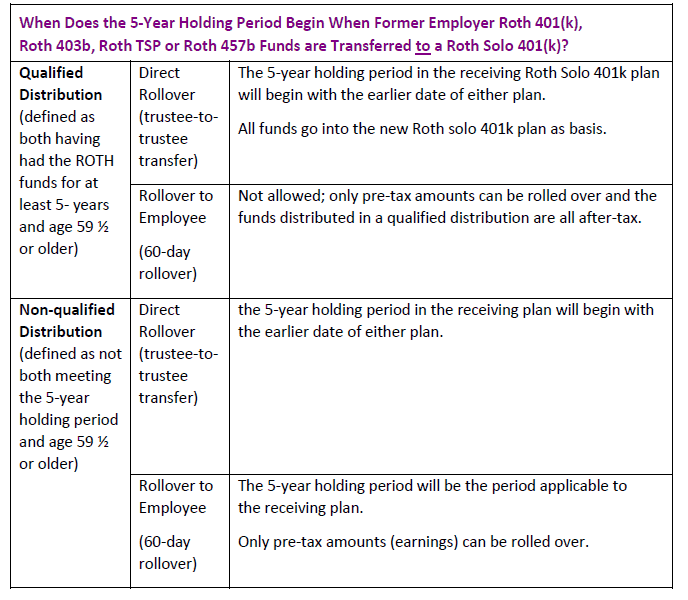
How the 5-Year Holding Period Works When Other Employer Roth Funds Are Transferred to a Roth Solo 401k:
- If you want to take a distribution of funds that were transferred from other employer Roth plans to a Roth Solo 401k plan, the following rules apply:
These funds CANNOT be contributed to Roth Solo 401k:
- Rollovers from Roth IRAs
- Rollovers of non-deductible IRA basis; however, gains from non-deductible IRAs may be transferred to the pretax solo 401k.
Overview of the Roth Solo 401k Contribution Rules:
Roth Solo 401k contributions have been allowed since January 1, 2006. While our plan document allows for Roth contributions, not all Solo 401k providers allow for Roth contributions.
Roth Solo 401k is governed by the same rules as other 401k plans. Therefore, contribution and distribution restrictions apply.
The income limits do not apply to Roth Solo 401k contributions. Contributions to Roth Solo 401k are made up of salary deferrals (employee contributions), and are contributed with after-tax funds. Unlike deferrals made to regular solo 401k, amounts deferred to Roth Solo 401k do not reduce your taxable income for the tax year.
We discussed whether one can make both Traditional and Roth Solo 401k contributions on our Daily Live Webinars hosted on our My Community (Free to Join! All are Welcome!):
Examples
Ryan, a self-employed business owner, participates in a Solo 401k that allows for Roth and regular, non-Roth Solo 401k contributions. This year Ryan makes $60,000 and defers $10,000 of his self-employment earnings to his non-Roth Solo 401k account.
Non-Roth Solo 401k–the $10,000 deferral is treated as pre-tax, thereby reducing Ryan’s income by $10,000 to $50,000. It is as if Ryan only made $50,000 a year because he is only required to pay taxes on $50,000.
Roth Solo 401k— The facts are the same as above except that Ryan chooses to treat the $10,000 deferral as a Roth contribution instead. The $10,000 deferral is now considered after-tax. As a result, Ryan’s full $60,000 self-employment income is subject to withholding.
Separate Tracking of Roth Solo 401k Funds Required:
Roth Solo 401k contributions must be separately accounted for in the solo 401k plan. This is a 401k regulation. The solo 401k trustee must keep track of gains, losses, contributions and distributions in the Roth solo 401(k) account and must be able to determine the basis in the account. This is easily accomplished under a separate bank or brokerage account dedicated to holding the Roth solo 401k funds.
In-plan Solo 401k Roth Rollovers:
An in-plan Roth rollover is the movement of assets from your existing Solo 401k to a designated Roth Solo 401k account within the same Solo 401k plan. Visit our blog to learn about in-plan Solo 401k Roth rollovers by clicking here.

Roth Solo 401k Distributions
There are two basic types of distributions from employee Roth Solo 401k plans—qualified and nonqualified distributions. Designated employee Roth solo 401k assets can be distributed tax and penalty free if they meet the qualified distribution requirements under IRC Sec. 402A(d)(2). www.gpo.gov
Qualified Distributions
Qualified distributions are tax free. Designated employee Roth solo 401k distributions must satisfy two requirements to be qualified distributions: 1) a five-taxable-year period must have elapsed, and 2) the distribution must be made after the participant has reached age 59 ½.
Nonqualified Roth Distributions
Nonqualified employee Roth solo 401k distributions (distributions made prior to satisfying both the five-year rule and the qualifying event requirement) are partially tax-free. The distribution will be taxed based on a pro rata distribution of employee Roth solo 401k contributions and earnings, and just the earnings portion is taxable.
ILLUSTRATION:
Assume the participant has the following Roth solo 401k account balance and wants to take a $5,000 distribution.
$ 9,400 basis (Roth solo 401k contributions)
$ 600 earnings
$10,000 account balance
Formula:
Basis /Account Balance X Distribution = nontaxable amount
$9,400/$10,000 X $5,000 = $4,700 of basis and $300 of taxable earnings
Five-Year Period
This five-year period begins with the earlier of:
1) the first taxable year for which the solo 401k participant made employee Roth solo 401k contributions under the solo 401k plan, or
2) the first taxable year the solo 401k participant made Roth contributions to a former employer’s retirement plan (AKA Roth 401k, Roth 403b, ROTH 457b or Roth 403b), which was directly rolled over to the distributing retirement plan (the Roth solo 401k)
- The five-year period generally is determined separately for each plan including Roth solo 401k plans.
- If a direct rollover was processed from a former employer Roth 401k, for example, to the Roth Solo 401k, the the five-year period is the earlier of the two plans’ five-year periods. This same rule also applies to direct rollovers from an alternate payee or spouse beneficiary.
- For an indirect rollover (a 60 day rollover), the five-year period under the distributing plan (e.g., the former employer Roth 401k) does not apply to the receiving plan (i.e., the Roth Solo 401k plan).
In-Plan Roth Rollovers
With the passage of the Small Business Jobs Act of 2010, and the American Taxpayer Relief Act of 2012 (ATRA), which also allowed all 401k participants including solo 401k participants under age 59 ½ to process in-plan rollovers of pretax solo 401k funds to the designated Roth solo 401k account within the solo 401k plan. For additional information published by the IRS in 2010 surrounding in plan conversions. see Notice 2010-84. www.irs.gov
Taxation of In-Plan Roth Rollovers
The conversion of pretax solo 40k funds is fully taxable in the year converted to the Roth solo 401k and included in the gross income for the year of the conversion. In the case of voluntary after-tax solo 401k funds that are converted to the Roth solo 401k, only the earnings are deemed taxable, not the basis (the amount contributed). The 10 percent early distribution penalty tax does not apply to in-plan Roth solo 401k conversions even if the participant is under age 59 ½ because he or she is not taking receipt of the funds. Instead, the funds stay in the solo 401k plan, and if assets are converted (e.g., equities, real estate, notes, crypto, etc..) they ae not liquidated.
Multiple in-plan Roth solo 401k conversion is allowed including during the same year. All in-plan conversions in a single year are deemed to have been rolled over on January 1 of that year. For example, a solo 401k participant who processes two in-plan conversions 2019will satisfy the five-year period on January 1, 2024, for both rollovers.
In-plan Roth solo 401k conversions are irreversible. The solo 401k participant cannot change the funds or assets back to pretax or voluntary after-tax status and may not recharacterize or return the assets to the account from which they were converted from.
An in-plan solo 401k conversion is required to be processed as direct rollovers. In other words, the solo 401k participant cannot have the assets or funds distributed in her name and then deposited into the Roth solo 401k.
Qualified Distribution Five-Year Clock
An in-plan Roth solo 401k conversion that is a participant’s first Roth contribution will start the five-year clock necessary for a qualified, tax-free distribution as of the first day of the first taxable year such in-plan Roth solo 401k conversion is completed.
Designated Roth Contributions
The sum of pretax salary deferrals and designated Roth contributions cannot exceed the IRC Sec. 402(g) limit, plus catch-up contributions, if eligible.
Is my understanding correct that if it's a Roth solo 401k the earnings act as a Roth IRA (earnings on investment as well as qualified withdrawals are tax free?)
You are correct that just like a Roth IRA where the funds grow tax-free the funds also grow tax-free inside a Roth 401(k) plan.
So for example: If by the time I am retirement age if I have 3 rental properties paid off inside the Roth solo 401k and those properties generate $36,000 annually in rental income, then that money or whatever amount I wish to take out is tax free money?
Once you have had the Roth 401k for 5 years and are over age 59 1/2, you can take tax free distributions from the Roth solo 401k, so yes.
RMD In-kind Roth Solo 401k QUESTION: What happens if I am over 73 years old and RMDs come into play on the 401k? How do they assess what percent you have to take? Just by the amount of money in the account? Or by the overall value of the real estate? If you keep buying property you possibly could have little money in the solo 401k trust bank account.
Correct that once you reach age 73 you will need to also start taking distribution from the Roth solo 401k. If you don't have enough cash to satisfy the RMD, the property will need to be appraised and part of the property will get assigned in your name and reported as an in-kind distribution to satisfy the RMD. However, effective 2024 Roth 401k plans including Roth solo 401k plans will no longer be subject to RMDs thanks to the SECURE 2.0 Act.
Is a Roth Solo 401k different than a Solo 401k Plan QUESTION: Do I need to open two solo 401k plans if I also want to make Roth Solo 401k contributions?
No. Technically, a business owner does not set up a Roth Solo 401(k). Instead, a traditional solo 401(k) is established and a Roth solo 401(k) is added as a feature. While not all solo 401k plan providers offer a solo 401k with a designated Roth account (DRA) feature, a solo 401k plan offered by My Solo 401k Financial provides for the DRA feature which is elected on the solo 401k adoption agreement.
Roth Solo 401k Contribution Limits QUESTION: Are the Roth Solo 401k contribution limits the same for a Roth solo 401k as for a traditional solo 401k?
The Roth solo 401k contribution limits are the same as the employee pre tax contribution limits. Also, similar to how the Roth IRA and Traditional IRA contributions are combined, the same combination rules apply to the employee contributions that are made to a solo 401k plan.
For 2023 the maximum contribution amount is $22,500 plus a $7,500 catch-up contribution if the employee is age 50 or older.
For 2024 the maximum contribution amount is $23,000 plus a $7,500 catch-up contribution if the employee is age 50 or older.
What is more, the SECURE 2.0 Act expanded the Roth solo 401k contributions limits by now allowing the treatment of employer profit sharing solo 401k contributions as Roth solo 401k contributions.
EXAMPLE:
In 2024 Greg is under age 50 so he does not qualify for solo 401k catch-up contributions. The maximum employee solo 401k contribution for 2024 is $23,000. The total employee contribution to both the pretax solo 401k and the Roth solo 401K cannot exceed $23,000 for 2024. Greg chooses to defer $11,500 to his Roth solo 401k and the remaining $11,500 to his pre tax solo 401k plan.
Plan Allows for ROTH Contributions QUESTION: Is my understanding correct that the plan allows for Roth Solo 401K contributions?
Yes, you are correct, our plan allows for Roth solo 401k Contributions.
Can I transfer-out Roth solo 401k funds before 5 years QUESTION: Even though I'm 69 years old and won't have to take required minimum distributions from my Roth solo 401k until I turn age 73 , I'm doing some planning now. Here is my question. Can I just transfer the Roth solo 401k funds and leave the pretax solo 41k funds alone to a Roth IRA.
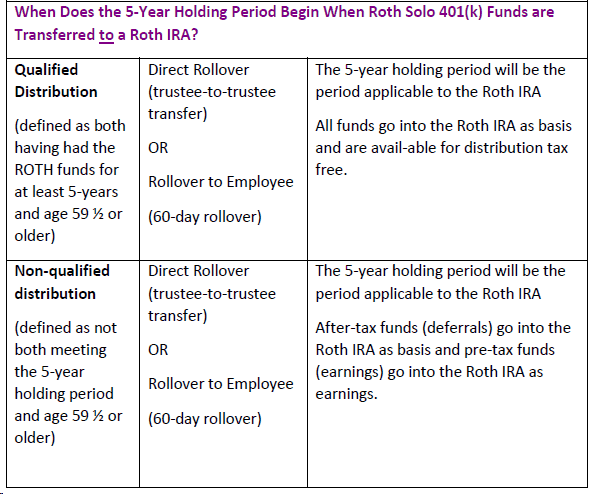
With respect to only transferring the Roth solo 401k funds to a Roth IRA and leaving the pretax solo 401k funds alone, this can be done even though you have not had the Roth solo 401k for 5 years provided you are over age 59 1/2. However, if the Roth solo 401k funds have not satisfied the 5 year holding period, the earnings on the Roth 41k cannot be distributed from the Roth IRA without paying taxes on the earnings until the Roth solo 401k funds have met the 5 year holding period in the new Roth IRA. Therefore, you will need to separately track the Roth solo 401k earnings in the Roth IRA if you plan to take distributions from the ROTH IRA before the 5 year clock has been satisfied. It appears that you are not looking to take distribution from the Roth IRA anytime soon so this should be a mute point.
Transfer Roth Solo 401k to Roth IRA QUESTION: In the future, can I roll the ROTH Solo 401K into my personal ROTH IRA:
Yes, and we would issue a 1099-R to report the non-taxable transfer to the Roth IRA. Also, the following rules apply:
Immediately Contribute to Roth Solo 401k and Transfer to ROTH IRA QUESTION: Can I convert the employee Solo Roth 401k contribution (maximum $22,500 for 2023) to a Roth IRA immediately without penalty? I am 30 years old and am not sure if I can perform this rollover without incurring a penalty. I am wanting to perform this rollover to avoid the RMD that comes with a Roth 401k but is not present with a Roth IRA. If I am able to perform this rollover, would it allow me to avoid the RMD for these funds?
Employer Contributions:
Similar to employee contributions, there are restrictions on the ability to transfer employer contributions to a solo 401(k) ( the employer contributions being withdrawn have been accumulated in the solo 401k plan for at least 2 years; or the participant has participated in the solo 401k plan for at least 5 years, etc.). However, you can make after-tax contributions (up to the lesser of 100% of your self-employed compensation or the overall limit (e.g. $66,000 for 2023) and then transfer those funds to a Roth IRA.
ANSWER:
Employee Contributions:
While it is certainly true that a Roth IRA is not subject to required minimum distributions (e.g. see our Roth IRA versus Roth 401(k) comparison chart HERE), effective in 2024 Roth solo 401k plans also won’t be subject to RMDs stemming from the passing of SECURE 2.0 Act.
You cannot transfer employee contributions such as contributions to a Roth solo 401(k) until there has been a triggering event such as turning 59 1/2 (e.g. see more on the rules regarding making a Solo 401k Distribution HERE). You can still achieve your objective, however, since our plan would allow you to make non-Roth after-tax contributions which can then be immediately transferred to your Roth IRA. As part of our services for no additional charge, we would guide you through the process to make those non-Roth after-tax contributions (e.g. the contributions would have to be made to a separate after-tax account) as well as the required reporting (even though it would not be a taxable transfer it will be a reportable transfer).
Retired and Distribution QUESTION: Do I have to be retired from the self-employment which allows for the Roth solo 401K contributions before I can transfer the Roth solo 401k funds to a Roth IRA?
Solo 401k plan participants who have invested in designated Roth accounts (aka Roth solo 401k) and meet a triggering event (see below) can roll over these Roth account assets to Roth IRAs. Because the contributions went into the Roth account on an after-tax basis, they are not subject to income tax when rolled over to a Roth IRA. The earning portion rolled over also is non-taxable.
What is a triggering event with respect to transferring Roth solo 401k funds to a Roth IRA?
Type 1: Annual Roth solo 401k contributions made to the Roth solo 401k plan.
- This type can only be transferred to a ROTH IRA if you are age 59 1/2 or no longer self-employed.
Type 2: Roth 401k funds that were transferred to the Roth Solo 401k from a former employer 401k, 403b or 457b plan.
- This type can be transferred to a ROTH IRA at any-time.
Type 3: After-tax voluntary contributions.
- This type can be converted to a Roth IRA at any-time.
Distribute the After-Tax Amount QUESTION: Can I withdraw tax free the amount that I have converted from the solo 401k voluntary after-tax account to the Roth solo 401k account?
If you are asking if you can take a distribution (non-conversion) from the Roth solo 401k that was funded through the conversion of solo 401k voluntary after-tax contributions instead of transferring the funds to a Roth IRA, yes you can provided you have both had the Roth solo 401k for 5 years and have reached age 59 1/2. Otherwise, you will owe taxes on the gains. To learn more about qualified Roth solo 401k distribution rules, visit here.
Distribution Before Age 59 1/2 QUESTION: Can I withdraw the solo 401k after-tax funds that I converted to the Roth Solo 401k tax free BEFORE 59.5 without the 10% penalty?
Good question. This would fall under the non-qualified distribution umbrella. Non-qualified distributions from the Roth Solo 401k are subject to the pro-rata basis distribution rules. See the following: https://www.mysolo401k.net/non-qualified-distributions-from-roth-solo-401k/
Immediately Convert Roth Solo 401k Contribution to Roth IRA QUESTION: Can I convert the employee Solo Roth 401k contribution (maximum $22,500 for 2023) to a Roth IRA immediately without penalty? I am 30 years old and am not sure if I can perform this rollover without incurring a penalty. I am wanting to perform this rollover to avoid the RMD that comes with a Roth 401k but is not present with a Roth IRA. If I am able to perform this rollover, would it allow me to avoid the RMD for these funds?
Employer Contributions:
Similar to employee contributions, there are restrictions on the ability to transfer employer contributions to a solo 401(k) ( the employer contributions being withdrawn have been accumulated in the solo 401k plan for at least 2 years; or the participant has participated in the solo 401k plan for at least 5 years, etc.). However, you can make after-tax contributions (up to the lesser of 100% of your self-employed compensation or the overall limit (e.g. $66,000 for 2023) and then transfer those funds to a Roth IRA.
ANSWER:
Employee Contributions:
While it is certainly true that a Roth IRA is not subject to required minimum distributions (e.g. see our Roth IRA versus Roth 401(k) comparison chart HERE), effective in 2024 Roth solo 401k plans also won’t be subject to RMDs stemming from the passing of SECURE 2.0 Act.
You cannot transfer employee contributions such as contributions to a Roth solo 401(k) until there has been a triggering event such as turning 59 1/2 (e.g. see more on the rules regarding making a Solo 401k Distribution HERE). You can still achieve your objective, however, since our plan would allow you to make non-Roth after-tax contributions which can then be immediately transferred to your Roth IRA. As part of our services for no additional charge, we would guide you through the process to make those non-Roth after-tax contributions (e.g. the contributions would have to be made to a separate after-tax account) as well as the required reporting (even though it would not be a taxable transfer it will be a reportable transfer).
Separate EIN for ROTH Solo 401k QUESTION: Does my Roth Solo 401k have to have its own EIN?
No, the Roth solo 401k component (designated Roth account) does not have its own EIN. Only one employer identification number (EIN) is required for the solo 401k plan. The solo 401k plan is made up of three components-- pretax, Roth and voluntary after-tax contributions.
Apply 5 year Roth 401k Designated Account Clock to Previous Year QUESTION: My OBJECTIVE here is to start the 5-year clock on 01/01/2020, so that beginning 01/01/2025, withdrawals can be made without penalty or tax on growth. This is in contrast to the 5-year clock starting on 01/01/2021. I made the first Roth solo 401k contribution in 2021 by my business tax return due date and the contribution was meant for tax year 2020. Can my Roth solo 401k clock start in 2025?
Yes since you made the Roth solo 401k contribution for 2020 in 2021 by your business tax return plus timely filed business tax return extension. The 5 year clock starts in the year for which the Roth solo 401k contribution was made (e.g. 2020 Roth solo 401k contributions made in 2021 start clock on 1/1/2020).
NOTE THAT THE IRS.GOV FAQ ALSO STATES THAT THE CLOCK BEGINS ON THE "first day of your taxable year for which you first made designated Roth contribution"...so again you use the year "for which" the contribution was made
Make Contribution in 2023 and Convert in 2024 QUESTION: If I make my max employer 2023 contribution to my pre tax solo 401k in calendar 2023 and then roll it over to my Roth solo 401k in calendar 2024, do I get the deduction for my tax year 2023 and pay tax on the rollover in 2024 tax year?
Your understanding is correct since conversions are reported in the year the funds are actually converted/deposited to the Roth solo 401k.
Distribute Land Owned by The Plan QUESTION: I have a question for you about taking a distribution from a self-directed Solo Roth 401k . I am considering investing in a vacant lot, using my 401k cash, as an investment. If I decide in a year or two that I would like to build a home on the property for personal use, would there be any penalty? Some details on this; I am already 63 years old and my Solo roth 401k plan will be in place for 5 years on Jan 1, 2021.
Once the Roth solo 401k funds have been in the plan for 5 years, you will be able to take an in-kind distribution of the land tax free, and because you are over age 59 1/2, penalty free (i.e., the 10% early distribution penalty that generally applies to distributions from retirement plan's such a solo 401k won't apply).
Since the land would now be held outside of the solo 401k plan, you could develop the land using personal funds but would not be able to use solo 401k funds to develop the land once the land has been distributed from the Roth solo 401k designated account.
Is my understanding correct that if it's a Roth solo 401k the earnings act as a Roth IRA (earnings on investment as well as qualified withdrawals are tax free?)
You are correct that just like a Roth IRA where the funds grow tax-free the funds also grow tax-free inside a Roth 401(k) plan.
So for example: If by the time I am retirement age if I have 3 rental properties paid off inside the Roth solo 401k and those properties generate $36,000 annually in rental income, then that money or whatever amount I wish to take out is tax free money?
Once you have had the Roth 401k for 5 years and are over age 59 1/2, you can take tax free distributions from the Roth solo 401k, so yes.
RMD In-kind Roth Solo 401k QUESTION: What happens if I am over 73 years old and RMDs come into play on the 401k? How do they assess what percent you have to take? Just by the amount of money in the account? Or by the overall value of the real estate? If you keep buying property you possibly could have little money in the solo 401k trust bank account.
Correct that once you reach age 73 you will need to also start taking distribution from the Roth solo 401k. If you don't have enough cash to satisfy the RMD, the property will need to be appraised and part of the property will get assigned in your name and reported as an in-kind distribution to satisfy the RMD. However, effective 2024 Roth 401k plans including Roth solo 401k plans will no longer be subject to RMDs thanks to the SECURE 2.0 Act.
Is a Roth Solo 401k different than a Solo 401k Plan QUESTION: Do I need to open two solo 401k plans if I also want to make Roth Solo 401k contributions?
No. Technically, a business owner does not set up a Roth Solo 401(k). Instead, a traditional solo 401(k) is established and a Roth solo 401(k) is added as a feature. While not all solo 401k plan providers offer a solo 401k with a designated Roth account (DRA) feature, a solo 401k plan offered by My Solo 401k Financial provides for the DRA feature which is elected on the solo 401k adoption agreement.
Roth Solo 401k Contribution Limits QUESTION: Are the Roth Solo 401k contribution limits the same for a Roth solo 401k as for a traditional solo 401k?
The Roth solo 401k contribution limits are the same as the employee pre tax contribution limits. Also, similar to how the Roth IRA and Traditional IRA contributions are combined, the same combination rules apply to the employee contributions that are made to a solo 401k plan.
For 2023 the maximum contribution amount is $22,500 plus a $7,500 catch-up contribution if the employee is age 50 or older.
For 2024 the maximum contribution amount is $23,000 plus a $7,500 catch-up contribution if the employee is age 50 or older.
What is more, the SECURE 2.0 Act expanded the Roth solo 401k contributions limits by now allowing the treatment of employer profit sharing solo 401k contributions as Roth solo 401k contributions.
EXAMPLE:
In 2024 Greg is under age 50 so he does not qualify for solo 401k catch-up contributions. The maximum employee solo 401k contribution for 2024 is $23,000. The total employee contribution to both the pretax solo 401k and the Roth solo 401K cannot exceed $23,000 for 2024. Greg chooses to defer $11,500 to his Roth solo 401k and the remaining $11,500 to his pre tax solo 401k plan.
Plan Allows for ROTH Contributions QUESTION: Is my understanding correct that the plan allows for Roth Solo 401K contributions?
Yes, you are correct, our plan allows for Roth solo 401k Contributions.
Can I transfer-out Roth solo 401k funds before 5 years QUESTION: Even though I'm 69 years old and won't have to take required minimum distributions from my Roth solo 401k until I turn age 73 , I'm doing some planning now. Here is my question. Can I just transfer the Roth solo 401k funds and leave the pretax solo 41k funds alone to a Roth IRA.
With respect to only transferring the Roth solo 401k funds to a Roth IRA and leaving the pretax solo 401k funds alone, this can be done even though you have not had the Roth solo 401k for 5 years provided you are over age 59 1/2. However, if the Roth solo 401k funds have not satisfied the 5 year holding period, the earnings on the Roth 41k cannot be distributed from the Roth IRA without paying taxes on the earnings until the Roth solo 401k funds have met the 5 year holding period in the new Roth IRA. Therefore, you will need to separately track the Roth solo 401k earnings in the Roth IRA if you plan to take distributions from the ROTH IRA before the 5 year clock has been satisfied. It appears that you are not looking to take distribution from the Roth IRA anytime soon so this should be a mute point.
Transfer Roth Solo 401k to Roth IRA QUESTION: In the future, can I roll the ROTH Solo 401K into my personal ROTH IRA:
Yes, and we would issue a 1099-R to report the non-taxable transfer to the Roth IRA. Also, the following rules apply:
Immediately Contribute to Roth Solo 401k and Transfer to ROTH IRA QUESTION: Can I convert the employee Solo Roth 401k contribution (maximum $22,500 for 2023) to a Roth IRA immediately without penalty? I am 30 years old and am not sure if I can perform this rollover without incurring a penalty. I am wanting to perform this rollover to avoid the RMD that comes with a Roth 401k but is not present with a Roth IRA. If I am able to perform this rollover, would it allow me to avoid the RMD for these funds?
Employer Contributions:
Similar to employee contributions, there are restrictions on the ability to transfer employer contributions to a solo 401(k) ( the employer contributions being withdrawn have been accumulated in the solo 401k plan for at least 2 years; or the participant has participated in the solo 401k plan for at least 5 years, etc.). However, you can make after-tax contributions (up to the lesser of 100% of your self-employed compensation or the overall limit (e.g. $66,000 for 2023) and then transfer those funds to a Roth IRA.
ANSWER:
Employee Contributions:
While it is certainly true that a Roth IRA is not subject to required minimum distributions (e.g. see our Roth IRA versus Roth 401(k) comparison chart HERE), effective in 2024 Roth solo 401k plans also won’t be subject to RMDs stemming from the passing of SECURE 2.0 Act.
You cannot transfer employee contributions such as contributions to a Roth solo 401(k) until there has been a triggering event such as turning 59 1/2 (e.g. see more on the rules regarding making a Solo 401k Distribution HERE). You can still achieve your objective, however, since our plan would allow you to make non-Roth after-tax contributions which can then be immediately transferred to your Roth IRA. As part of our services for no additional charge, we would guide you through the process to make those non-Roth after-tax contributions (e.g. the contributions would have to be made to a separate after-tax account) as well as the required reporting (even though it would not be a taxable transfer it will be a reportable transfer).
Retired and Distribution QUESTION: Do I have to be retired from the self-employment which allows for the Roth solo 401K contributions before I can transfer the Roth solo 401k funds to a Roth IRA?
- This type can only be transferred to a ROTH IRA if you are age 59 1/2 or no longer self-employed.
- This type can be transferred to a ROTH IRA at any-time.
- This type can be converted to a Roth IRA at any-time.
Distribute the After-Tax Amount QUESTION: Can I withdraw tax free the amount that I have converted from the solo 401k voluntary after-tax account to the Roth solo 401k account?
If you are asking if you can take a distribution (non-conversion) from the Roth solo 401k that was funded through the conversion of solo 401k voluntary after-tax contributions instead of transferring the funds to a Roth IRA, yes you can provided you have both had the Roth solo 401k for 5 years and have reached age 59 1/2. Otherwise, you will owe taxes on the gains. To learn more about qualified Roth solo 401k distribution rules, visit here.
Distribution Before Age 59 1/2 QUESTION: Can I withdraw the solo 401k after-tax funds that I converted to the Roth Solo 401k tax free BEFORE 59.5 without the 10% penalty?
Good question. This would fall under the non-qualified distribution umbrella. Non-qualified distributions from the Roth Solo 401k are subject to the pro-rata basis distribution rules. See the following: https://www.mysolo401k.net/non-qualified-distributions-from-roth-solo-401k/
Immediately Convert Roth Solo 401k Contribution to Roth IRA QUESTION: Can I convert the employee Solo Roth 401k contribution (maximum $22,500 for 2023) to a Roth IRA immediately without penalty? I am 30 years old and am not sure if I can perform this rollover without incurring a penalty. I am wanting to perform this rollover to avoid the RMD that comes with a Roth 401k but is not present with a Roth IRA. If I am able to perform this rollover, would it allow me to avoid the RMD for these funds?
Employer Contributions:
Similar to employee contributions, there are restrictions on the ability to transfer employer contributions to a solo 401(k) ( the employer contributions being withdrawn have been accumulated in the solo 401k plan for at least 2 years; or the participant has participated in the solo 401k plan for at least 5 years, etc.). However, you can make after-tax contributions (up to the lesser of 100% of your self-employed compensation or the overall limit (e.g. $66,000 for 2023) and then transfer those funds to a Roth IRA.
ANSWER:
Employee Contributions:
While it is certainly true that a Roth IRA is not subject to required minimum distributions (e.g. see our Roth IRA versus Roth 401(k) comparison chart HERE), effective in 2024 Roth solo 401k plans also won’t be subject to RMDs stemming from the passing of SECURE 2.0 Act.
You cannot transfer employee contributions such as contributions to a Roth solo 401(k) until there has been a triggering event such as turning 59 1/2 (e.g. see more on the rules regarding making a Solo 401k Distribution HERE). You can still achieve your objective, however, since our plan would allow you to make non-Roth after-tax contributions which can then be immediately transferred to your Roth IRA. As part of our services for no additional charge, we would guide you through the process to make those non-Roth after-tax contributions (e.g. the contributions would have to be made to a separate after-tax account) as well as the required reporting (even though it would not be a taxable transfer it will be a reportable transfer).
Separate EIN for ROTH Solo 401k QUESTION: Does my Roth Solo 401k have to have its own EIN?
No, the Roth solo 401k component (designated Roth account) does not have its own EIN. Only one employer identification number (EIN) is required for the solo 401k plan. The solo 401k plan is made up of three components-- pretax, Roth and voluntary after-tax contributions.
Apply 5 year Roth 401k Designated Account Clock to Previous Year QUESTION: My OBJECTIVE here is to start the 5-year clock on 01/01/2020, so that beginning 01/01/2025, withdrawals can be made without penalty or tax on growth. This is in contrast to the 5-year clock starting on 01/01/2021. I made the first Roth solo 401k contribution in 2021 by my business tax return due date and the contribution was meant for tax year 2020. Can my Roth solo 401k clock start in 2025?
Yes since you made the Roth solo 401k contribution for 2020 in 2021 by your business tax return plus timely filed business tax return extension. The 5 year clock starts in the year for which the Roth solo 401k contribution was made (e.g. 2020 Roth solo 401k contributions made in 2021 start clock on 1/1/2020).
Make Contribution in 2023 and Convert in 2024 QUESTION: If I make my max employer 2023 contribution to my pre tax solo 401k in calendar 2023 and then roll it over to my Roth solo 401k in calendar 2024, do I get the deduction for my tax year 2023 and pay tax on the rollover in 2024 tax year?
Your understanding is correct since conversions are reported in the year the funds are actually converted/deposited to the Roth solo 401k.
Distribute Land Owned by The Plan QUESTION: I have a question for you about taking a distribution from a self-directed Solo Roth 401k . I am considering investing in a vacant lot, using my 401k cash, as an investment. If I decide in a year or two that I would like to build a home on the property for personal use, would there be any penalty? Some details on this; I am already 63 years old and my Solo roth 401k plan will be in place for 5 years on Jan 1, 2021.