
For Videos Slides Click Here

When Do I Need to Make My Solo 401(k) Contributions?
Answer:
When Do I Need to Make My Solo 401(k) Contributions?
For the 2025 tax year, eligible Solo 401(k) contributions may generally be deposited in 2026 by the applicable business tax return due date, including extensions..
Tax Year 2025: For example, for tax year 2025 both the employee and employer solo 401k contributions as well as voluntary after-tax contributions can be made in 2026 by the business tax return due date including extension. The specific contribution deadline can vary based on whether your business is taxed as a sole proprietorship, partnership, S corporation, or other entity. See the following chart.
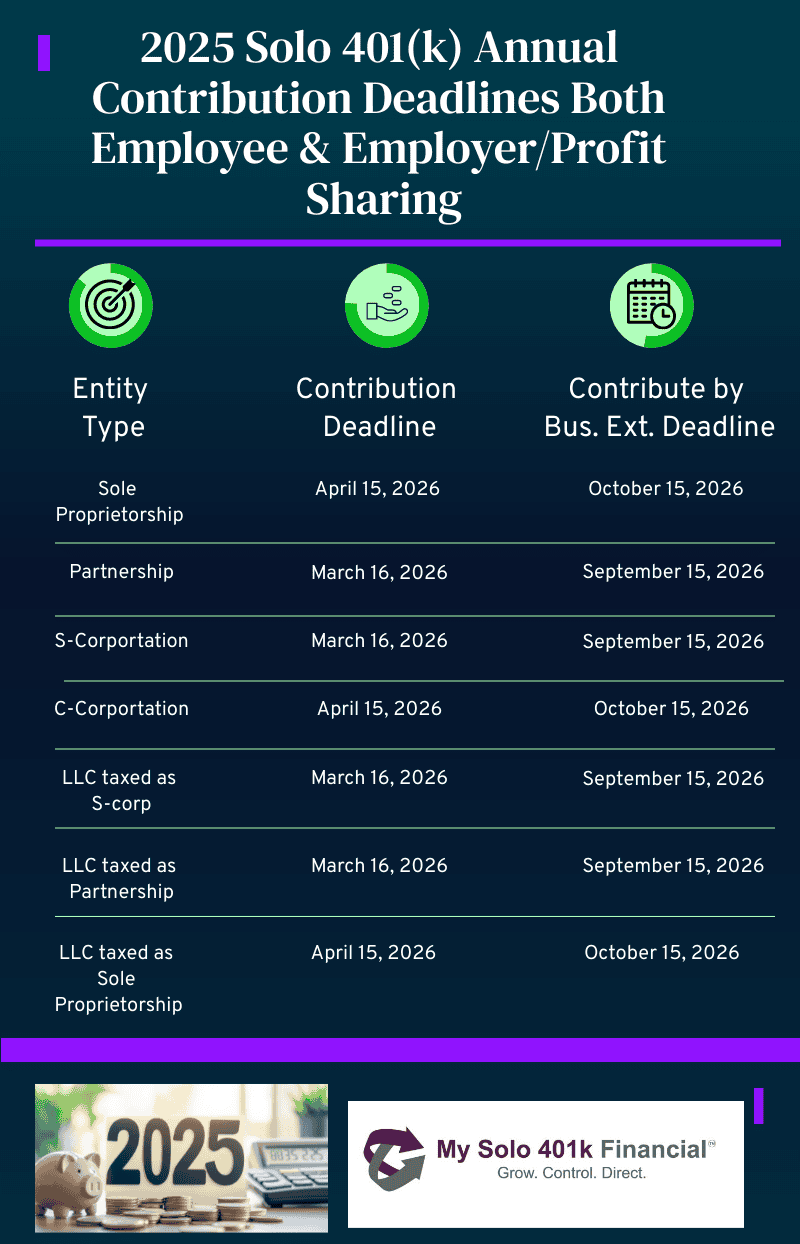
Year 2026 Solo 401k Contribution Deadlines

For more information: Click Here
When Does Form 5500-EZ Need to Be Filed?
If the total value of your Solo 401(k) plan exceeds $250,000 as of December 31, 2025, Form 5500-EZ is generally due to the IRS by July 31, 2026.
When determining whether the $250,000 threshold has been exceeded, you must include the value of all accounts and investment sources held under the Solo 401(k) plan. Also, if multiple participants (e.g., you and your spouse) participate in the solo 401k plan, all participants funds in the plan have to be aggregated to determine if the plan meets the required filing threshold.
Filing is only required in years when the plan’s total assets exceed $250,000. Because we do not have access to your Solo 401(k) bank, brokerage, or investment accounts, you must notify us in a timely manner if you would like assistance preparing Form 5500-EZ.
For additional information, please review our Form 5500-EZ FAQ: Learn More About Form 5500-EZ
When Do I Need Form 1099-R?
Solo 401k Distributions:
Anytime a plan participant or beneficiary takes a distribution including a required minimum distribution (RMD) from his or her self-directed solo 401k, IRS reporting requirements apply. Also, participant loan default distributions are reportable on a Form 1099-R.
Roth Solo 401k Conversions:
1099-R reporting also applies to in-plan Roth 401k conversions as well as conversions from the solo 401k to a Roth IRA. Payers must send a Form 1099-R, Distributions From Pensions, Annuities, Retirement or Profit-Sharing Plans, IRAs, Insurance Contracts, etc., to the IRS and to the individual receiving the distribution. The form is due to the IRS by February 28. Again, Since we don’t have access to your funds, it is your responsibility to let us know. For more information please see the following link: Click Here
NOTE: Please let us know by December 31 if you took any distributions and/or processed conversions so that we can timely issue the Form 1099-R. Requests received after 12/31 will need to be processed by your tax preparer.
If I transferred a former employer 401k or IRA to my self-directed solo 401k does any reporting apply?
When you transfer funds to a solo 401k plan from a former employer plan such as a 403(b), 457(b), 401k, TSP, DBP, etc., or IRAs such as SEP IRAs, SIMPLE IRAs and Traditional IRAs, the institution where the funds were transferred from will issue a Form 1099-R. Make sure the Form 1099-R has a code “G” in box 7. A code “G” communicates to the IRS that the transfer to the solo 401k was non-taxable.
Do I report solo 401k contributions to you?
No, as solo 401k contributions are deposited to the solo 401k bank or brokerage accounts which is how they are tracked. You then report them on your business and personal tax return. Click here to learn more.
When are Solo 401k IRS Required Plan Updates needed?
As the solo 401k plan provider, we are responsible for updating the plan for any required IRS changes. The next update is the SECURE 2.0 Act Amendment due by 12/31/2026.