
Contribute to Multiple Employer Plans Including a Self-Directed Solo 401k

The IRS rules allow annual contributions up to a certain limit regardless of the number of traditional IRAs and or/Roth IRAs the participant has. However, the rules are more favorable for qualified plans such as 401k plans in that the participant can maximize annual contributions to multiple qualified retirement plans including a solo 401k ; thereby, the participant may be able to shelter more of his or her earned income.
Watch: Learn how to contribute to multiple 401k plans
2025 Employer Plan Contribution Limits
Only working for one employer (e.g., self-employed business)
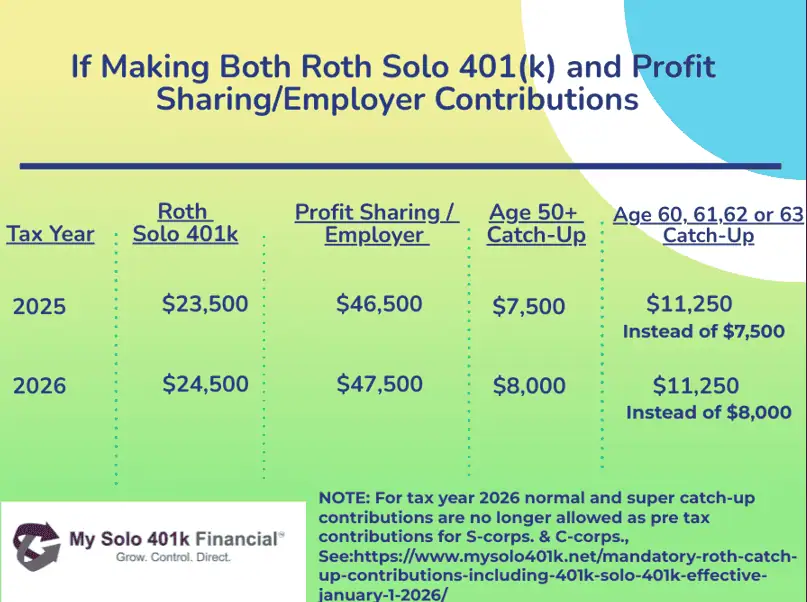
If you are self-employed and work for no one else, the maximum contribution that can be made to your Solo 401k for the 2025 tax years is:
$70,000 in employer (profit sharing) and employee (salary deferral) contributions (combined). If you are 50 or older by the end of the 2025, you may contribute an additional $7,500 as catch-up salary deferral contribution. Starting in 2025, those ages 60 to 63 have a higher catch-up contribution (super catch-up) limit of $11,250 instead of $7,500 thus resulting in being able to contribute $81,250.
Working for More than One Employer
If you work for more than one employer, the contribution limit is increased.
For example, if you are self-employed and work for another employer, you adopt a solo 401k for your self-employed business and your other employer offers a profit sharing plan, you can contribute $70,000 to your solo 401k for 2025 and another $70,000 as a profits sharing contribution to your other employer plan. This would result in a total contribution of of $140,000 to both plans combined for tax year 2025.
The 403(b) Exception
403(b) plans are an exception to the general multiple employer rule. The below illustration sheds light on the 403b exception.
Illustration
Let’s say that you are self-employed part-time and have adopted a solo 401k plan, and that you also work for a school full-time and participate in their 403(b). For purpose of plan contribution limits, you would be treated as if you are participating in one employer’s retirement plan, which limits your aggregate contributions to both plans to $70,000 plus a catch-up contribution of $7,500. However, if the school offered a 401(k) plan instead of a 403(b), you would be able to contribute in aggregate $147,500 including the $7,500 catch-up amount (a limit of $7,500 plus catch-up contributions to one plan).
IMPORTANT: Don’t confuse the Salary Deferral Limitations; click here to learn more.
QUESTION:
Can i still funnel some of my business funds into a solo 401K even though I have a 401K at a job?
ANSWER:
Note that you can contribute to both a solo 401k and full-time employer 401k. Contributions to the solo 401k plan would be based on your net self-employment income whereas contribution to your full-time employer 401k would be based on your W-2 wages from that full-time employer.
Also, making profit sharing (employer contributions) to your day-time employer 401k won’t impact your overall contribution limit to your solo 401k.
However if you make employee pretax and employee Roth solo 401k contributions, you first have to determine that amount of employee pretax or employee Roth 401k contributions that you may have already made to your full-time employer as those contributions will reduce the amount of employee pre tax and employee Roth contributions that can be made to the solo 401k. Lastly, you can still make voluntary after-tax contributions to the solo 401k even if you maximize all contributions types to your day-time employer 401k. See the following for more on this: https://www.mysolo401k.