Are Democrats Moving to Ban Trump Accounts? The $10M Mega IRA Crackdown Explained

Are Democrats Moving to Ban Trump Accounts? The $10M Mega IRA Crackdown Explained

Watch: How the new Trump Accounts could eventually collide with a proposed $10 million retirement account cap

A newborn with a Trump Account could, decades from now, run straight into a proposed $10 million cap on retirement account balances. That is not a hypothetical — it is basic math. Below, we walk through what Trump Accounts (technically Section 530A accounts) actually allow, what the proposed mega IRA cap would do, and how the two policies may be headed for a collision that lawmakers may not have fully considered.

Educational purposes only. This article is provided for general information and should not be construed as tax, legal, or investment advice, or as a solicitation. Please consult your tax attorney and financial professional before making decisions about your retirement accounts.

What Are Trump Accounts (Section 530A)?

Trump Accounts are tax-advantaged starter accounts for minors under age 18, created under Section 530A. Unlike a traditional IRA, no earned income is required to contribute — which matters, since the account holders are newborns.

Key Features

  • Eligible for U.S. citizens born between 2025 and 2028
  • One-time $1,000 seed deposit, activated via Form 5471
  • Annual contribution maximum of $5,000, indexed to the Consumer Price Index (CPI)
  • Contributions may come from parents, grandparents, or even employers
  • No earned income requirement for the minor beneficiary
  • Investments limited to low-cost, broad-based U.S. index funds — no active trading, options, or private assets
  • Assets are locked until age 18 and generally cannot be distributed early without disqualifying the account
Example: A child born in 2026 receives the $1,000 seed contribution. Parents and grandparents contribute the full $5,000 annual maximum from birth through age 17. Growing at a historical 7–10% average annual return, that account could realistically be worth somewhere in the neighborhood of $200,000 by the time the child turns 18.

At age 18, the account automatically converts to a traditional IRA, with the option to convert further to a Roth IRA. At that point, the investment restrictions fall away entirely, and the now-adult beneficiary gains full self-direction capability — including the ability to roll the funds into a self-directed retirement account if they choose.

The Proposed $10 Million Mega IRA Cap

Separately — and not a new idea, having surfaced in Congress before — a proposal has re-emerged to cap aggregate retirement account balances for high earners. This is often referred to informally as the “mega IRA” or “mega retirement account” crackdown.

How the Proposed Cap Would Work

  • Applies an aggregate limit of $10 million across all of a high earner’s retirement accounts — not just IRAs
  • Once a filer’s aggregate balance exceeds the threshold, further contributions to those accounts would be prohibited
  • Balances above $10 million would be subject to a forced distribution of 50% of the excess
  • The $10 million threshold is a fixed dollar figure — it is not indexed for inflation
Important: Because the proposed cap does not adjust for inflation, it effectively gets stricter every year. At a modest inflation rate, $10 million six decades from now could have the purchasing power of roughly $1.6 million to $2 million in today’s dollars.

Public discussion around this proposal has frequently referenced large, headline-grabbing balances — accounts like Peter Thiel’s roughly $5 billion Roth IRA, or Mitt Romney’s outsized IRA balance — both of which reportedly grew through early access to private, pre-IPO investments rather than conventional index funds.

Trump Accounts vs. the Proposed Mega IRA Cap

Feature Trump Accounts (Section 530A) Proposed Mega IRA Cap
Status In effect Proposed, not yet law
Who it affects Children born 2025–2028 High earners with $10M+ in retirement accounts
Annual limit $5,000, indexed to inflation $10,000,000 aggregate cap, not indexed
Allowed investments Low-cost U.S. broad index funds only N/A — restricts balance, not investment type
Consequence of exceeding limits N/A Contributions barred; forced 50% distribution of excess

The Math: Projecting a Collision Over a 65-Year Horizon

Here is where the two policies intersect. Assume a child is born in 2026, receives the $1,000 seed deposit, and gets the full $5,000 annual contribution every year from birth through age 17. At 18, the account converts to a traditional IRA, and the beneficiary continues contributing and investing for retirement, this time without the conservative investment restrictions.

Assumed Annual Return Balance at Age 18 Approx. Age Balance Reaches $10M
7% ~$200,000 ~Age 78
8% ~$200,000+ ~Age 70
10% ~$200,000+ ~Age 58
Example: Under a steady 10% historical market return, a child born today with a fully-funded Trump Account could see their retirement balance cross the proposed $10 million threshold by around age 58 — well before typical retirement age. Even at more conservative 7–8% returns, the $10 million mark could still be reached in their late 60s or 70s, squarely within a normal retirement horizon.

The Policy Tension

The Case for the Cap

Proponents of the proposed mega IRA cap argue that tax-advantaged retirement accounts should support retirement security, not serve as vehicles for multi-generational wealth sheltering. The proposal is generally framed as targeting the small number of ultra-high-balance accounts — often built through early access to private, pre-IPO investments unavailable to most savers — rather than everyday retirement savers.

The Unintended Consequence

Trump Accounts, by contrast, are restricted to conservative, low-cost U.S. index funds — a very different investment profile than the private equity and pre-IPO stakes typically cited in mega-balance examples like Peter Thiel’s or Mitt Romney’s accounts. Trump Accounts are also explicitly positioned as a tool to help middle-class families build a retirement savings head start, not a wealth-sheltering mechanism. Because the proposed cap is not indexed for inflation, its effective reach grows more restrictive every year, which means a policy aimed at ultra-wealthy outliers today could, decades from now, sweep in beneficiaries whose balances grew mainly through ordinary index-fund compounding and time in the market.

Whether or not the mega IRA cap becomes law, and in what form, is still uncertain. What is clear is that the two policies were not designed with each other in mind — and the long time horizon involved means today’s newborns could be the ones who eventually find out how that tension gets resolved.

If you are exploring related contribution strategies for your own retirement accounts, you may also be interested in our guide to the Mega Backdoor Roth using a Solo 401k, or our overview of Solo 401k plans generally.

Have questions about how proposed retirement account legislation could affect your plan?Our team can help you understand how your Solo 401k fits into the current retirement account landscape, and keep you updated as proposals like the mega IRA cap develop.

Next Steps:

Get Started Today or join our free community of solopreneurs and advisors at My Solo 401k Financial’s community.

Remember: This information is provided for educational purposes only. Always consult with qualified tax, legal, and investment professionals before making decisions with your retirement funds.

Can I Invest My 401k in a Private Company?

Can I Invest My 401k in a Private Company?

One of the most common questions from self-employed investors is: can I invest my 401k in a private company? The short answer is yes — but only under the right conditions. Your plan must explicitly allow for alternative investments, the transaction must comply with IRS prohibited transaction regulations, and the investment must be structured to benefit the Solo 401k plan — not you personally.

This guide covers everything you need to know: what qualifies as a private company investment, how the self-directed Solo 401k makes it possible, what the rules are, and how to execute the investment correctly from start to finish.

Watch: My Solo 401k Financial explains how to invest Solo 401k funds in private companies and pre-IPO stock while staying IRS-compliant.

What Is a Private Company Investment?

A private company is a business whose ownership interests are not publicly traded on a securities exchange such as the NASDAQ or the Dow Jones. When your Solo 401k invests in a private company, the plan becomes a shareholder and owns shares of that company.

Private company investments through a Solo 401k may include:

  • Pre-IPO stock in companies preparing to go public (e.g., SpaceX, Anthropic, OpenAI’s ChatGPT)
  • Venture capital (VC) funds
  • Private equity (PE) funds
  • Syndications and pooled investment vehicles
  • Startup equity and angel investments

ⓘ Key Insight:

When your Solo 401k invests in a private company, the plan itself does not disappear. The private investment simply becomes an asset of the plan — just like publicly traded stocks such as Microsoft or NVIDIA. The cash has been exchanged for a private security that the plan now owns.

Does Your 401k Plan Allow Private Company Investments?

This is the first and most critical question. While the IRS regulations permit alternative investments including private stock, it ultimately comes down to whether your plan documents allow it. Most traditional employer-sponsored 401k plans do not.

⚠ Important:

If you have a 401k through a full-time employer, you must check with that employer first. Most workplace plans do not allow private stock investments. To invest in private companies through a retirement account, you generally need a self-directed Solo 401k — one whose plan documents explicitly authorize alternative investments.

Plan Type Private Company Investments Allowed? Notes
Employer-Sponsored 401k Generally No Confirm with your employer’s plan administrator
Standard Solo 401k Depends on provider Many basic providers do not include alternative investment language
Self-Directed Solo 401k (My Solo 401k Financial) Yes Plan documents explicitly authorize private stock, real estate, crypto, notes, and more
ROBS 401k (Rollover for Business Startups) Yes — own business only Required if you want to invest in your own business using retirement funds

A properly drafted self-directed Solo 401k — such as the plan offered by My Solo 401k Financial — provides broad investment options including private company stock. As the trustee of your own plan, you choose the investments you want to make, as long as the plan allows it and the transaction complies with IRS rules.

Who Is Eligible to Open a Self-Directed Solo 401k?

Before making any private company investment through a Solo 401k, confirm that you are eligible to open and maintain the plan. The requirements are straightforward:

  • You must have self-employment income (from a business you own or freelance/contractor work)
  • Your business must not employ any non-owner, full-time W-2 employees who are age 21 or older and work 1,000 hours or more per year
  • Your spouse may also participate if he or she works in the business — both participate in the same plan (not two separate plans)

ⓘ Two-Participant Plans:

If both spouses are self-employed in the same business, it is still considered one Solo 401k plan. However, each spouse maintains separate holding accounts for contributions, IRA rollovers, and investments. This doubles the plan’s annual contribution capacity without creating a second plan.

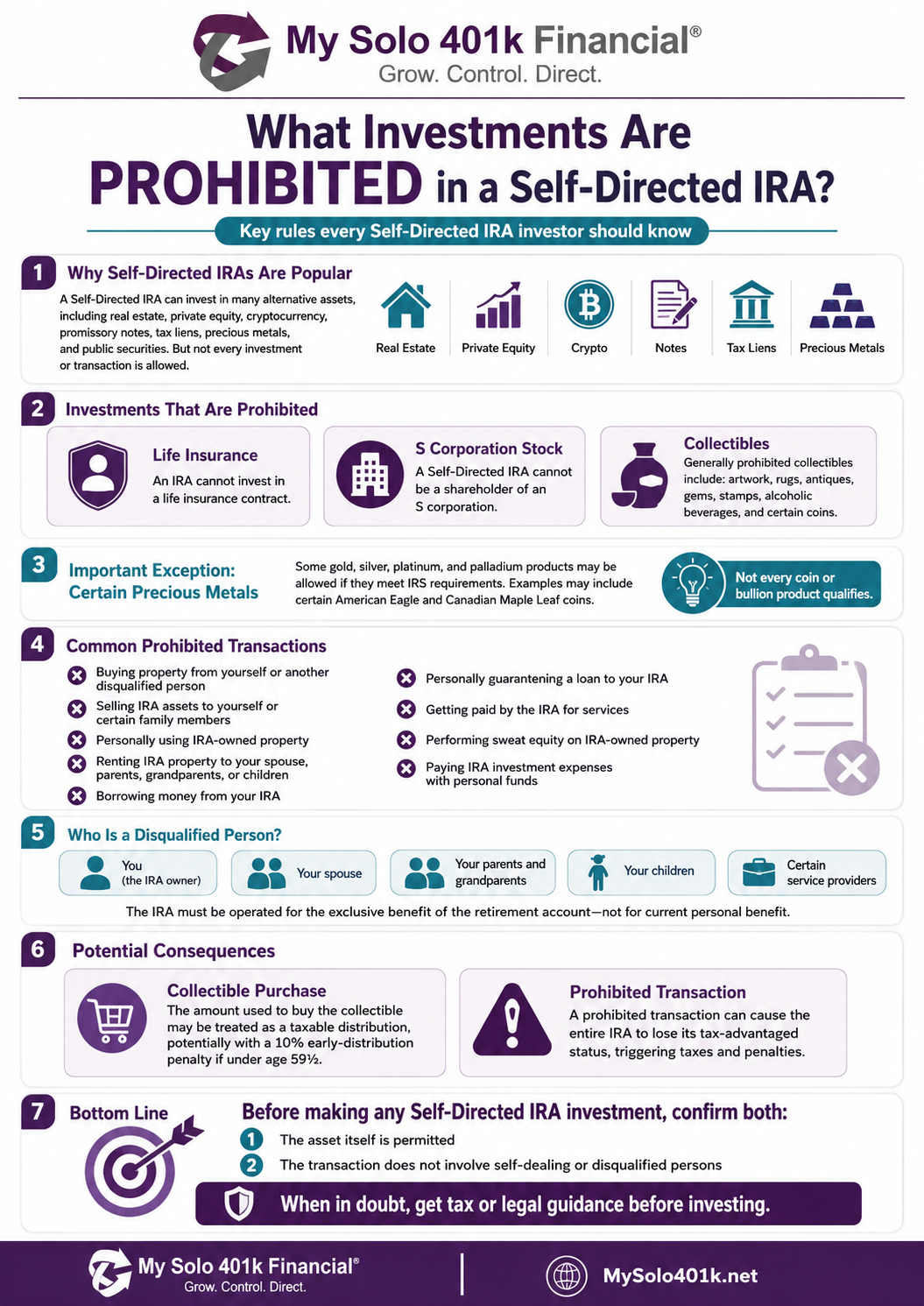
Understanding Prohibited Transactions

This is the most important compliance concept when investing a Solo 401k in a private company. Under the Internal Revenue Code, the IRS defines a prohibited transaction as any transaction between a retirement plan and a disqualified person.

Who Counts as a Disqualified Person?

Disqualified persons include:

  • You (the plan participant and trustee)
  • Your spouse
  • Your children and their spouses
  • Your parents
  • Any business in which you or the above family members are an owner, officer, director, or employee

⚠ Critical Rule:

You cannot invest your Solo 401k in a private company if you — or a disqualified family member — are an owner, officer, director, or employee of that company. To invest in your own business, you must use a ROBS 401k (Rollover for Business Startups) structure instead. My Solo 401k Financial also offers ROBS plans for this purpose.

The Core Principle

Your Solo 401k cannot be used as a source of capital to benefit you personally. Every investment must be made solely to benefit the plan — not to generate a personal gain, salary, commission, or referral fee for you or any disqualified person connected to the investment.

Scenario Permitted? Why
Invest in a startup where you have no role or ownership ✅ Yes No disqualified person is involved
Invest in a friend’s company (friend is not a relative) ✅ Yes (with conditions) Friend is not a disqualified person; you cannot control the company or receive compensation
Invest in pre-IPO stock (SpaceX, Anthropic, ChatGPT) ✅ Yes Arm’s-length investment; plan is investor on same terms as others
Invest in a company where you are an officer or director 🚫 No You are a disqualified person; prohibited transaction
Invest in your own business directly 🚫 No Requires a ROBS 401k structure instead

Can I Also Invest My Personal Money in the Same Private Company?

Yes — co-investing alongside your Solo 401k is permitted. You can invest both your Solo 401k funds and your personal money in the same private company, subject to one important aggregate ownership rule.

⚠ The 50% Aggregate Ownership Rule:

When you co-invest personally alongside your Solo 401k, you must ensure that the combined ownership — your personal stake plus the plan’s stake — does not reach 50% or more of the private company. This aggregate calculation also includes the ownership interests of disqualified family members (spouse, children, parents) who invest in the same company. Breaching the 50% threshold triggers prohibited transaction rules.

▶ Example: Co-Investing with Correct Aggregation

Your Solo 401k purchases a 20% stake in a private startup. You personally invest in the same company for an additional 15% stake. Your spouse (a disqualified person) also purchases 10%. Combined ownership = 20% + 15% + 10% = 45% — below the 50% threshold. This is permissible. If the combined total had reached 50% or more, a prohibited transaction would result.

How to Make a Private Company Investment with Your Solo 401k

Once you have confirmed eligibility, plan authorization, and prohibited transaction compliance, executing a private company investment through your Solo 401k is straightforward. Here is the step-by-step process:

Step 1 — Confirm Your Plan Allows Alternative Investments

Before anything else, verify that your Solo 401k plan documents explicitly authorize private company investments. If you use My Solo 401k Financial, this authorization is built into your plan. If you use another provider, review your plan documents or ask your provider directly.

Step 2 — Confirm Solo 401k Eligibility

Make sure you are eligible to maintain a Solo 401k: self-employment income, no non-owner full-time W-2 employees (age 21+, 1,000+ hours per year).

Step 3 — Fund the Solo 401k

Ensure your plan has sufficient liquid funds to make the investment. This may involve making annual contributions, rolling over funds from an IRA or former employer plan, or liquidating other plan holdings to generate cash.

Step 4 — Title All Investment Documents in the Plan’s Name

The subscription agreement, offering memorandum, and all other investment documents must be titled in the name of the Solo 401k plan — not your personal name. As the trustee of the plan, you sign all documents in your trustee capacity.

▶ Example: Correct Titling

The subscription agreement for a private equity fund should read: “[Your Name] Solo 401k Plan, [Your Name], Trustee” — not simply your personal name. This establishes that the plan, not you personally, is the investor.

Step 5 — Wire Funds Directly from the Solo 401k Account

Funding must flow directly from the Solo 401k bank or brokerage account to the private company’s or fund’s bank account — never through your personal account. A wire transfer is the typical method. Funds that pass through your personal account — even temporarily — can constitute a prohibited transaction.

Step 6 — Return All Income and Proceeds to the Plan

All income generated by the investment — interest payments, dividends, distributions — must flow back directly to the Solo 401k. Likewise, when the investment is sold, all proceeds return to the plan. Those funds remain tax-sheltered within the plan and can be reinvested in equities or other alternative investments.

# Step Key Requirement
1 Confirm plan allows alternative investments Must be in plan documents
2 Verify Solo 401k eligibility Self-employment income; no non-owner FT employees
3 Fund the Solo 401k Contributions, rollovers, or liquidate existing holdings
4 Title documents in plan’s name Signed by you as trustee — not in personal name
5 Wire funds directly from Solo 401k account Never through your personal bank account
6 All income and proceeds return to the plan Tax-deferred (pre-tax) or tax-free (Roth) growth

Tax Treatment: Pre-Tax vs. Roth Solo 401k Investments

The tax treatment of returns from a private company investment depends on which bucket of your Solo 401k was used to fund the investment:

Contribution Source Growth Treatment Distribution Treatment
Pre-Tax Solo 401k funds Tax-deferred Taxable as ordinary income at distribution
Roth Solo 401k funds Tax-free Tax-free qualified distributions in retirement

Using Roth Solo 401k funds to invest in a high-growth private company — especially a pre-IPO investment with significant upside — can be a powerful strategy. If the company’s value increases substantially before going public, all of that appreciation is tax-free inside the Roth bucket.

ⓘ Mega Backdoor Roth & Private Investments:

My Solo 401k Financial was the first provider in the industry to offer the Mega Backdoor Roth Solo 401k, going back to tax year 2013. This strategy allows after-tax contributions up to the overall annual limit ($70,000 for 2025; $72,000 for 2026) to be converted to Roth — creating a large Roth balance that can then be deployed into private company investments for completely tax-free growth.

Due Diligence Before Investing

Because you are the trustee of your own Solo 401k, you bear responsibility for the investments your plan makes. Performing proper due diligence protects both your retirement savings and your plan’s tax-advantaged status.

Key Due Diligence Steps

  • Verify the company is legitimate — research the company’s background, leadership, and business model. Avoid Ponzi schemes and fraudulent investment vehicles
  • Review the offering documents — carefully read the private placement memorandum (PPM), subscription agreement, and any operating agreements before signing
  • Ensure you have sufficient liquidity — private investments are typically illiquid. Make sure your plan retains enough liquid assets to cover future expenses and required minimum distributions (RMDs) when applicable
  • Confirm prohibited transaction compliance — before committing, verify that neither you nor any disqualified family member has a role in the company that would create a prohibited transaction
  • Consult qualified professionals — a tax advisor and legal counsel familiar with ERISA and IRS retirement plan rules can help you evaluate the investment and its compliance implications

⚠ Liquidity Warning:

Private company investments are typically illiquid — you may not be able to sell your stake quickly or at all until a liquidity event (IPO, acquisition, etc.) occurs. Before committing your Solo 401k funds to a private investment, ensure the plan retains sufficient liquid assets for ongoing needs and potential future distributions.

Why My Solo 401k Financial for Private Company Investments?

My Solo 401k Financial is a leading provider of self-directed Solo 401k plans and has been helping self-employed investors access alternative investments — including private company stock — for over a decade. Here’s what sets the plan apart:

Feature Detail
Broad investment authorization Plan documents explicitly allow private stock, real estate, cryptocurrency, promissory notes, precious metals, and more
You choose where to hold funds My Solo 401k Financial does not hold your funds or require you to use a specific institution — use Fidelity, Schwab, a local bank, or a specialized custodian
You are the trustee As plan trustee, you have full checkbook control — no custodian approval required for each investment
Step-by-step investment guidance My Solo 401k Financial provides a detailed procedure and video walkthrough on how to make private investments through the plan
Mega Backdoor Roth support First provider to offer the Mega Backdoor Roth Solo 401k (since 2013); handles Form 1099-R reporting
ROBS 401k also available For investing in your own business, My Solo 401k Financial also offers ROBS 401k plans

Ready to Invest Your Solo 401k in a Private Company?

Whether you’re eyeing a pre-IPO opportunity, a private equity fund, or a startup investment, My Solo 401k Financial can help you set up the right self-directed Solo 401k structure — with the plan documents, step-by-step guidance, and ongoing compliance support you need.

Next Steps:

Open a Self-Directed Solo 401k Today  |  Visit My Solo 401k Financial

Disclaimer: This information is provided for educational purposes only. Always consult with qualified tax, legal, and investment professionals before making investment decisions with your retirement funds.


Does Schwab Allow 401k Loans?


Does Schwab Allow 401k Loans?

Watch: Why Schwab’s basic plan blocks 401k participant loans — and how solopreneurs unlock them while keeping their accounts at Schwab

Quick Answer:

No. Schwab’s own basic Solo 401k plan document does not allow 401k participant loans. Like virtually every discount brokerage, Schwab has made the business decision not to offer loans under its in-house plan. The good news: Schwab will open accounts for solopreneurs who bring their own plan documents. By restating (upgrading) to a fully featured plan from My Solo 401k Financial, you can take a Solo 401k participant loan of up to 50% of your balance (not to exceed $50,000) while keeping your cash and investments right where they are — at Schwab.

Who Is Eligible for a Solo 401k?

Before we get to loans, let’s lay the foundation. To be eligible for a Solo 401k, you must satisfy two simple requirements.

Requirement 1: Earned Self-Employment Income

You need to be self-employed, and you demonstrate that by reporting earned self-employment income on your tax return. Your business does not have to be taxed in any particular manner — you don’t even need a formal legal entity.

Business Tax Classification Where Earned Self-Employment Income Is Reported
Sole proprietor (no entity) Schedule C net earned income
Single-member LLC taxed as a disregarded entity Schedule C net earned income
S-corporation W-2 wages from your self-employed business
C-corporation W-2 wages from your self-employed business
Partnership Line 14 of the K-1 you receive from the partnership

Requirement 2: No Non-Owner, Non-Spouse Full-Time W-2 Employees

You cannot have non-owner, non-spouse full-time W-2 employees working for any business owned by you or your spouse.

Example: You run a marketing consultancy and use three 1099-NEC independent contractors. Because those individuals are not full-time W-2 employees, they do not prevent you from having a Solo 401k. Your spouse can also work in the business and participate in the plan.

Why Schwab’s Basic Solo 401k Plan Blocks 401k Loans

When you open a basic Solo 401k at Schwab, two things are true: (1) you are using Schwab’s plan documents to create the 401k plan, and (2) the account is held at Schwab.

A Solo 401k, like any 401k, is a legal entity. As with any legal entity, it’s the documents that create it — and it’s the documents that dictate what you can do with it. Schwab, like virtually all other discount brokerages, has made the business decision not to offer a Solo 401k plan that permits 401k participant loans.

Important: If you open the basic plan at Schwab, you are limited to Schwab’s documents. That means no Solo 401k participant loans, no ability to make Mega Backdoor Roth contributions, no ability to invest in alternative investments such as real estate or crypto, and no ability for the solopreneur to claim the available tax credits.

Feature Comparison: Schwab’s Basic Plan vs. a Restated My Solo 401k Financial Plan

Feature Schwab Basic Solo 401k My Solo 401k Financial Plan (Accounts Still at Schwab)
401k participant loans Not permitted Supported
Mega Backdoor Roth (voluntary after-tax) contributions Not permitted Supported
Alternative investments (real estate, crypto, notes) Not permitted Supported
$1,500 in Solo 401k startup tax credits Not available Available
Form 5500-EZ preparation and filing support Not handled — directed to your tax advisor Handled at no additional fee
Stocks, bonds, mutual funds, ETFs Available Available

The Solution: Bring Your Own Plan Documents to Schwab

Schwab — like the other discount brokerages our clients use — will open accounts for people who bring their own plan documents. If you already started with the basic Solo 401k plan at Schwab, you can restate (upgrade) your plan to our plan documents.

My Solo 401k Financial offers a fully featured 401k plan, but we do not hold or have access to our customers’ funds. Our IRS-approved plan documents allow for Solo 401k participant loans, Mega Backdoor Roth Solo 401k contributions, and alternative investments — while your accounts and investments stay at Schwab.

What Are Schwab Company Retirement Accounts (CRA Accounts)?

From Schwab’s perspective, the accounts you opened using their basic plan documents are governed by their plan. Once you have your own plan documents, Schwab needs to know that — so new accounts must be established. Schwab offers what it calls a Company Retirement Account (CRA) for third-party plans.

  • CRA accounts are essentially brokerage accounts for the restated plan.
  • Schwab charges nothing to open them and there is no maintenance fee.
  • Investment options are the same as any other retirement account — stocks, bonds, mutual funds, and more.
  • Schwab will even provide a free checkbook on those accounts.
  • As part of onboarding, My Solo 401k Financial pre-fills the paperwork Schwab requires to open the CRA accounts.

Info Highlight — The Transfer Is Not Taxable: Moving cash and assets from your pre-existing Schwab Solo 401k accounts to the corresponding new CRA accounts (pre-tax to pre-tax, Roth to Roth, and so on) is not reportable and not taxable. The funds never leave the Solo 401k — they simply move to new accounts for the same, but restated, plan.

The Dual-Entity Structure: Separating the Plan Provider from the Account Provider

The result is a clean separation of roles. You keep your accounts at Schwab, but the plan itself is provided by a third party — My Solo 401k Financial. We don’t hold or have access to customer funds. We focus on providing the fully featured plan document plus ongoing educational and compliance support, while giving you the freedom to hold accounts at the bank or brokerage of your choice.

What Upgrading Your Schwab Solo 401k Unlocks

  1. Solo 401k participant loans — up to 50% of the plan value, not to exceed $50,000.
  2. Alternative investments — real estate, crypto, private notes, and more.
  3. Mega Backdoor Roth — voluntary after-tax contributions that can be converted to a Roth Solo 401k or a Roth IRA.
  4. $1,500 in Solo 401k tax credits — $500 per year for three consecutive years under the SECURE Act.
  5. Form 5500-EZ filing support — prepared and e-filed by us at no additional fee (as long as we are timely notified)

Example — The Tax Credits Outrun the Fees: Our fee structure is a flat $650 initial cost and $125 per year beginning 12 months later. It is totally flat — it does not increase as the value of the plan grows. Over the first seven years that totals less than the $1,500 in Solo 401k tax credits available under the SECURE Act, so the credits more than cover our fees for those first seven years.

Form 5500-EZ: The $250,000 Threshold

Once the value of your Solo 401k exceeds $250,000, the Form 5500-EZ filing requirement applies. When measuring that threshold, aggregate all plan accounts — multiple participants (such as a husband and wife), and different money types (pre-tax and Roth) — and include the value of any defined benefit plan you may have.

Important: Schwab does not handle Form 5500-EZ for its Solo 401k customers — it will direct you to your tax advisor. My Solo 401k Financial handles the Form 5500-EZ at no additional fee. Because we don’t have access to your accounts, clients and their advisors simply need to notify us once the value exceeds $250,000 so we can add them to the process, gather the financial information needed, and e-file through the EFAST system.

How to Fund and Take Your Solo 401k Loan at Schwab

Step What Happens
1 Restate the plan. Upgrade your vanilla Schwab Solo 401k to our IRS-approved plan documents, which allow 401k participant loans.
2 Open new CRA accounts at Schwab. We pre-fill the paperwork for the restated plan’s accounts as part of onboarding.
3 Fund the restated plan. Three ways: transfer cash and assets from your pre-existing Schwab Solo 401k, roll over funds from a former employer plan or non-Roth IRA, or make new contributions.
4 Submit the loan form. Complete the form on our website to prompt us to prepare the required loan documents — drafted within one business day at no additional charge.
5 Transfer and repay. Move the loan proceeds from the Schwab brokerage account for the restated plan to your personal account, then repay the loan back to that same account.

Solo 401k Participant Loan Rules at a Glance

You may use the proceeds of a Solo 401k participant loan for any purpose — business or personal. The loan is not subject to taxes or penalties provided it is properly documented as a loan and stays within the required terms.

Loan Term Rule
Maximum amount 50% of the plan value, not to exceed $50,000
Interest rate Prime plus 1%, or a comparable CD rate plus 2%
Payment frequency Monthly or quarterly — your choice — in equal payments of principal and interest
Loan term Five years standard; may be extended if the proceeds are used to purchase your primary residence
Permitted use Any purpose — business or personal
Repayment account The same account the loan came from (pre-tax loan repaid to pre-tax; Roth loan repaid to Roth)
Document preparation Prepared by My Solo 401k Financial within one business day at no additional charge

Example — Calculating the Maximum Loan:

You have $60,000 in your pre-tax Solo 401k account and $40,000 in your Roth Solo 401k account — $100,000 in total plan value. Because the 50% test looks at the entire value of the plan, you could take a $50,000 loan, draw the full amount from the pre-tax account, and then repay it to that same pre-tax account.

Info Highlight — Using the CD Rate Option: If you use the CD-rate method for a $50,000 loan, look for comparable $50,000 CD rates with a five-year term (checking a couple and averaging is a reasonable approach), provide us that rate, and we add the 2% when drafting the loan documents.

Ready to Unlock 401k Loans While Keeping Your Accounts at Schwab?

Whether you’re restating an existing Schwab Solo 401k or starting fresh, My Solo 401k Financial can set up the right Solo 401k structure so you can take participant loans, make Mega Backdoor Roth contributions, and invest in alternatives — with your accounts still at Schwab.

Next Steps: Get Started Today! Ten simple questions — and we prepare your documents within the same business day. You can also join our free community at mysolo401k.net/my-community or subscribe to our channels for daily live sessions.

Remember: This information is provided for educational purposes only. Always consult with qualified tax, legal, and investment professionals before making investment decisions with your retirement funds.

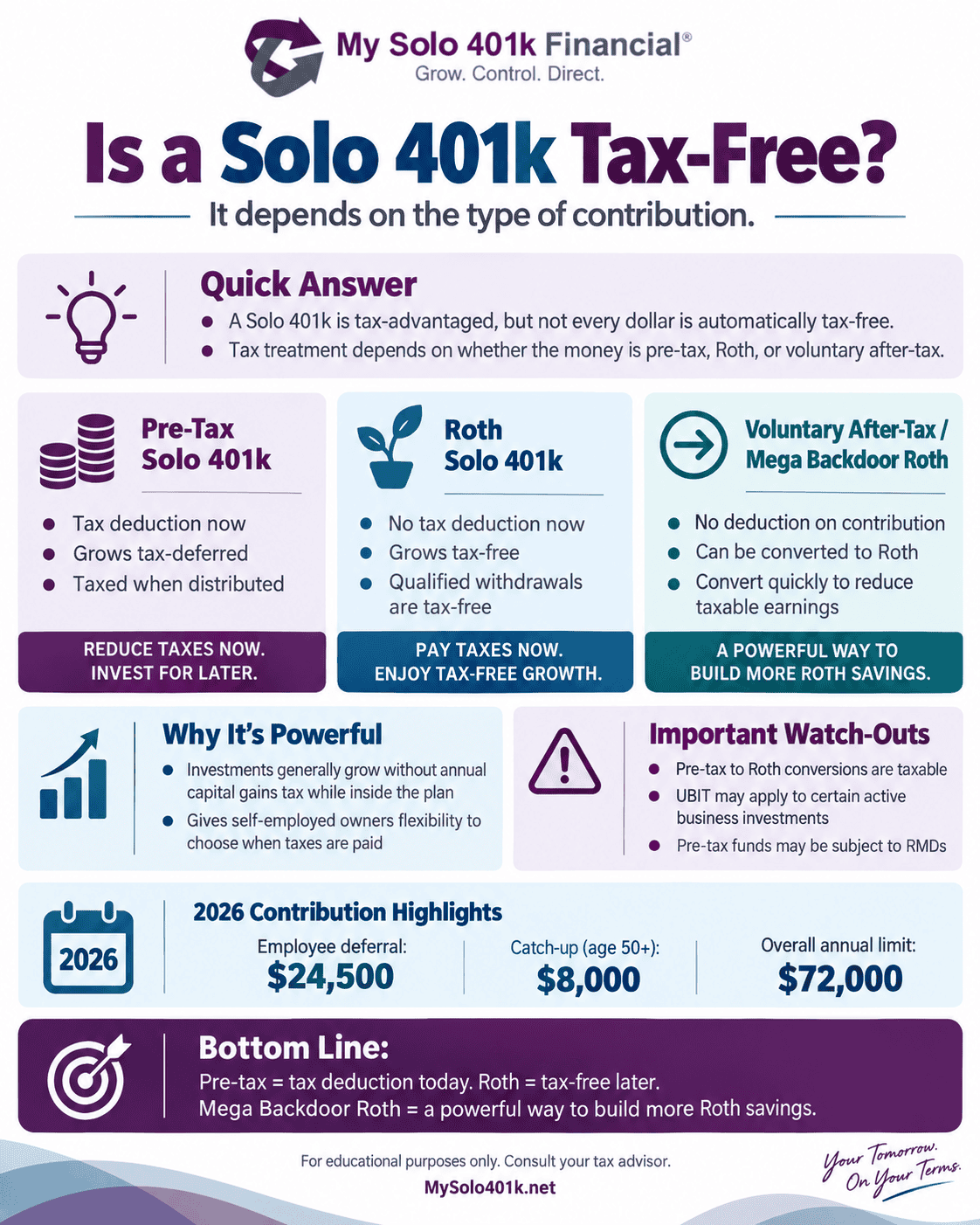
How Does Solo 401k Affect Taxes?

How Does Solo 401k Affect Taxes?

Watch: How pre-tax, Roth, and voluntary after-tax Solo 401k contributions each affect your taxes differently.

A Solo 401k is one of the most powerful retirement accounts available to the self-employed — but its tax
impact depends entirely on how your contributions are structured. Depending on the contribution type you choose, a Solo 401k can reduce your current taxable income, grow your savings completely tax-free, or both. This
guide breaks down exactly how each contribution type affects your taxes, how your business structure changes the math, and how the Mega Backdoor Roth strategy fits in.

Not All Solo 401k Contributions Are Tax-Deductible


A common misconception is that every Solo 401k contribution reduces your taxable income. It doesn’t. The tax
treatment depends entirely on which of the four contribution sources you use: a pre-tax employee contribution, a Roth employee contribution, an employer profit sharing contribution, or a voluntary after-tax contribution. If your goal is an
immediate tax deduction, you would not make a Roth employee contribution or a voluntary after-tax contribution
— neither reduces your taxable income for the year they’re made.

Contribution Type Reduces Taxable Income Now? Tax Treatment of Growth
Pre-tax employee contribution Yes Tax-deferred; taxed at distribution
Employer profit sharing contribution Yes (deducted on business return) Tax-deferred; taxed at distribution
Roth employee contribution No Tax-free growth; tax-free qualified distributions
Voluntary after-tax contribution No Tax-free once converted (Mega Backdoor Roth)

Info Highlight: My Solo 401k Financial’s plan allows for all four contribution types — pre-tax employee,
Roth employee, employer profit sharing, and voluntary after-tax — giving you full flexibility to decide each year whether you want an immediate deduction or long-term tax-free growth.

Who Qualifies for a Solo 401k?

A Solo 401k is designed for owner-only businesses — meaning the business only employs owners, or owners and
their spouses. Your spouse can participate without being an owner, as long as she works in the business and reports earned income. If you employ a non-owner, non-spouse W-2 employee who is age 21 or older and works 1,000+ hours a year, you would not qualify for a Solo 401k — and this test applies across all businesses under your control, factoring in
controlled group and affiliated service group rules.

Contribution Deadlines: More Flexible Than a Traditional 401k

Important: Solo 401k contributions do not need to flow through payroll or be made periodically. All
contribution types — employee, employer, and voluntary after-tax — must be made by your business tax return due date, plus a timely filed extension. Don’t confuse this with a traditional employer 401k, which is subject to more stringent ERISA contribution rules. IRS Publication 560 includes a chart (generally page 3) confirming the Solo 401k deadline rules.

How Your Business Structure Determines Contributions and Reporting

Because a business owner effectively wears two hats — employee and employer — how you calculate and report each contribution type depends on how your self-employed business is taxed.

Sole Proprietorship (or LLC Taxed as a Sole Proprietorship)

The starting figure is Line 31 of Schedule C (net self-employment income). Subtract one-half of
self-employment tax, then multiply the result by 20% to determine your employer profit sharing contribution. Pre-tax employee
and employer contributions are reported on Schedule 1, Line 16 of Form 1040. Roth contributions are not
reported directly on your personal return — they’re indirectly reported via Form 1099-R when a Mega Backdoor
Roth conversion is processed.

S-Corporation (or LLC Taxed as an S-Corp)

All contribution types are based on Box 1 W-2 wages (plus any applicable Box 12 amount). Multiply W-2 wages
by 25% for the employer profit sharing contribution. Employee pre-tax contributions can be reported either in Box 12 of the
W-2 or on Schedule 1, Line 16 of your personal return — never both. Employer contributions are deducted on
Form 1120-S, Line 17 (or Line 16, depending on contribution type). Roth employer profit sharing contributions
are treated as a taxable in-plan conversion, requiring a Form 1099-R.

Partnership (or LLC Taxed as a Partnership)

Review Schedule K-1, Line 14, Code A for self-employment income — that’s your starting figure. Subtract
one-half of self-employment tax, then multiply by 20% for the employer profit sharing contribution. Pre-tax employee and
employer contributions are reported in two places: Schedule 1, Line 16, and Schedule K-1, Line 13,
Code R
.

Business Structure Contribution Starting Point Employer Profit Sharing Rate
Sole Proprietorship Schedule C, Line 31 (minus ½ SE tax) 20%
S-Corporation W-2, Box 1 gross wages 25%
Partnership Schedule K-1, Line 14, Code A (minus ½ SE tax) 20%

Example: A self-employed business owner has $100,000 in eligible compensation and makes a $24,500 pre-tax
employee contribution for 2026. That contribution reduces the owner’s 2026 taxable self-employment income dollar for dollar, lowering the tax bill for that year.

The Mega Backdoor Roth Solo 401k Strategy

Info Highlight: Voluntary after-tax contributions don’t provide a current-year tax deduction, but once
inside the plan, they can be converted to a Roth Solo 401k or Roth IRA — this is the
Mega Backdoor Roth strategy. Because voluntary after-tax contributions are calculated dollar-for-dollar
(not as a percentage), it takes less earned income to maximize your Roth contributions this way compared to a standard employee Roth deferral, which is capped at $24,500 for 2026.

Example: An S-Corp owner pays themselves $72,000 in Box 1 W-2 wages. They can contribute the entire
$72,000 to the voluntary after-tax Solo 401k bucket, then immediately convert it to the Roth Solo 401k or Roth IRA —maximizing the overall $72,000 annual limit (the 415(c) limit) for 2026 entirely through the Mega Backdoor Roth strategy.

Even better: voluntary after-tax contributions are not aggregated with contributions made to a day-job 401k.
So if you max out your employer’s 401k at your day job, you can still separately maximize your Mega Backdoor
Solo 401k contributions — up to $72,000 — based on your self-employment income, which is a major reason high
income earners use this strategy.

Roth Solo 401k Distribution Rules

Important: For a Roth Solo 401k distribution to be qualified (tax-free), you must be age 59½ or older
and have held funds in the Roth Solo 401k account for five years. Unlike Roth IRAs, you cannot aggregate this
five-year clock with a Roth account from a day-job 401k — it’s specific to the Roth Solo 401k account itself. Roth Solo 401k accounts are also no longer subject to required minimum distributions.

2026 Solo 401k Contribution Limits

Contribution Type 2026 Limit
Employee contribution (pre-tax or Roth) $24,500
Overall annual limit (415(c) limit, under age 50) $72,000
Normal catch-up (ages 50–59 and 64+) +$8,000
Super catch-up under SECURE Act 2.0 (ages 60–63) +$11,250

Important: Catch-up contributions cannot be made as voluntary after-tax contributions — they must be made
as Roth employee contributions instead. You also cannot combine the normal catch-up and super catch-up; if you qualify for the super catch-up, you use that amount only. Both employee deferral limits and catch-up contributions are aggregated across all 401k plans you participate in, including a day-job 401k.

Solo 401k Reporting: Form 1099-R and Form 5500-EZ

A Form 1099-R is issued whenever you process a distribution or a conversion — pre-tax or voluntary after-tax
— such as a Mega Backdoor Roth conversion. Form 5500-EZ applies once your Solo 401k’s market value exceeds
$250,000 at year-end. If you also participate in a self-employed defined benefit plan, its value is added to your Solo 401k balance when testing that $250,000 threshold, and two separate Form 5500-EZs would be required.

Example: My Solo 401k Financial prepares and files Form 5500-EZ and issues Form 1099-R for clients who
timely request these services — both are covered under the annual fee, with no extra charge.

Bottom Line

How a Solo 401k affects your taxes comes down to which contribution source you use. Pre-tax employee and
employer profit sharing contributions reduce your taxable income today; Roth and voluntary after-tax contributions don’t —but they set you up for tax-free growth, especially when paired with the Mega Backdoor Roth strategy.
Understanding your business structure, contribution deadlines, and reporting obligations helps you get the most tax valueout of your Solo 401k each year.

Ready to Put Your Solo 401k Tax Strategy to Work?
Whether you want an immediate tax deduction, tax-free Roth growth, or a Mega Backdoor Roth conversion, we can help you set up
the right Solo 401k structure for your goals.
Next Steps:
Get Started Today! You can also watch more
webinars on our YouTube channel or browse our blog for additional Solo 401k and
Mega Backdoor Roth strategies.
Remember: This information is provided for educational purposes only. Always consult with qualified tax,
legal, and investment professionals before making decisions with your retirement funds.


Solo 401k Withdrawal Hack: How to Avoid the Mandatory 20% Withholding

Solo 401k Withdrawal Hack: How to Avoid the Mandatory 20% Withholding

Watch: How to legally sidestep the mandatory 20% federal withholding on a Solo 401k distribution

If you’ve ever needed a lump sum of cash from your Solo 401k — for a business opportunity, an emergency, or anything else — you’ve probably run into an unwelcome surprise: the mandatory 20% federal withholding on taxable distributions. This article breaks down exactly why that withholding happens, what it takes to comply with it as your own plan’s trustee, and two legitimate strategies to avoid it entirely.

The 80/20 Reality: A $50,000 Example

Picture this scenario: you need $50,000 from your Solo 401k for a business opportunity or an emergency. Before requesting a distribution, you first need to be eligible to take one — generally you must be 59½ or older, or otherwise meet a triggering event. One common triggering event: dollars that were rolled into your Solo 401k from a former employer plan or a non-Roth IRA can be withdrawn even if you haven’t reached 59½.Once you’re eligible to take a taxable distribution, the IRS requires 20% of the distributed amount to be withheld and sent to the federal government by the 15th of the month following the distribution. On a $50,000 distribution, that means $10,000 is withheld and you walk away with only $40,000 — 80% of what you requested.

Important: Unlike a corporate 401k — where the plan administrator handles withholding automatically — with a Solo 401k, you are the trustee. That means you’re personally responsible for compliance, which involves several manual steps.

What Trustee Responsibility Actually Involves

  • Enrolling in the Electronic Federal Tax Payment System (EFTPS)
  • Waiting to receive your government PIN by physical mail
  • Manually calculating and wiring the 20% withholding to the Treasury
  • Meeting the deadline: the 15th of the month following the distribution

Direct Distribution vs. the Two Withholding Hacks

Approach 20% Withholding? Cash in Hand (on $50,000)
Direct Solo 401k distribution Mandatory $40,000
Hack #1: Rollover to an IRA, then withdraw Optional (can elect none) $50,000
Hack #2: Solo 401k participant loan None — it’s a loan, not a distribution Up to $50,000 (must be repaid)

Hack #1: The IRA Rollover Maneuver

If you’re eligible to take a taxable distribution, you’re also eligible to roll those same dollars into an IRA — for example, a pre-tax IRA if the funds are pre-tax money. That first step, the transfer to the IRA, is reportable but not taxable. My Solo 401k Financial prepares the required Form 1099-R showing a nontaxable direct rollover, as long as the client or advisor submits the request through our website in a timely fashion. Because it’s a direct rollover, there’s no 20% withholding.

Example: Once the $50,000 is in the IRA, there’s no triggering event required to withdraw it, and withholding on IRA distributions is optional. You can elect out of withholding and take the full $50,000 — compared to the $40,000 you’d net from a direct Solo 401k withdrawal.

Hack #2: The Solo 401k Participant Loan

The second hack isn’t a distribution at all — it’s a loan. If your Solo 401k plan document allows for participant loans, such as the plan offered by My Solo 401k Financial, you can borrow up to 50% of your account balance, not to exceed $50,000. Because it’s a loan, it’s not subject to taxes, penalties, or withholding — provided you follow the rules:

  • Stay within the loan limits (50% of balance, capped at $50,000)
  • Have the loan properly documented before you take it — My Solo 401k Financial prepares these loan documents at no additional charge, typically within one business day, once requested
  • Repay the loan on the required schedule

Repayment Terms

Repayments are made monthly or quarterly (your choice), in equal payments of principal and interest, over a five-year term. The interest rate is either prime plus 1% or a CD rate plus 2%. Importantly, that interest isn’t paid to a bank or to us — it’s paid back into your own Solo 401k.

The Look-Back Rule

After a loan is fully repaid, you must wait 12 months before taking another loan of the same size. For example, if you took a loan in month one and fully repaid it by month six, you’d need to wait until month eighteen for another full loan. However, if you didn’t borrow the full amount — say you took $30,000 against a balance of at least $100,000 — you could still take the remaining $20,000 without waiting.

Warning: If you default on a Solo 401k loan, the unpaid balance becomes a “deemed distribution” — meaning you’ll owe both taxes and penalties on it.

The Brokerage Trap

Here’s the catch: standard, big-box brokerage Solo 401k plans — such as those offered directly by Fidelity or Schwab — generally do not allow participant loans, because their plan documents simply don’t provide for them. These are one-size-fits-all, vanilla plans limited mostly to mutual fund investing.

Info: The good news is those same brokerages (Fidelity, Schwab, and others) will custody accounts for a self-directed Solo 401k that uses your own custom plan document — like the plan offered by My Solo 401k Financial. Our plan supports participant loans, the Mega Backdoor Roth, in-plan Roth conversions, and true alternative investments such as real estate, cryptocurrency, private placements, and pre-IPO stock.

Upgrading a basic brokerage plan to our full-featured Solo 401k also makes the solopreneur eligible to claim the $1,500 Solo 401k tax credit under the SECURE Act — available not just for brand-new plans, but for existing vanilla plans that are upgraded to ours as well.

Fees vs. the Tax Credit

Item Cost
Initial fee (establishment + first-year annual fee) $650 ($525 establishment + $125 first-year annual fee)
Annual fee, starting 12 months later $125/year
Solo 401k tax credits (SECURE Act) $500 for first 3 years (total $1,500) — more than covers fees for the first 7 years

Ready to Set Up a Solo 401k That Actually Works for You?Whether you need participant loan flexibility, Mega Backdoor Roth capability, or access to alternative investments, we can help you set up the right Solo 401k structure.

Next Steps:

Get Started Today!

Remember: This information is provided for educational purposes only. Always consult with qualified tax, legal, and investment professionals before making investment decisions with your retirement funds.

Can I Open a Solo 401k for My Wife?

Can I Open a Solo 401k for My Wife?

Watch: Can your wife participate in your Solo 401k? Eligibility, contributions, and the Mega Backdoor Roth explained.

Yes — your wife may participate in your Solo 401k. But being married to a business owner is not enough on its own.
To qualify, your wife must perform legitimate work for the business that sponsors the plan and must receive
compensation from that business. This guide walks through exactly how eligibility, contribution limits, the
Mega Backdoor Roth strategy, and annual reporting all work when a spouse joins the plan.

How Your Business Structure Affects Your Wife’s Eligibility

Depending on how your self-employed business is taxed, your wife’s compensation — and how her Solo 401k contribution is calculated — will look different:

LLC Taxed as an S-Corporation

Compensation is typically reported as W-2 wages. Each spouse receives a separate W-2, and each spouse’s contribution is calculated from their own W-2 wage figure.

Sole Proprietorship

Your wife would file her own separate Schedule C, meaning the business would have two Schedule Cs total — one for you and one for her. Contributions are based on each spouse’s respective Line 31 net self-employment income.

LLC Taxed as a Partnership

Each spouse would receive their own Schedule K-1. Review Line 14, Code A of the K-1 for self-employment income — that figure is the starting point for the contribution calculation.

Business Structure Compensation Source Where to Look
LLC taxed as S-Corp W-2 wages (one per spouse) Each spouse’s Form W-2
Sole Proprietorship Net self-employment income Schedule C, Line 31 (separate Schedule C for each spouse)
LLC taxed as Partnership Self-employment income Schedule K-1, Line 14, Code A (separate K-1 for each spouse)

One Plan, Not Two: How Spousal Participation Actually Works

A common misconception is that you’d open a separate Solo 401k just for your wife. Generally, you do not.
A Solo 401k — also called a one-participant 401k — is sponsored by the business itself, and
both spouses participate as participants in that same plan, provided both are legitimately working in the business.
This is why it’s often nicknamed the “husband and wife 401k.”

Info Highlight: It’s one plan with separate participant accounts — think of them as individual
bank or brokerage sub-accounts — to hold each spouse’s pre-tax, Roth, and voluntary after-tax funds separately.

Example: A Two-Participant Plan

Example: Both spouses are self-employed in the same LLC taxed as an S-Corporation. The LLC sponsors one
Solo 401k, and both spouses are participants. Each receives a separate W-2 for calculating contributions.
The plan itself — a retirement trust — has its own EIN, used to open each participant’s holding accounts. If each spouse
wants to make pre-tax, Roth, and voluntary after-tax contributions, that’s 3 accounts per spouse
6 accounts total — all under that one plan.

How Much Can Your Wife Contribute?

Your wife is subject to the same annual Solo 401k contribution rules as you are. She can make contributions
as an employee, as an employer (profit sharing), and — if the plan allows — voluntary after-tax contributions. For tax year 2026,
the overall contribution limit is $72,000 for someone under age 50. That means a husband and wife who are both
self-employed in the same business could together contribute up to $144,000 to the household’s retirement savings.

2026 Contribution Type Per-Spouse Limit
Overall annual limit (under age 50) $72,000
Catch-up contribution (ages 50–59 and 64+) +$8,000
Super catch-up contribution (ages 60–63) +$11,250

Real-World Example: Husband-and-Wife S-Corp

Example: Both spouses work in the same S-Corporation, and each receives $100,000 in W-2 wages
(two separate W-2s issued). Neither spouse is required to contribute the same amount as the other — a
Solo 401k is not subject to the nondiscrimination testing that applies to a common-law employer plan.

Contribution Type Calculation Amount (Each Spouse)
Employee contribution Dollar-for-dollar election $24,500
Employer profit sharing contribution 25% × $100,000 W-2 wages $25,000
Voluntary after-tax contribution (optional) Remainder up to the $72,000 overall limit Up to $22,500

The Mega Backdoor Roth Solo 401k Strategy

Info Highlight: Instead of making employee and employer contributions, each spouse can choose to make
voluntary after-tax Solo 401k contributions of up to $72,000 for 2026, then immediately convert those funds
to a Roth Solo 401k or Roth IRA. This is the Mega Backdoor Roth strategy,
and both spouses can each perform it — up to $144,000 combined converted to Roth in a single year.

Can Your Wife Work Part-Time? The Spousal Exception

Yes — your wife does not need to work full-time to participate in the Solo 401k. This is thanks to the
spousal exception: a plan sponsor must generally avoid employing any non-owner, non-spouse, full-time
W-2 employee who works 1,000 hours or more per year and is age 21 or older. Your spouse is exempt from this restriction.

Important: If you employ a non-owner, non-spouse W-2 employee age 21+ who works 1,000+ hours a year,
you cannot maintain a Solo 401k. Also watch the long-term part-time employee rule: if a
part-time employee (500–999 hours) works two consecutive years and turns 21, you may need to convert to a full-time
employer plan or transfer assets to an IRA.

What if Your Wife Has a Full-Time Job Elsewhere?

Info Highlight: If your wife participates in a full-time employer’s 401k and works in your
business, she can still contribute to your Solo 401k. Aggregation rules that limit total employee
deferrals across multiple plans apply only to employee contributions — not to employer profit sharing
or voluntary after-tax contributions. So even if she maxes out her day-job 401k, she can still make voluntary after-tax
Solo 401k contributions up to $72,000, as long as she has sufficient self-employment income from your
business. This is why many anesthesiologists, physicians, attorneys, and CPAs use this strategy alongside their W-2 jobs.

What if Your Wife Owns Her Own Business?

If your wife owns a separate business of her own, she would not participate in your Solo 401k. Instead,
she would establish her own separate Solo 401k sponsored by her own business — two separate plans, each
sponsored by a different self-employed business. As long as both spouses work in the same business, however, only
one Solo 401k is needed.

Reporting Requirements: Form 5500-EZ and Form 1099-R

Important: Form 5500-EZ applies at the plan level. If both spouses are self-employed in the same
business, you add up all participant account balances across the plan. If the combined total exceeds
$250,000 in market value, the plan is subject to an annual Form 5500-EZ filing, typically due by
July each year.

If either or both spouses perform the Mega Backdoor Roth conversion, a Form 1099-R must be
issued to report each conversion — one per spouse, so up to two forms total if both convert.

Example: My Solo 401k Financial includes preparation and filing of Form 5500-EZ, and issuance of
Form 1099-R for voluntary after-tax conversions, as part of the $125 annual fee for clients who timely request these services.

Bottom Line

Your wife may absolutely be included in a Solo 401k — as long as she is legitimately performing
self-employment work and receiving compensation from the same business that sponsors the plan. That means one plan,
shared by both spouses, with separate participant accounts and the potential to combine contributions — including the
Mega Backdoor Roth strategy — up to the overall annual limit for each spouse.

Ready to Add Your Spouse to Your Solo 401k?
Whether your wife receives W-2 wages, files her own Schedule C, or reports income on a Schedule K-1, our team can help you
set up the right Solo 401k structure for your household.
Next Steps:
Get Started Today! You can also explore more
webinars on our YouTube channel or browse our blog for additional Solo 401k and
Mega Backdoor Roth strategies.
Remember: This information is provided for educational purposes only. Always consult with qualified tax,
legal, and investment professionals before making decisions with your retirement funds.


Can I Contribute 100% of My Salary to my 401k?

Can I Contribute 100% of My Salary to my 401k?

Watch: A full breakdown of employee, employer, and voluntary after-tax Solo 401k contribution rules for 2026.

A common question from self-employed savers is whether they can put 100% of their paycheck into their Solo 401k. The short answer: sometimes, but only up to the applicable IRS limit, and only if you have enough qualifying compensation to support it. Below, we break down the 2026 contribution rules for employee deferrals, employer profit sharing, and the Mega Backdoor Roth strategy using voluntary after-tax contributions.

What “100% of Compensation” Actually Means

The phrase “100% of compensation” is only one half of the contribution formula — it does not override the IRS’s annual dollar limit. For 2026, the employee (salary deferral) contribution limit to a 401k, including a Solo 401k, is the lesser of 100% of your eligible compensation or $24,500. That means someone earning $20,000 could potentially defer the entire amount, while someone earning $100,000 is still capped at $24,500 as an employee contribution.

Example: Jack is self-employed through an LLC taxed as an S-corporation and receives $18,000 of W-2 wages (Box 1) for 2026. Because $18,000 is below the $24,500 employee deferral limit, Jack can elect to contribute the entire $18,000 to his Solo 401k as an employee contribution — he simply doesn’t have enough compensation to reach the full $24,500.
Important: If Jack instead earned $80,000 of W-2 wages from that same S-corporation, he still cannot contribute more than $24,500 as an employee contribution. The $24,500 figure is an IRS ceiling on employee deferrals, not a percentage of an unlimited salary.

2026 Solo 401k Contribution Limits by Age

Catch-up contributions increase what you can defer as an employee if you meet the age requirements. Here is a summary of the 2026 figures:

Age Group Employee Deferral Limit Catch-Up Amount Total Employee Limit Overall 415(c) Limit*
Under 50 $24,500 $0 $24,500 $72,000
50–59, or 64+ $24,500 $8,000 $32,500 $80,000
60–63 (super catch-up) $24,500 $11,250 $35,750 $83,250

*The overall Section 415(c) limit for 2026 is $72,000 (100% of eligible compensation, if lower), plus any applicable catch-up amount.

Catch-Up Contributions Are a Dollar-for-Dollar Requirement

To make the full catch-up amount, you need matching gross wages. A participant age 50–59 (or 64+) needs at least $32,500 of gross W-2 wages (Box 1) from the self-employed business to support the full $24,500 plus $8,000 catch-up. A participant age 60–63 needs at least $35,750 of gross wages to support the full $24,500 plus $11,250 super catch-up.

Aggregation Rules: Daytime Job Plus Solo 401k

If you work a full-time job that offers a 401k and run a self-employed business with its own Solo 401k, your employee contributions are aggregated across both plans — you cannot contribute $24,500 to each plan separately.

Example: Jack earns $18,000 of W-2 wages from his own S-corp and also works for Walmart, which offers a 401k. Jack contributes the full $18,000 as an employee contribution to his Solo 401k. He can then contribute the remaining $6,500 (to reach the $24,500 aggregate limit) to the Walmart 401k, as long as his Walmart W-2 wages support it.
Info: Employer profit sharing contributions and voluntary after-tax contributions are not subject to this aggregation rule. That means you can max out your daytime employer’s 401k and still contribute up to the full $72,000 overall limit to your Solo 401k through employer profit sharing or voluntary after-tax contributions.

S-Corp Shareholder Distributions Don’t Count

Warning: The IRS has confirmed that S-corporation shareholder distributions are not earned income for retirement plan contribution purposes — this applies to Solo 401k, SEP IRA, SIMPLE IRA, and defined benefit plans alike. Only gross W-2 wages (Box 1) count.

For example, if Jack receives $25,000 of W-2 wages and $75,000 of shareholder distributions ($100,000 total eligible compensation on paper), he can only use the $25,000 of W-2 wages to calculate his Solo 401k contributions — the $75,000 in distributions is off-limits.

Sole Proprietors and Partnerships: Adjusting Your Income Figure

Business structure changes the starting figure for your contribution calculation:

Business Structure Starting Figure Reduce by 1/2 SE Tax?
S-Corporation Box 1 W-2 gross wages No
Sole Proprietorship Schedule C, Line 31 Yes
Partnership (LLC taxed as) Schedule K-1, Line 14, Code A Yes

For sole proprietors and partners, that starting figure must be reduced by one-half of self-employment tax (Social Security and Medicare) before calculating any Solo 401k contribution — employee, employer, or voluntary after-tax. This reduction does not apply to S-corporations, where the full W-2 Box 1 wages are used directly.

Contributions Don’t Reduce Payroll Taxes

Important: Employee contributions reduce taxable wages for federal income tax purposes (when made pre-tax), but they do not reduce Social Security or Medicare tax. For an LLC taxed as an S-corporation, FICA tax still applies to employee contributions, though it does not apply to employer profit sharing contributions.

Pre-Tax vs. Roth Employee Contributions

Pre-tax and Roth employee contributions share the same $24,500 limit for 2026 — it is not a separate limit for each. You can split the $24,500 however you like between the two. For example, you could contribute $14,500 pre-tax (reducing your taxable income) and $10,000 as a Roth employee contribution, totaling $24,500.

Voluntary After-Tax Contributions and the Mega Backdoor Roth

Beyond employee deferrals, many Solo 401k plans — including ours — allow voluntary after-tax contributions. These are the engine behind the Mega Backdoor Roth strategy: making voluntary after-tax contributions and immediately converting them to your Roth Solo 401k (or a Roth IRA) so the earnings grow tax-free going forward.

Contribution Type Counts Toward Aggregated Across Plans? Catch-Up Eligible?
Employee (Pre-Tax or Roth) $24,500 deferral limit Yes Yes
Employer Profit Sharing $72,000 (415(c)) limit No No
Voluntary After-Tax (Mega Backdoor Roth) $72,000 (415(c)) limit No No
Example: Jack maximizes his contributions to the Walmart 401k at $72,000 for 2026. Because voluntary after-tax contributions are not subject to aggregation rules, Jack can also contribute the full $72,000 to his Solo 401k as a voluntary after-tax contribution, as long as he reports at least $72,000 of W-2 wages from his own S-corporation.
Important: If voluntary after-tax funds are not converted right away, only the basis is tax-free when distributed — the earnings that accrued are taxable. This defeats the purpose of the strategy, so always convert voluntary after-tax funds to your Roth Solo 401k or Roth IRA promptly. Catch-up contributions can never be made as voluntary after-tax contributions.

Tracking Separate Holding Accounts

A plan that supports the Mega Backdoor Roth needs to separately track each source of funds, so you’ll typically open three holding accounts: pre-tax, Roth, and voluntary after-tax. If your spouse also participates in the plan, that’s three more accounts for a total of six — still just one Solo 401k plan overall.

Employer Roth Solo 401k Contributions

Employer Roth contributions are allowed but less commonly used, since they’re calculated as a percentage of compensation rather than dollar-for-dollar — meaning it takes more earned income to max out your Roth Solo 401k this way compared to the Mega Backdoor Roth. Employer Roth contributions are deductible on the business side but treated as a taxable in-plan conversion on the personal side, requiring a Form 1099-R. For an S-corporation, this contribution is reported on Form 1120-S, line 17.

Employer Profit Sharing Contributions

Profit sharing contributions are employer contributions, separate from employee deferrals and voluntary after-tax contributions. For an LLC taxed as an S-corporation, the employer can contribute up to 25% of W-2 wages. Without W-2 wages (or qualifying self-employment income for a sole proprietorship or partnership), no profit sharing contribution can be made — you must have earned income from self-employment activity to justify any contribution to your Solo 401k.

Choosing Where to Hold Your Funds

Info: With My Solo 401k Financial, you choose where your funds are held — a local bank, credit union, or brokerage firm such as Fidelity, Schwab, or Interactive Brokers. We never take custody of your funds.
Warning: Account-opening times vary significantly by custodian. Fidelity and Schwab typically take four to eight business days. E-Trade has taken as long as eight months in our experience since its merger with Morgan Stanley, so plan accordingly if you choose that route.

Key Takeaways

You can contribute 100% of your compensation to a 401k, including a Solo 401k, only when your compensation is below the applicable employee deferral limit. For 2026: the regular employee deferral limit is $24,500, the standard catch-up is $8,000 (age 50+), and the super catch-up is $11,250 (ages 60–63). The overall Solo 401k contribution limit is $72,000, excluding catch-up amounts, and total contributions can never exceed 100% of eligible compensation.

Employee contributions are aggregated across every 401k plan you participate in, but employer profit sharing and voluntary after-tax contributions are not. If you’re self-employed as a sole proprietor or partnership, remember to subtract one-half of self-employment tax from your earned income before calculating any contribution.

Ready to Maximize Your Solo 401k Contributions?
Whether you’re weighing employee deferrals, employer profit sharing, or the Mega Backdoor Roth, our team at My Solo 401k Financial can help you structure your Solo 401k the right way.
Next Steps: Watch more videos on our YouTube channel, read more posts on our blog, or reach out to our team directly.Get Started Today!
Remember: This information is provided for educational purposes only. Always consult with qualified tax, legal, and investment professionals before making contribution decisions with your retirement funds.

How MUCH Can My Business Contribute to My Solo 401k?

How MUCH Can My Business Contribute to My Solo 401k?

Watch: My Solo 401k Financial breaks down exactly how much your business can contribute to your Solo 401k for tax year 2026.

One of the most common questions we get every year is: how much can my business contribute to my Solo 401k? The answer depends on your business structure, your earned income, and the annual IRS contribution limits. This post breaks down employer profit-sharing contributions — also known as business or employer contributions — for tax year 2026, including how the calculation changes depending on whether your self-employed business is a sole proprietorship, an S-corporation, a C-corporation, or a partnership.A Solo 401k (also called an individual 401k, single-K, or self-employed 401k) is a 401k plan built for owner-only businesses. One of its biggest advantages is that it allows for multiple contribution types: employee salary deferral contributions, voluntary after-tax contributions, and employer profit-sharing contributions. This article focuses on that last category — how much your business itself can contribute on your behalf.

Important — There’s Still Time for 2025 Employer Contributions: Thanks to SECURE Act 2.0, the deadline to both establish a Solo 401k plan and make employer profit-sharing contributions for the prior tax year was extended to your business tax return due date, plus any timely filed extension. If your self-employed business is an S-corporation and you filed a 2025 tax return extension, you have until September 15, 2026 to open and fund a Solo 401k for 2025. If your business is a sole proprietorship, you have until October 15, 2026.

2026 Solo 401k Contribution Limits

For tax year 2026, the overall contribution limit to a Solo 401k plan is $72,000. This overall limit applies to the combined total of employee contributions, employer contributions, and voluntary after-tax contributions (catch-up contributions are separate and are never considered employer contributions).

Contribution Type 2026 Limit
Employee salary deferral $24,500
Catch-up contribution (age 50+) $8,000
Super catch-up contribution (ages 60–63) $11,250 (instead of the standard catch-up, not both)
Overall Solo 401k limit (employee + employer + voluntary after-tax) $72,000

How Employer Profit-Sharing Contributions Are Calculated

The IRS allows one-participant 401k plans (Solo 401k plans) to accept employer profit-sharing contributions of up to 25% of compensation, though the actual formula used to get there depends entirely on how your business is taxed. Special calculations apply for self-employed individuals. Here’s how the calculation breaks down by entity type:

Business Structure Employer Contribution Formula
Sole proprietorship / single-member LLC taxed as a sole proprietorship 20% of adjusted net self-employment income (Schedule C, Line 31, minus one-half of self-employment tax)
S-corporation or C-corporation (or LLC taxed as either) 25% of gross W-2 wages (Box 1)
Partnership / LLC taxed as a partnership 20% of adjusted self-employment earnings (Schedule K-1, Line 14, Code A, minus one-half of self-employment tax)
Example — S-Corporation: If you report $100,000 of W-2 wages (Box 1) from your self-employed S-corporation, your maximum employer profit-sharing contribution is $100,000 × 25% = $25,000. You cannot contribute more than 25% of your W-2 wages as an employer contribution, whether made pre-tax or as a Roth Solo 401k employer contribution.
Example — Sole Proprietorship / Partnership: Take your Schedule C, Line 31 income (or Schedule K-1, Line 14, Code A for a partnership), subtract one-half of self-employment tax, then multiply the result by 20%. My Solo 401k Financial’s online Solo 401k contribution calculator performs this calculation for you automatically.

You Need W-2 Wages to Support an S-Corp Contribution

Warning: Even though an employer profit-sharing contribution is deductible on your business tax return, you must have the W-2 wages to support it. If your S-corporation only reports $10,000 of W-2 wages, your maximum employer profit-sharing contribution is $10,000 × 25% = $2,500 — not $25,000. Solo 401k contributions for an S-corp are driven entirely by Box 1 gross wages, so make sure your payroll supports the contribution you’re planning to make.

Can Employer Contributions Be Made as Roth?

Yes — and you have SECURE Act 2.0 to thank for that. Traditionally, employer profit-sharing contributions are made pre-tax so the business receives a tax deduction. Under SECURE Act 2.0, Solo 401k plans offered by providers like My Solo 401k Financial can also accept employer Roth Solo 401k contributions.

Info Highlight: An employer Roth Solo 401k contribution is deductible on the business tax return, but it’s treated as a taxable in-plan conversion on your personal return. Because of this, most clients skip employer Roth contributions and instead use the Mega Backdoor Roth strategy: making voluntary after-tax Solo 401k contributions and immediately converting them to a Roth Solo 401k or Roth IRA. Voluntary after-tax contributions are calculated dollar-for-dollar rather than as a percentage of compensation, which typically allows for a much larger Roth conversion opportunity than an employer Roth contribution would.

Spousal Contributions Can Double Your Household Savings

If your spouse works in your business and earns compensation from it, he or she doesn’t need to be an owner to participate. Your spouse can join the same Solo 401k plan — it remains one plan sponsored by the business, not a second plan — and can make his or her own employee, employer, and voluntary after-tax contributions, each subject to the same 2026 limits.

In a two-participant plan (both spouses), each spouse typically has three separate holding accounts (pre-tax, Roth, and voluntary after-tax), for a total of six accounts. My Solo 401k Financial can help set these up at Fidelity, Schwab, or another brokerage or bank of your choosing.

Contributing to Your Solo 401k While Also Having a Day-Job 401k

Many self-employed individuals also work a W-2 day job with its own 401k. Here’s how the rules interact:

Contribution Type Aggregated Across Both Plans?
Employee salary deferral ($24,500 for 2026) Yes — shared across all 401k plans you contribute to
Employer profit-sharing contribution No — calculated separately for your Solo 401k
Voluntary after-tax contribution No — calculated separately for your Solo 401k

In other words, even if you’ve maxed out your day-job 401k, you can still make full employer profit-sharing and voluntary after-tax contributions to your Solo 401k, up to the overall $72,000 limit for 2026.

Eligibility: Who Can Have a Solo 401k?

A Solo 401k is for owner-only businesses, meaning you generally cannot have any non-owner, full-time common-law employees who work 1,000+ hours per year. There are a few exceptions: a working spouse (does not need to be an owner), independent contractors, and any employee under age 21, regardless of hours worked.

Important — Ongoing Eligibility Rules: Under SECURE Act 2.0’s long-term part-time employee rule, if you hire a non-owner, non-spouse W-2 employee who works between 500 and 999 hours for two consecutive years, you’ll need to close the Solo 401k, transfer it to an IRA, or convert it to a full employer 401k plan after that two-year period. The same applies if a W-2 employee works 1,000+ hours in any 12-month period.

EIN Reporting: Solo 401k vs. Business EIN

Info Highlight: A Solo 401k is a separate legal trust with its own EIN — you do not use your business EIN to open the holding accounts. That Solo 401k EIN is used for Form 1099-R reporting (for example, when processing a Mega Backdoor Roth conversion). However, once your Solo 401k’s market value exceeds $250,000, you’ll file an informational Form 5500-EZ using your business EIN, not the Solo 401k’s EIN.

New for 2026: Mandatory Roth Catch-Up Contributions

Important — Effective January 1, 2026: Under new SECURE Act 2.0 regulations, if your self-employed business is taxed as an S-corporation or C-corporation and your 2025 Form W-2, Box 3 (Social Security wages) was $150,000 or more, your catch-up and super catch-up contributions must be made as Roth Solo 401k contributions — they can no longer be made pre-tax. This rule does not apply to sole proprietorships or partnerships, and it does not apply in the first year a new S-corp or C-corp is established, since there’s no prior-year W-2 to reference.

Key Takeaways

Topic 2026 Takeaway
Overall Solo 401k limit $72,000 (not counting catch-up contributions)
Sole prop / partnership employer contribution 20% of adjusted net self-employment income
S-corp / C-corp employer contribution 25% of W-2 wages (Box 1)
Earned income requirement No W-2 wages or self-employment income means no contributions of any kind

The bottom line: how much your business can contribute to your Solo 401k depends on your business structure and your earned income. Understanding the right formula for your entity type — and keeping your W-2 wages or self-employment income properly documented — is essential to maximizing your employer profit-sharing contribution each year.

About the $1,500 Auto-Contribution Tax Credit

My Solo 401k Financial was the first provider in the industry to offer the auto-contribution feature, which qualifies eligible plans for a tax credit under the SECURE Act. The credit is claimed as $500 per year for three consecutive years (a total of $1,500), filed using Form 8881, and can help offset the cost of maintaining a Solo 401k.

Ready to Maximize Your Solo 401k Contributions?Whether you’re a sole proprietor, an S-corp, a C-corp, or a partnership, My Solo 401k Financial can help you calculate your maximum employer profit-sharing contribution and set up the right Solo 401k structure — including Mega Backdoor Roth and spousal participant accounts.

Next Steps:

Get Started Today, watch more of our videos, or read more articles on our blog!

Remember: This information is provided for educational purposes only. Always consult with qualified tax, legal, and investment professionals before making investment decisions with your retirement funds.

BREAKING: Edward Jones Exits Solo 401k Plans — What Owner K Clients Must Do Before IRS Deadline

BREAKING: Edward Jones Exits Solo 401k Plans — What Owner K Clients Must Do Before IRS Deadline

Watch: Full breakdown of the Edward Jones Owner K exit letter, key deadlines, your options, and cost & feature comparison

In an official client notification letter dated June 29, 2026, Edward Jones announced it is exiting the Solo 401k plan document business. Effective December 31, 2026, Edward Jones will discontinue providing the plan document — and all document maintenance services — for its Owner K (Solo 401k) plans. If you are self-employed and sponsor an Owner K plan, or you are an Edward Jones financial advisor with clients who do, this announcement affects you directly — and the clock is already ticking on multiple deadlines.

Critical Clarification: Per the official Edward Jones notice, this change has NO impact on your investment advisory or custodial services at Edward Jones — those continue completely uninterrupted. Only the underlying plan document is affected. Your investment accounts stay right where they are, regardless of which plan document provider you choose. This is a paperwork decision, not an investment decision.

Why Is Edward Jones Discontinuing Owner K Plan Documents?

According to the letter, the regulatory changes in the SECURE 2.0 Act expanded plan design options beyond what the Edward Jones Owner K prototype document permits. Rather than update its document, Edward Jones is exiting the plan document business and directing clients to a third-party provider. The IRS requires that all Solo 401k plans be amended for the SECURE 2.0 Act by December 31, 2026, and the Edward Jones service end date aligns with that deadline.

Critical Deadlines Every Owner K Client Must Know

Date What Happens
August 14, 2026 Deadline to notify your Edward Jones advisor if you do NOT want your plan data (EIN, address, email, plan elections) automatically shared with FuturePlan
Mid-August 2026 Plan data transfers to FuturePlan by default for clients who do not opt out
Early Fall 2026 FuturePlan begins distributing pre-selected plan documents for signature
December 31, 2026 Edward Jones document support ends; IRS SECURE 2.0 restatement deadline; plan otherwise converts to an “individually designed plan” with no document sponsor
End of 2027 Outside window to retroactively adopt a new pre-approved plan document
Important — The Risks of Doing Nothing: If you fail to adopt a SECURE 2.0-compliant plan document by 12/31/2026, your plan ceases to be a pre-approved plan and risks tax penalties, up to and including plan disqualification and loss of tax-favored status. Separately, if you do not opt out by August 14, 2026, Edward Jones will automatically transmit your plan’s data to FuturePlan — you forfeit your decision-making window and are defaulted to a pre-selected provider.

Your Three Options as an Edward Jones Owner K Client

Option 1: Default to FuturePlan

Do nothing and your plan transitions to FuturePlan, the document provider Edward Jones has arranged. You will pay a $150 one-time SECURE 2.0 amendment fee in 2026 plus a $150 annual document maintenance fee starting in 2027 — and the restrictive brokerage prototype plan design is expected to remain fully in place.

Option 2: Upgrade to a Specialized Solo 401k Provider

Restate your plan onto a flexible plan document with My Solo 401k Financial — keeping your existing Edward Jones investment accounts in place while unlocking premium plan features like the Mega Backdoor Roth, participant loans, tax credits, and alternative investments.

Option 3: Terminate the Plan

You may terminate your Owner K plan — but note that IRS rules still require your plan document to be updated in connection with a termination, so a compliant restated document is needed either way.

Cost Comparison: FuturePlan vs. My Solo 401k Financial

Fee / Service Element FuturePlan (Default) My Solo 401k Financial
One-Time Amendment Fee $150 (due in 2026) Included in flat initial fee
Annual Document Maintenance $150/year (first due 2027) Included in flat ongoing fee
IRS Form 5500-EZ Compliance Not provided (extra service) Included at no additional cost (simply timely request)
IRS Form 1099-R Preparation Not provided (extra service) Included at no additional cost (simply timely request)
Third-Party Administrator (TPA) Fees “Strongly recommended” by Edward Jones at extra cost No TPA or separate fees required

Features, Not Just Fees: What the Default Plan Still Won’t Allow

The bigger issue is plan design. FuturePlan is expected to simply restate the existing restrictive Edward Jones brokerage prototype — meaning the same limitations remain in place. Compare the plan features side by side:

Plan Feature FuturePlan My Solo 401k Financial
Mega Backdoor Roth Contributions
$1,500 SECURE Act Tax Credits
Participant Loans (borrow up to $50,000)
Alternative Investments (real estate, notes, crypto, metals)
Open Architecture Custody Model
Keep Your Edward Jones Accounts: Our open custody model means restating to a Solo 401k plan with My Solo 401k Financial does not require moving your existing Edward Jones brokerage accounts. You keep your advisor relationship and investments in place — while gaining the plan features above.

Deep Dive: The Mega Backdoor Roth Opportunity

The Mega Backdoor Roth strategy allows you to make voluntary after-tax contributions up to the overall annual IRS Section 415(c) limit (e.g., $72,000 for 2026) and then convert those funds to a Roth Solo 401k or Roth IRA — building tax-free retirement wealth far beyond standard contribution limits.

The Hurdle: Standard brokerage prototype documents — including the Edward Jones Owner K document and the expected FuturePlan restatement — specifically block voluntary after-tax contributions, making the Mega Backdoor Roth impossible. A specialized plan document that supports after-tax contributions is required to use this strategy.

Deep Dive: Claim $1,500 in Tax Credits

Under the SECURE Act, solopreneurs can claim a federal tax credit of $500 per year for 3 consecutive years — $1,500 total — simply for adding automatic enrollment to their Solo 401k plan. The catch: your plan document must natively support an Eligible Automatic Contribution Arrangement (EACA) provision. Basic institutional prototypes like the Edward Jones and FuturePlan documents do not support EACA — while My Solo 401k Financial plan documents fully include it, making you eligible to claim these credits.

The Restatement Process: 5 Simple Steps

Step 1: Apply Online

Submit your current plan details and payment in minutes – click HERE to get started.

Step 2: Document Preparation

Our team drafts your custom SECURE 2.0-compliant restated plan documents within the same business day.

Step 3: Sign

Sign and finalize your newly restated plan adoption agreement.

Step 4: No Asset Transfers Required

Your Edward Jones investment accounts stay exactly where they are — consistent with the Edward Jones notice confirming advisory and custodial services continue uninterrupted.

Step 5: Ongoing Support

We handle ongoing tax reporting support (Form 5500-EZ and Form 1099-R — simply timely request) plus all future IRS-required amendments and restatements.

Pro Tip: If you plan to choose your own document provider, remember to opt out of default data sharing with FuturePlan by notifying your Edward Jones advisor before August 14, 2026.

A Note for Edward Jones Financial Advisors

If your clients received this letter, the most important reassurance you can offer is this: transitioning the plan document does not require moving assets away from your firm. Advisory continuity is guaranteed by the original exit notice itself. Partnering with a specialized document provider allows you to protect the client relationship while delivering highly desired features — Mega Backdoor Roth, participant loans, and SECURE Act tax credits — that standard institutional prototypes cannot offer.

Received the Edward Jones Owner K Letter? Turn Forced Change Into an Upgrade.

Restate your Solo 401k to a plan that unlocks the Mega Backdoor Roth, $1,500 in tax credits, participant loans, and alternative investments — while keeping your Edward Jones accounts exactly where they are.

Next Steps:
Get Started Today!

Remember: This information is provided for educational purposes only. Always consult with qualified tax, legal, and investment professionals before making investment decisions with your retirement funds.

Every Way to Fund a Roth Solo 401k in 2026 (And the One Way You Can’t)

Every Way to Fund a Roth Solo 401k in 2026 (And the One Way You Can’t)

The Roth Solo 401k is consistently one of the most requested topics among new Solo 401k account holders. A plan gets established — often with accounts at Schwab or Fidelity — and immediately the principal question emerges: How do I actually get funds into the designated Roth account?

In this guide, we take an in-depth look at every path into the designated Roth account of a Solo 401k in 2026, the hidden strategy rules that determine which path works best, and the single transaction type prohibited by the IRS.

Watch: Every way to fund a Roth Solo 401k in 2026 — and the one way you can’t

First, Understand the Solo 401k Account Structure

Before walking through each funding “door,” it helps to understand how a Solo 401k holds different money types. A Solo 401k is a retirement trust, and the self-employed business owner serves as trustee. With a plan from My Solo 401k Financial, each contribution type is tracked in its own sub-account — for example, a pre-tax account, a voluntary after-tax account, and a designated Roth account.

Unlike a brokerage prototype plan, we are not the custodian and do not have access to your funds. Instead, we help customers open accounts at the bank or brokerage of their choice — whether that’s Fidelity, Schwab, or elsewhere. If two participants (say, a husband and wife working in the same business) each want pre-tax and Mega Backdoor Roth capability, that one plan would have six separate accounts for the one solo 401k plan (Pre-tax, Roth and Voluntary After-tax for each spouse).

Info: When opening the bank account, use language the bank understands: you are the trustee of a retirement trust, with an EIN for the trust and a certificate of trust. Approaching the bank this way avoids being incorrectly steered toward opening an IRA.

Door #1: Direct Roth Contributions

Roth Employee Contributions

The most familiar path is the Roth employee contribution, made from your earned self-employment compensation directly into the designated Roth account. The limit is 100% of your self-employment compensation, dollar for dollar, up to $24,500 for 2026 — or more if you’re age 50 or older.

Age (as of end of 2026) Catch-Up Amount Total Employee Contribution
Under 50 N/A $24,500
50–59 or 64+ $8,000 $32,500
60–63 (super catch-up under SECURE Act 2.0) $11,250 $35,250

These limits assume you didn’t make employee contributions to another plan, such as a day-job 401k. Reporting depends on how your business is taxed: if your business is taxed as an S-corporation or C-corporation, the Roth employee contribution is reported on your W-2. If your business is taxed as a sole proprietorship (including a single-member LLC taxed as a sole proprietorship) or a partnership, Roth employee contributions are not reported on your personal or business tax return — and no Form 1099-R is required.

Important — 2026 Mandatory Roth Catch-Up: Thanks to SECURE Act 2.0, beginning in 2026, if your prior-year FICA wages (W-2 Box 3) from your self-employed business exceeded $150,000, all catch-up contributions must be made on a Roth basis. If your self-employed business doesn’t pay you a W-2 (e.g., you’re a sole proprietor), this mandatory Roth catch-up rule does not apply — though you always retain the option to make catch-up contributions as Roth.

Roth Employer Contributions

Historically, employer contributions were always pre-tax, but SECURE Act 2.0 now allows employer contributions to be designated as Roth contributions. In our experience, however, this option is virtually never used by our clients — because they already have the ability to make Mega Backdoor Roth contributions, which win on two fronts:

1. Lower income requirement. The employer contribution limit is a percentage of compensation — 20% of self-employment compensation for a sole proprietorship or partnership, or 25% of W-2 wages for an S-corp or C-corp. That means you need a multiple of your desired contribution in compensation to justify it. By contrast, voluntary after-tax contributions can be 100% of self-employment compensation, dollar for dollar, up to the overall limit — so you hit the ceiling with far less income.

2. Simpler tax reporting. A Roth employer contribution is tax-deductible on the employer’s return for the year the contribution is made but taxable to the employee for the year it’s deposited. The Mega Backdoor Roth is more streamlined: the after-tax contribution itself isn’t reportable on your personal or business return, and only the after-tax-to-Roth transfer is reported (via Form 1099-R — which we prepare for no additional charge for those who submit the required info in a timely fashion).

Door #2: In-Plan Conversions (Including the Mega Backdoor Roth)

The Mega Backdoor Roth Solo 401k

The Mega Backdoor Roth is one of the top use cases among our customers, and it’s the fastest way to reach the 2026 overall ceiling of $72,000. It’s a two-step process:

Step 1: Make voluntary after-tax contributions to a separate after-tax sub-account — up to 100% of your self-employment compensation, dollar for dollar, up to the overall limit.
Step 2: Convert those after-tax dollars to a Roth account, where they can be invested with tax-free growth potential.

Example: As long as you have at least $72,000 of self-employment compensation in 2026, you could contribute 100% of it as a voluntary after-tax contribution to the Solo 401k and then transfer those dollars to your Roth account. At the end of the day, you’ve got $72,000 in a Roth account for 2026 — assuming you made no other Solo 401k contributions, and no contributions were made to a 403b by you or on your behalf (403b contributions aggregate with Solo 401k contributions toward the overall limit).

With our plan, you have two destination options for converted after-tax funds:

Destination Why Choose It
Roth Solo 401k (stay in the plan) Preserves the ability to take a Solo 401k participant loan (you cannot take a loan from a Roth IRA) and to easily invest in alternative investments within the plan.
Roth IRA (transfer out of the plan) Best for those satisfied with an existing Roth IRA’s performance who want to accumulate dollars there. To invest Roth IRA dollars in alternative investments, you’d need a specialty self-directed Roth IRA provider.
Warning: The choice to transfer voluntary after-tax funds out of the plan to a Roth IRA is a one-way street. Once dollars land in a Roth IRA, they can never be rolled back into any type of 401k — including a Solo 401k. Choose your destination carefully.

Pre-Tax to Roth In-Plan Conversions

The other conversion strategy is to take pre-tax dollars already inside your Solo 401k — for example, funds previously rolled in from a former employer plan or a pre-tax IRA — and convert all or some of them to the Roth Solo 401k. Key features:

  • No dollar limit on how much you can convert.
  • No triggering event required.
  • Taxable and reportable for the year of conversion, since funds move from pre-tax to Roth status.
  • In-kind conversions allowed: if you’ve made a specific investment in the pre-tax account, you don’t have to liquidate to cash — the position can be transferred in kind to the Roth account.
Info: We handle the required Form 1099-R reporting for both Mega Backdoor Roth transfers and pre-tax Roth conversions for no additional charge. Customers or their advisors simply submit the reporting form on our website — accessible 24/7 — in a timely fashion.

Door #3: Rollovers Into the Solo 401k

The third door is transferring money from another retirement account into your Solo 401k. Under the rules, you can roll in funds from:

  • A pre-tax IRA (and then you can process an in-plan taxable Pre-tax Solo 401k to Roth Solo 401k conversion)
  • A pre-tax former employer plan (e.g., a 401k, 403b, or similar) (and then you can process an in-plan taxable Pre-tax Solo 401k to Roth Solo 401k conversion)
  • Roth dollars in a former employer plan — for example, a Roth 401k at a previous job can roll directly into your Roth Solo 401k

The One Way You Can’t: Roth IRA to Solo 401k

Prohibited by the IRS: You cannot roll over a Roth IRA to any type of 401k — including a Solo 401k. This is a strict one-way street. You can transfer voluntary after-tax Solo 401k funds out of the plan to a Roth IRA, but you can never bring them back, because the Roth IRA rules simply don’t allow Roth IRA dollars to move into any 401k.

Quick Reference: Every Path Into the Roth Solo 401k for 2026

Funding Method 2026 Limit Allowed?
Roth employee contribution $24,500 (+ $8,000 or $11,250 catch-up) ✅ Yes
Roth employer contribution (SECURE Act 2.0) 20%/25% of compensation ✅ Yes (rarely used)
Mega Backdoor Roth (after-tax → Roth) Up to $72,000 overall limit ✅ Yes
Pre-tax to Roth in-plan conversion No limit ✅ Yes (taxable)
Rollover of Roth 401k from former employer No limit ✅ Yes
Rollover from a Roth IRA Prohibited

Ready to Start Building Tax-Free Wealth in a Roth Solo 401k?

Whether you plan to make Roth employee contributions, run the Mega Backdoor Roth strategy, or convert pre-tax dollars, My Solo 401k Financial can help you set up the right Solo 401k structure — with plan documents prepared the same business day and Form 1099-R reporting handled at no additional charge.

Next Steps:
Get Started Today!

Remember: This information is provided for educational purposes only and should not be construed as tax, legal, or investment advice. Always consult with qualified tax, legal, and investment professionals before making investment decisions with your retirement funds.
  •  

  • About MySolo401k

    We help our clients take control of their retirement money. Our products and services provide our clients the freedom to invest their retirement savings in their own business as well as alternative investments such as real estate, private companies, promissory notes, precious metals, tax liens and equities.
    Learn more

    Connect with us

  • We’re here to help.

    Call: 800-489-7571

    Monday-Friday

    8:00 am - 4:00 pm PT

    Why us?
MENU