

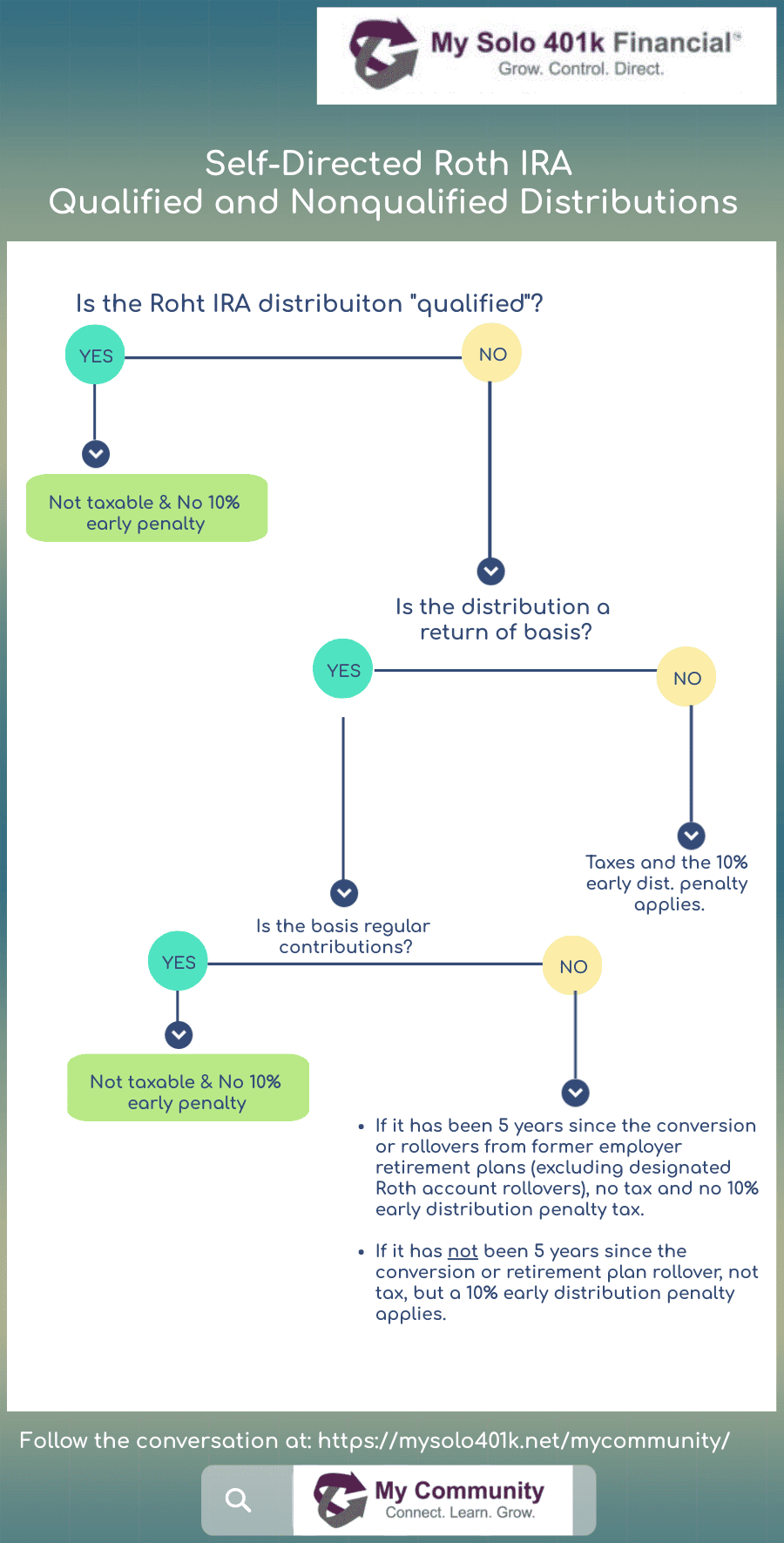
Whether a distribution from a self-directed Roth IRA is taxable or not depends on whether it is considered qualified or nonqualified. Qualified Roth IRA distributions are not taxable. However, if it falls under the non qualified category then only part of it (generally the earnings) is taxable resulting in the payment of income tax and a 10 percent early distribution penalty tax if the Roth IRA owner is under age 59 1/2.
Quick Items to Know
- All your Roth IRAs are considered as one Roth IRA with respect to making contributions and distributions. Therefore, you can maintain as many Roth IRA as your prefer and it won’t impact contributions (i.e., the annual contribution limit is aggregated for all of your IRAs) or distributions (i.e., the Roth IRA distributions rules are the same for all of your Roth IRAs).
- These distribution ordering rules only apply to Roth IRAs, so they do not impact distributions from Roth solo 401k plans or inherited Roth IRAs as they both have different distribution ordering rules.
- When taking a distribution from a Roth IRA, the following ordering rules apply, meaning certain funds must first be distributed prior to being able to distribute other funds from the Roth IRA(s):
Tax rules require Roth IRA assets to be distributed in the following order (see IRC Sec. 408A(d)(4) and Treas. Reg. 1.408A-6):
First: regular contributions (not taxes or penalties apply);
Second: conversions and rollovers from qualified plans such as a solo 401k (no taxes apply; however, the 10% early distribution penalty applies unless the funds are distributed after 5 years OR after reaching age 59 1/2); and
Third: earnings on Roth IRAs are both tax and penalty free ONLY if distributed after having had any Roth IRA for 5 years and you are 59 1/2 or older.
Roth IRA Distributions from Self-Directed Roth IRA LLC
Where the Roth IRA invested in an LLC resulting in the Roth IRA being the sole member of the LLC (aka checkbook Roth IRA), the same ordering Roth IRA distributions rules above apply because the LLC was funded with Roth IRA funds. What is more, the cash is being distributed from the Roth IRA, and if the Roth IRA does not already have liquid funds, then the manager of the Roth IRA LLC will need to first directly send funds from the LLC bank account to the self-directed Roth IRA. Reason being, the self-directed Roth IRA custodian is required to both process the distribution from the Roth IRA and to report it on Form 1099-R.
Also, in the event you choose to process an-kind distribution from a self-directed Roth IRA LLC (i.e., instead of taking a distribution in the form of cash, you instead distribute LLC units), you still need to work with the self-directed IRA custodian as they will need to assign units from the name of the Roth IRA to your name personally and will also need to issue a Form 1099-R to report the in-kind distribution whether it is taxable or not.
Lastly, the Roth IRA custodian is not responsible for tracking the taxable and nontaxable funds or LLC units in your self-directed Roth IRA.




