
As a self-employed individual with a Solo 401(k), it’s crucial to understand when and how to take Required Minimum Distributions (RMDs). RMDs are mandatory withdrawals that the IRS requires once you reach a certain age. Failing to take your RMD on time can result in significant penalties.
In this blog post, we’ll walk you through the timing, rules, and important considerations related to your first Solo 401(k) RMD.
What Is a Required Minimum Distribution (RMD)?
A Required Minimum Distribution (RMD) is the minimum amount you must withdraw annually from certain retirement accounts once you reach a specific age. These accounts include traditional IRAs and Solo 401(k) plans with pre-tax contributions.
For Solo 401(k)s, only pre-tax funds are subject to RMDs. Roth Solo 401(k) funds, under the SECURE Act 2.0, are no longer subject to RMDs during your lifetime, bringing them in line with Roth IRAs.
🗓 When Do I Take My First RMD?
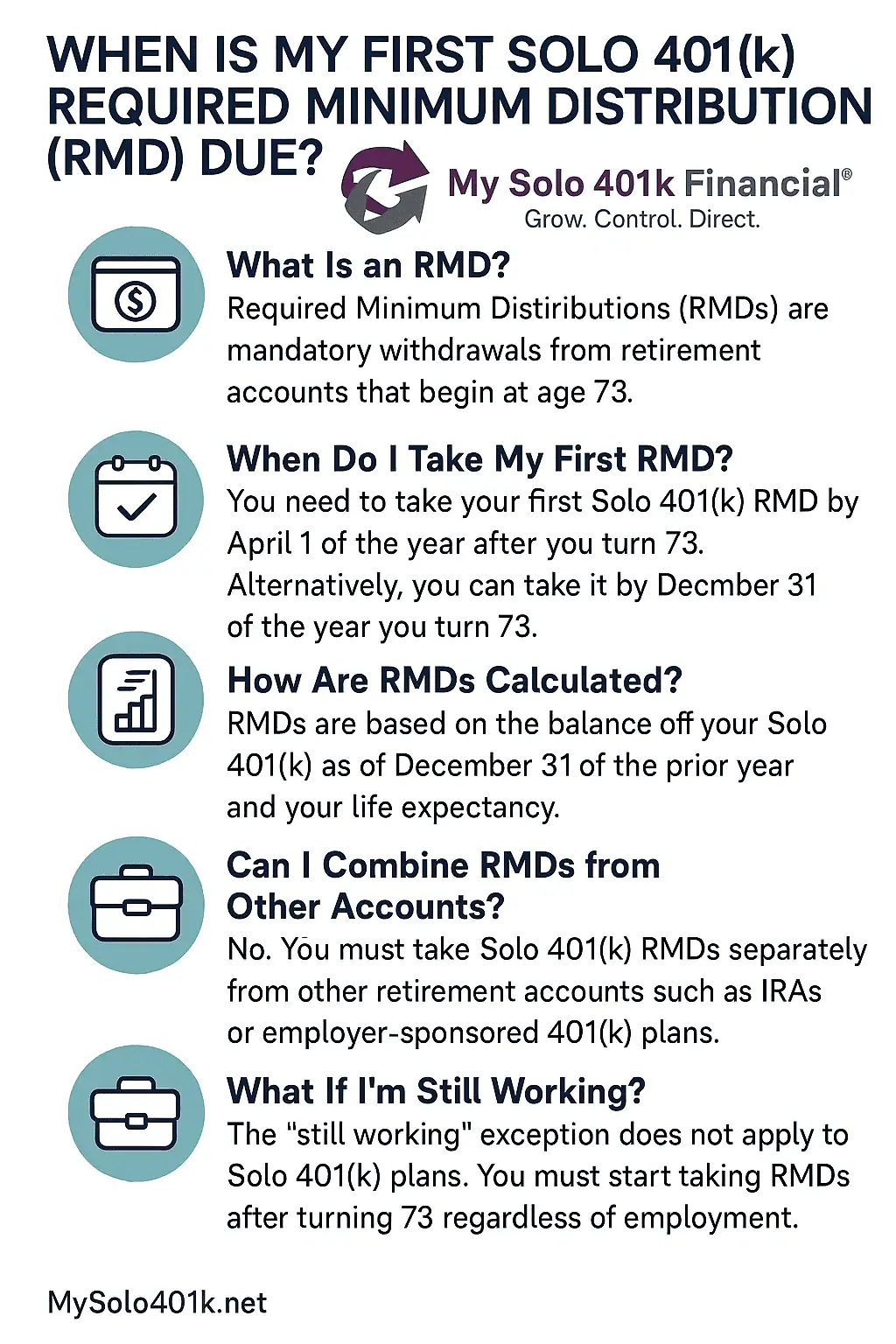
Your first RMD from a Solo 401(k) must be taken by April 1 of the year following the year you turn age 73 (as established by SECURE Act 2.0). However, you also have the option to take it by December 31 of the year you turn 73.
-
RMDs begin at age 73 (for those turning 73 in 2023 or later under SECURE Act 2.0).
-
You can delay your first RMD until April 1st of the following year after turning 73.
-
Every subsequent RMD must be taken by December 31st each year.
📌 Example:
-
You turn 73 in 2025.
-
You can take your first RMD by December 31, 2025, or delay it until April 1, 2026.
-
If you delay, you’ll have to take two RMDs in 2026: one by April 1 (for 2025) and another by December 31 (for 2026).
How Are RMDs Calculated?
Your RMD amount is calculated based on your account balance and your life expectancy. The IRS Uniform Lifetime Table is commonly used to determine your annual RMD amount. The balance used for the calculation is the total value of your Solo 401(k) as of December 31 of the previous year.
RMDs are calculated using the IRS Uniform Lifetime Table based on:
-
Your age
-
The balance in your Solo 401(k) as of December 31st of the previous year
To help simplify this process, you can use My Solo 401k Financials’ online Solo 401(k) RMD calculator to determine your required withdrawal amount.
Aggregation Rules for RMDs
No. Unlike IRAs, where you can take the total RMD from one IRA account, 401(k) plans—including Solo 401(k)s—must be handled separately. If you have multiple 401(k) plans, you must take individual RMDs from each account.
For instance, if you have a Solo 401(k) and a 401(k) through a current or past employer, each plan will require its own RMD. You cannot satisfy one plan’s RMD by taking a distribution from another.
The same rule applies to IRAs. You cannot use your Solo 401(k) to satisfy the RMD requirement for your traditional IRA, or vice versa. Each plan type requires a separate RMD.
You cannot aggregate RMDs across different 401(k) plans. Each plan must process its own RMD.
-
You must take Solo 401(k) RMDs separately from Traditional IRA RMDs.
-
You must also take RMDs separately from any full-time employer 401(k) plans.
Do I Need to Take an RMD If I’m Still Working?
Yes. The “still working” exception does not apply to Solo 401(k) plans. Even if you’re still working in your business at age 73 or beyond, you must begin taking RMDs from your pre-tax Solo 401(k).
Many people ask whether they are required to take RMDs from their Solo 401(k) if they’re still actively working in their business. The answer is yes. The IRS does not offer a “still working” exception for Solo 401(k) plans.
This is different from traditional 401(k) plans through an employer, where you might be allowed to delay RMDs if you’re still working and don’t own more than 5% of the business. Since a Solo 401(k) is by definition for owner-only businesses, that exception does not apply.
RMD Reporting Made Easy
If you’re a client of My Solo 401k Financial, the team will issue the required IRS Form 1099-R for your RMD at no additional cost, provided you request it in a timely manner.
Final Thoughts
Required Minimum Distributions are an important part of Solo 401(k) compliance once you reach age 73. While you can delay your first RMD until April 1 of the following year, doing so will require you to take two distributions in that year, which could increase your tax burden.
Remember, RMD rules for Solo 401(k) plans differ from those for IRAs and traditional employer-sponsored 401(k) plans. Understanding these distinctions can help you stay on the right track and avoid surprises when it’s time to withdraw funds from your retirement account.
If you’re nearing RMD age or have questions about your specific situation, consult a qualified financial advisor or reach out to your Solo 401(k) provider for guidance.