

High-income professionals often assume they must choose one Roth strategy per year. In reality, the IRS allows a powerful combination of three separate Roth funding strategies to be used simultaneously — a structure we call the Roth Trifecta.
When implemented correctly, the Roth Trifecta can allow an eligible taxpayer to contribute well over $100,000 in a single year into Roth-designated retirement accounts — all with tax-free growth forever.
Let’s break down how it works, who qualifies, and why these strategies do not interfere with each other.
Watch: Here is how to process a Roth Trifecta to really maximize your Roth retirement funds
What Is the Roth Trifecta?

The Roth Trifecta refers to funding three independent Roth pipelines in the same tax year:
-
Backdoor Roth IRA
-
Mega Backdoor Roth Solo 401(k) (for self-employed income)
-
Mega Backdoor Roth 401(k) through a full-time employer (if available)
Each strategy is governed by different sections of the tax code, which is precisely why they can coexist without violating IRS limits.
Strategy #1: Backdoor Roth IRA

The Backdoor Roth IRA is a two-step strategy used by individuals whose income exceeds the Roth IRA income limits.
How it works:
-
Make a non-deductible IRA contribution

-
Convert that contribution to a Roth IRA
Because non-deductible IRA contributions have no income limits, this strategy remains available even to high earners.
Key rules to understand:
-
Annual IRA contribution limits still apply
-
The strategy works best when you have no other pre-tax IRA balances
-
Pre-tax IRAs can often be rolled into a Solo 401(k) to avoid the IRA pro-rata rule
Most importantly, 401(k) balances are not counted under IRA pro-rata rules, which is why the Backdoor Roth IRA remains completely independent from Solo 401(k) or employer 401(k) activity.
Strategy #2: Mega Backdoor Roth Solo 401(k)

If you are self-employed, this is often the largest Roth funding opportunity available.
Who qualifies?
You must:
-
Have self-employment income (sole proprietor, S-corp, partnership, etc.)
-
Have no non-owner full-time W-2 employees
-
Sponsor a properly designed Solo 401(k) plan
How it works:
A Mega Backdoor Roth Solo 401(k) requires:
-
Voluntary after-tax contributions
-
In-plan Roth conversions or in-service rollovers
With the right plan design, you can:
-
Contribute up to the overall annual limit
-
Convert after-tax contributions to Roth
-
Pay tax only on minimal earnings (if converted promptly)
For example:
-
2025 overall limit: $70,000

-
2026 overall limit: $72,000
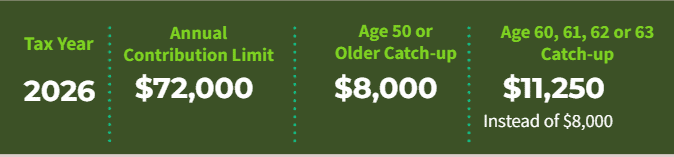
These amounts can be contributed entirely as after-tax Solo 401(k) contributions, then converted to Roth — resulting in a massive Roth balance funded in a single year.
Strategy #3: Mega Backdoor Roth 401(k) Through Your Employer

Some full-time employer 401(k) plans allow:
-
Voluntary after-tax contributions and
-
Roth conversions or in-service rollovers
This is commonly referred to as the “Mega Backdoor Roth at Work.”
Important:
Not all employer plans allow this feature. You must confirm:
-
After-tax contributions are permitted
-
Roth conversions or in-service rollovers are allowed
If your employer plan supports this structure, it becomes a third, independent Roth pipeline that does not reduce your Solo 401(k) or IRA contribution opportunities.
Why These Strategies Do NOT Interfere With Each Other

This is where most confusion occurs — but the rules are very clear.
-
IRAs and 401(k)s follow separate contribution limits
-
Unrelated 401(k) plans do not aggregate after-tax contributions
-
IRA rules do not restrict 401(k) conversions
-
Solo 401(k) limits are based solely on self-employment income
-
Employer 401(k) limits are based solely on W-2 wages
As long as:
-
Income sources are correctly matched to the plan
-
Contribution types stay within each plan’s rules
-
Proper tracking and reporting is maintained
…the Roth Trifecta works exactly as intended.
Putting the Roth Trifecta Together

In a single tax year, an eligible taxpayer can:
-
Fund a Backdoor Roth IRA
-
Execute a Mega Backdoor Roth through a full-time employer
-
Execute a Mega Backdoor Roth Solo 401(k) using self-employment income
This creates:
-
Massive Roth accumulation
-
Long-term tax-free growth
-
Diversification across Roth IRA, Roth Solo 401(k), and employer Roth accounts
The Roth Trifecta is not a loophole — it is simply the result of different sections of the tax code working together.
Final Thoughts
For high-income professionals with:
-
Multiple income streams
-
Both W-2 and self-employment income
-
Access to the right plan design
…the Roth Trifecta represents one of the most aggressive and effective Roth funding strategies available today.
Execution matters. Plan design matters. Compliance matters.
When structured properly, the Roth Trifecta can dramatically change the trajectory of your long-term, tax-free retirement wealth.