
Solo 401(k) End Triggers: 7 Changes That Could Force Closure or Conversion
What life or business changes can end a Solo 401(k) plan?
Direct Answer
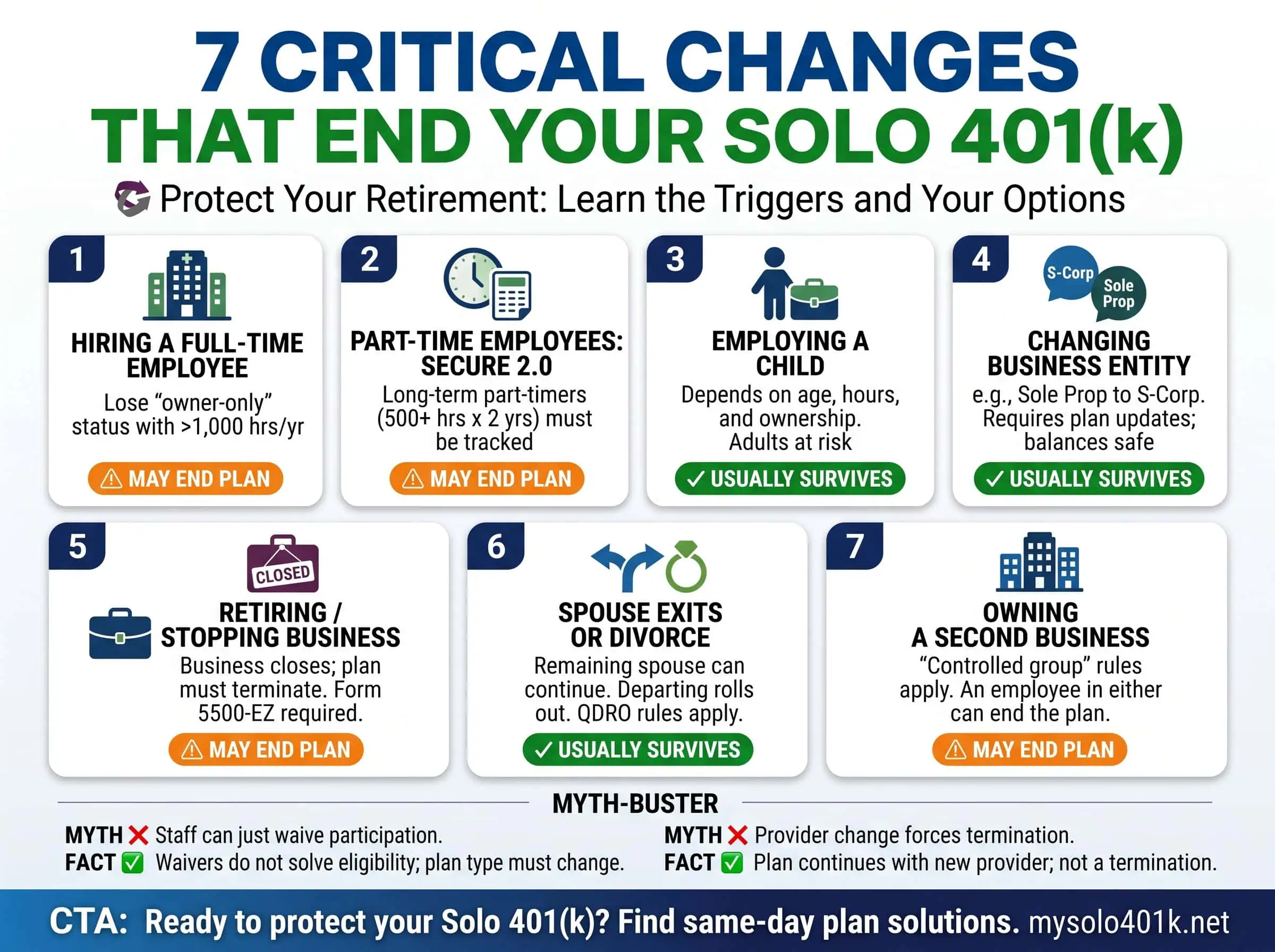
A Solo 401(k) is reserved exclusively for owner-only businesses. Seven common life and business changes — hiring a full-time W-2 employee, adding part-time workers who cross the 500-hour threshold, hiring a child who becomes eligible, restructuring the business entity, retiring or stopping self-employment, a spouse exiting the business, or acquiring a second business with its own employees — can threaten Solo 401(k) eligibility. Depending on the facts, the plan may need to be converted, frozen, or formally terminated with a final Form 5500-EZ. Most changes do not force immediate termination; options exist.
Live webinar hosted by My Solo 401k Financial. Watch the full session above or read the structured summary below.
Key Takeaways
- A Solo 401(k) is an owner-only plan — a 401(k) sponsored by a self-employed business that has no non-owner, non-spouse employees who meet the eligibility criteria (age 21+, 1,000 hours/year, one year of service).
- Hiring even one full-time W-2 employee who works 1,000+ hours per year with a year of service disqualifies the business from maintaining a Solo 401(k); the plan must be converted or terminated before that employee reaches eligibility.
- Under SECURE 2.0’s long-term part-time employee rules, part-time workers who log 500 or more hours per year for two consecutive years also become eligible, threatening owner-only status.
- A child employed by the business does not automatically end the Solo 401(k) — the child’s hours, age, and ownership percentage all determine whether they are treated as an eligible non-owner employee or as a co-owner exempt from the rules.
- Reorganizing the business entity (for example, converting from a sole proprietorship to an S corp) generally requires only a plan document update — not termination — as long as the business remains owner-only.
- When a Solo 401(k) is terminated, a final Form 5500-EZ is required regardless of plan asset value, and any outstanding 401(k) loan balance becomes a taxable distribution if not repaid first.
- Owning a second business that employs non-owner, non-spouse workers can end the Solo 401(k) under the IRS control group and affiliated service group rules, even if the plan’s sponsoring business has no employees of its own.
The Owner-Only Rule: The Foundation of Every Solo 401(k)
A Solo 401(k) survives or falls based on a single question: is the sponsoring business still an owner-only business? An owner-only business is one whose only workers are owners and their spouses — or W-2 employees who do not yet meet the plan eligibility criteria. The moment that definition breaks, the Solo 401(k) faces a decision.
“The foundational concept here is whether or not the business after the particular change is going to still be considered an owner-only plan, because that’s the key from a Solo 401(k) perspective. If not, you may have to amend the plan, you may have to terminate the plan, it may be possible to keep the status quo — so do nothing — or maybe freeze the plan.”
(1:59 in the webinar)
A common myth is that most changes automatically force plan termination. They do not. Four paths are available — amend, terminate, freeze, or do nothing — and which path applies depends on the specific facts of the business change.
The 7 Triggers: A Change-by-Change Analysis
Trigger 1: Hiring a Full-Time W-2 Employee
Hiring a full-time W-2 employee is the most common Solo 401(k) end trigger. A full-time employee, for Solo 401(k) eligibility purposes, is someone who is age 21 or older, has completed one year of service, and has worked 1,000 or more hours during that year. Once such an employee exists, the business is no longer owner-only and the Solo 401(k) cannot be maintained.
When this happens, two paths are available. First, convert the Solo 401(k) into a traditional employer 401(k) plan that can cover non-owner, non-spouse employees. Second, terminate the Solo 401(k) before any employee reaches eligibility, rolling the assets to an IRA or taking a taxable distribution. Either path carries a cost: conversion means losing the Solo 401(k)’s advanced features — alternative investments, Mega Backdoor Roth, and plan loans — because a standard employer plan does not support them.
Trigger 2: Hiring Part-Time Employees Who Cross the 500-Hour Threshold
Part-time employees who work fewer than 1,000 hours per year do not immediately threaten the Solo 401(k) — but they can, over time. Under the long-term part-time employee rules enacted by SECURE 2.0, a part-time worker who logs 500 or more hours per year for two consecutive years becomes eligible to participate in the employer’s 401(k) plan. When that eligibility threshold is crossed, the Solo 401(k) faces the same convert-or-terminate decision described above.
The practical lesson: solopreneurs who employ part-time workers should track hours annually from day one — not wait until eligibility is imminent. Being blindsided by the two-year lookback is avoidable with advance planning.
“It’s important to do some advanced planning and start to track those hours so that the solopreneur is not blindsided.”
(5:08 in the webinar)
Trigger 3: Hiring a Child (Who May or May Not Be a Problem)
Hiring a child does not automatically break the Solo 401(k) rules. A child employee preserves the owner-only status as long as at least one of the following is true:
- The child is under age 21 (below the 401(k) eligibility age).
- The child works fewer than 1,000 hours per year (or fewer than 500 hours per year for two consecutive years under the part-time rules).
- The child is age 21 or older but holds a 3% or greater ownership stake in the company — making them a co-owner who falls under the co-owner exception.
An adult child who works full-time as a W-2 employee without an ownership interest, however, is treated as any other non-owner employee and does threaten owner-only status.
Trigger 4: Changing the Business Entity (Usually Just a Document Update)
Reorganizing the business — for example, converting from a sole proprietorship to an S corporation — does not require terminating the Solo 401(k), provided the business remains owner-only. The plan documents must be updated to reflect the new sponsoring entity (the S corp becomes the plan sponsor), but the plan itself continues. Balances are unaffected, investments are unaffected, and no distribution or rollover is triggered.
“The new entity would seamlessly adopt the 401(k) plan, the restated 401(k) plan. So the plan would continue, but now be sponsored by the new business entity.”
(7:41 in the webinar)
Trigger 5: Retiring or Stopping Self-Employment
A Solo 401(k) is a business-sponsored plan. If the self-employed business permanently closes — whether through retirement, dissolution of the entity, or a return to traditional employment — the 401(k) plan must likewise be wound down. The assets must be transferred to an IRA or taken as a taxable distribution, and a final Form 5500-EZ must be filed. This final 5500-EZ is required even if the plan value has always been below $250,000 and no 5500-EZ has ever been filed during the plan’s life.
A nuanced middle path exists: if the solopreneur stops active self-employment but has not permanently closed the business (for example, they return to corporate work but remain open to occasional consulting), they may be able to freeze the plan rather than terminate it. Freezing preserves the plan and its investments in place without requiring a distribution. New contributions cannot be made without self-employment income to justify them, but the existing assets — including alternative investments like real estate or private equity — remain inside the plan.
Trigger 6: A Spouse Exiting the Business or Divorce
When spouses co-own and co-participate in a Solo 401(k), a spouse’s departure — through divorce or otherwise — does not necessarily end the plan. If the remaining spouse continues to operate the owner-only business, the Solo 401(k) can continue under that spouse’s name. The departing spouse’s balance is transferred out (to their own IRA or taken as a taxable distribution), which requires a 1099-R to report the transfer but does not require a final Form 5500-EZ, since the plan itself is not being shut down.
In the case of divorce specifically, a Qualified Domestic Relations Order (QDRO) is the court order that governs how the Solo 401(k) assets are divided between the spouses. The QDRO specifies the allocation, and only after its terms are satisfied can the departing spouse’s portion be moved out of the plan.
“A spouse exiting the business or divorce is not necessarily going to force the closure of the business, but it could impact, for example, either the remaining spouse’s assets if they’re divided as part of a divorce or the exiting spouse rolling their assets or taking a taxable distribution of their assets out of the Solo 401(k) as part of that separation.”
(12:05 in the webinar)
Trigger 7: Owning a Second Business With Employees (Control Group Rules)
The IRS does not evaluate each business a solopreneur owns in isolation. Under the control group rules and affiliated service group rules, a group of businesses owned by the same person — or by related persons, such as a husband and wife — is treated as a single employer for retirement plan purposes. If any business in that group employs a non-owner, non-spouse worker who meets the eligibility criteria, no company in the group can maintain a Solo 401(k), because those employees are counted across all entities.
The affiliated service group rules cast an even wider net, looking at functional and service relationships between businesses — not just common ownership. A solopreneur who adds a second business, a side venture, or even a consulting entity should confirm whether the new business creates a controlled or affiliated group before assuming the Solo 401(k) is safe.
The one clear exception: if the solopreneur simply expands their self-employment activity under a new entity — with no employees in any related business — there is generally no problem. The solopreneur can even aggregate income from all their owner-only businesses to justify Solo 401(k) contributions, with no change to the plan documents required.
“The IRS is going to look at a group of businesses that are ultimately owned by the same person or related persons — like a husband and wife — as one unit under what they call the control group rules.”
(13:23 in the webinar)
7 Triggers at a Glance: What Each Change Means for Your Solo 401(k)
Note: “Convert” means upgrading to a standard employer 401(k) plan that can cover non-owner, non-spouse employees. Advanced features (alternative investments, Mega Backdoor Roth, plan loans) are generally lost upon conversion or if assets roll to a standard IRA.
3 Common Myths About Solo 401(k) Plan Changes
Myth 1: “My staff can sign a waiver to opt out — that keeps the Solo 401(k) intact.”
False. A Solo 401(k) is only for businesses without non-owner, non-spouse employees who meet the eligibility criteria. Whether those employees want to participate in the plan is irrelevant. Even if every eligible employee signs a waiver declining plan participation, the business has still lost its owner-only status. The plan must be converted or terminated.
Myth 2: “Changing plan providers forces termination.”
False. Switching Solo 401(k) plan document providers — for example, to access advanced features like the Mega Backdoor Roth, alternative investments, or 401(k) loans — does not constitute a plan termination. The plan continues; the document restates it under the new provider. Assets, balances, and investment positions are unaffected.
Myth 3: “I’ll have to sell my real estate or alternative investments to close the plan.”
False. If a Solo 401(k) must be terminated and the plan holds alternative investments — real estate, promissory notes, private equity — those investments do not have to be liquidated. They can be transferred in kind to a self-directed IRA that is set up to hold those same asset types. The transfer is reported on a 1099-R but is non-taxable as a direct rollover. Only a 401(k) loan balance at the time of termination becomes immediately taxable if not first repaid.
“Even if you close the Solo 401(k) as part of one of these life or business changes, it’s possible to transfer the assets to an IRA — even a self-directed IRA that can hold those alternative investments. So you won’t necessarily have to liquidate your investments.”
(18:25 in the webinar)
What Solo 401(k) Termination Actually Involves
When a Solo 401(k) must be formally terminated, four steps are required:
- Repay or default any outstanding plan loan. If a loan balance remains at termination, it is treated as a taxable distribution.
- Transfer or distribute all plan assets. Assets may be transferred to an IRA (non-taxable direct rollover) or taken as a taxable distribution. Alternative investments that cannot be liquidated are transferred in kind to a self-directed IRA.
- File a final Form 5500-EZ. This filing is required regardless of whether a 5500-EZ has ever been filed before, and regardless of plan value. There is no minimum-balance exception on termination.
- Issue a 1099-R. The distribution or rollover is reported on a 1099-R. A direct rollover to an IRA is non-taxable but still reportable.
Frequently Asked Questions
Can I keep my Solo 401(k) if I hire a part-time employee who works 20 hours a week?
Does changing my business from an LLC to an S corp require terminating my Solo 401(k)?
If I go back to a W-2 job, do I have to close my Solo 401(k)?
Can my child work in my business without ending my Solo 401(k)?
Does my spouse getting divorced from me end my Solo 401(k)?
I own two businesses. Can the second business have employees without affecting my Solo 401(k)?
Do I have to sell real estate inside my Solo 401(k) if I have to close the plan?
Is a Form 5500-EZ required when I terminate a Solo 401(k) with a small balance?
This article is based on the live webinar hosted by My Solo 401k Financial on .Ready to Open a Solo 401(k)?
My Solo 401k Financial prepares plan documents within the same business day. Join tens of thousands of self-employed entrepreneurs who use our Solo 401(k) plan — supporting alternative investments, Mega Backdoor Roth, plan loans, and more.