
Self-Directed IRA Real Estate Rules: Not One Day of Personal Use (IRC 4975)
By Mark Nolan, Founder/ Compliance Officer, My Solo 401k Financial · Published
Direct answer: Self-Directed IRA real estate is legal, but the property must be held purely as an investment. Title goes in the custodian’s name for the benefit of the IRA. The IRA pays every expense and receives every dollar of income. Neither the owner nor any disqualified person may use, repair, buy, sell, or lease the property, even at fair market rent.
Key Takeaways
- Title to Self-Directed IRA real estate is held in the IRA custodian’s name for the benefit of the IRA, never in the owner’s personal name.
- IRC 4975 prohibited-transaction rules bar personal use of IRA-owned property, even for one day a year and even at fair market rent.
- The IRA owner, spouse, lineal ancestors, lineal descendants, and IRA service providers are disqualified persons; siblings, aunts, and uncles generally are not.
- A Self-Directed IRA can borrow only through a non-recourse loan, and debt-financed income above a $1,000 specific deduction is taxed as UDFI on Form 990-T.
- In the webinar’s example, $30,000 of annual rent minus $12,000 of taxes, insurance, and maintenance leaves $18,000 growing inside the IRA.
- The webinar’s rule of thumb is no more than one or two house flips per year in a Self-Directed IRA, alongside other passive investments.
- A self-directed Solo 401(k) can use a non-recourse loan without UDFI under IRC 514(c)(9), but only self-employed owners without eligible employees qualify.
Status: As of , the Self-Directed IRA real estate rules in this article reflect current federal law under IRC 408, IRC 4975, and IRC 511–514. None of them is a pending proposal.
Video: the live webinar on Self-Directed IRA Real Estate rules, hosted by My Solo 401k Financial.
What are the rules for buying property with a self-directed IRA?
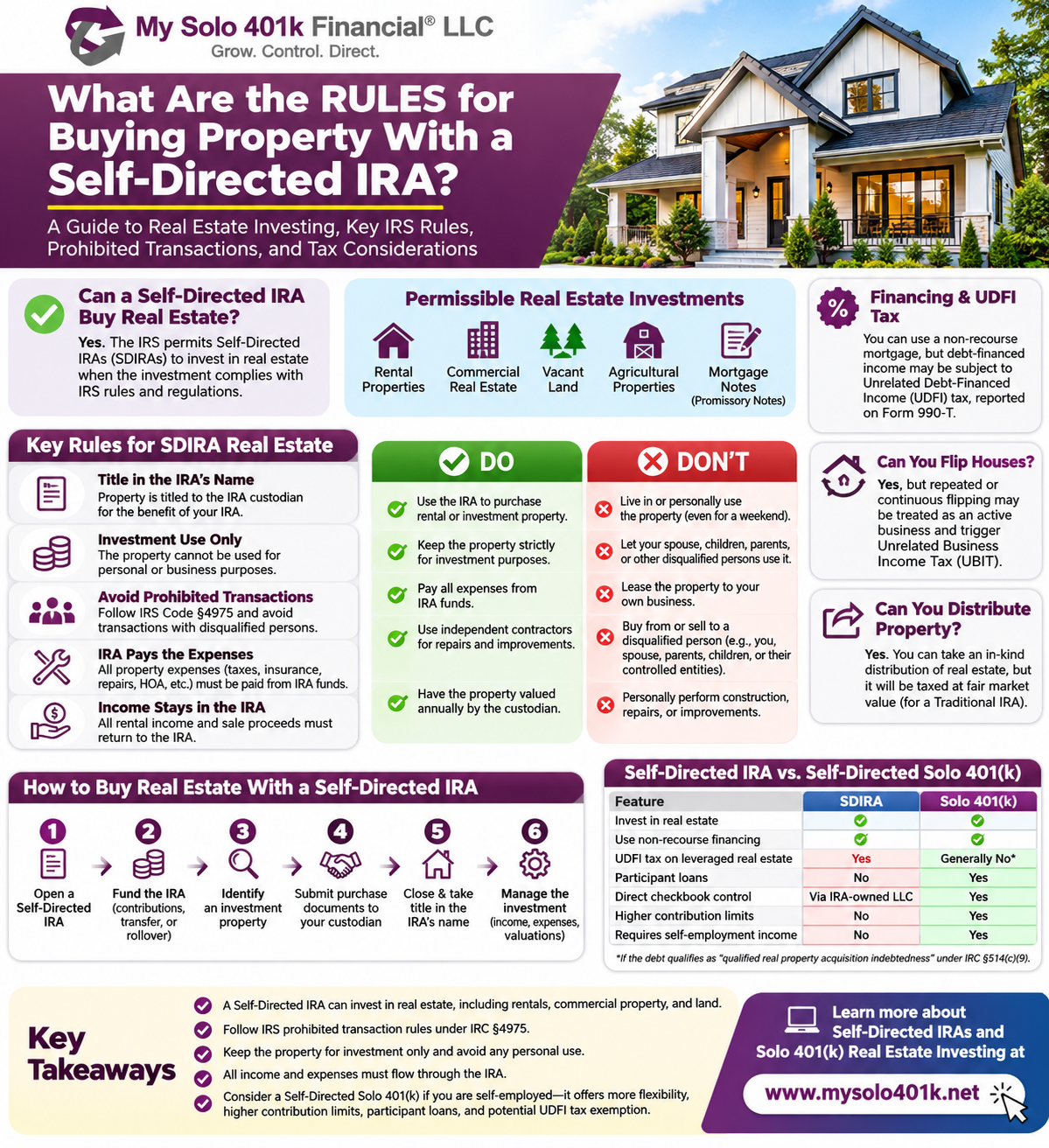
Self-Directed IRA real estate purchases follow six core rules from the webinar. The custodian holds title for the IRA. The property is for investment only. No transaction may involve a disqualified person. The IRA pays all expenses. All income returns to the IRA. Any loan must be non-recourse.
A Self-Directed IRA is an IRA whose custodian permits alternative assets such as real estate. Conventional brokerage and bank IRAs usually do not allow those assets.
What types of real estate can a Self-Directed IRA hold?
Self-Directed IRA real estate can include residential rentals, commercial buildings, vacant land, and agricultural property. A Self-Directed IRA can also hold promissory notes secured by real estate. The IRS permits these holdings as long as they comply with the IRA rules and the prohibited-transaction rules.
How is title held on Self-Directed IRA real estate?
Self-Directed IRA real estate is titled in the name of the IRA custodian or trust company for the benefit of the owner’s IRA. The owner is not personally investing. The IRA is the buyer, so the deed never carries the owner’s personal name.
Can you personally use Self-Directed IRA real estate?
Self-Directed IRA real estate cannot be used personally by the owner or any disqualified person. The ban has no minimum-use exception. Paying fair market rent does not cure it.
“So again, you cannot use that property for personal use, even if you use it one day out of the year, or even if you pay fair market rate, that’s not allowed.”
Important: The webinar listed these as prohibited uses of IRA-owned property:
- Living in a house the IRA owns.
- Spending a weekend at an IRA-owned vacation rental.
- Letting your children or parents stay in an IRA-owned property.
- Leasing IRA-owned commercial space to your own business.
Who is a disqualified person for Self-Directed IRA real estate?
Self-Directed IRA real estate cannot be bought from, sold to, leased to, or lent to a disqualified person. IRC 4975 defines that group. Any such dealing is a prohibited transaction.
“So specifically the IRS code section that applies to IRAs is IRC code 4975. And a self-directed IRA cannot engage in prohibited transactions with individuals or entities.”
Table summary: The owner, spouse, ancestors, descendants, the owner’s business, and IRA service providers are disqualified persons; siblings, aunts, and uncles generally are not.
Straw-man and roundabout transactions
Self-Directed IRA real estate cannot be passed through a non-disqualified party to reach you. The webinar gave two examples. Selling the property to your brother so you can buy it back is prohibited. So is selling your home to a neighbor so your IRA can buy it from the neighbor.
Can you repair or renovate Self-Directed IRA real estate yourself?
Self-Directed IRA real estate must be repaired by an unrelated third-party contractor, not by the owner. Sweat equity from you, your spouse, your parents, or your children raises prohibited-transaction concerns. The concern is greatest when the work raises the account’s value.
“Yes, you might be handy, but unfortunately, you can’t show off your skills on your property owned by your self-directed IRA. You’re gonna have to save those skills for property you own personally.”
Prohibited hands-on work
The webinar listed fixing a toilet, painting, replacing flooring or a roof, and installing cabinets as prohibited hands-on work. Electrical or plumbing repairs are also prohibited. Personally supplying construction materials is too, because materials are an IRA expense.
Permitted management tasks
The owner may still manage Self-Directed IRA real estate without compensation. Finding tenants and hiring contractors are managerial functions, not sweat equity.
How do expenses and rental income flow in Self-Directed IRA real estate?
Self-Directed IRA real estate expenses must be paid from IRA funds. Those expenses include property taxes, insurance, HOA fees, repairs, maintenance, and renovations. All income must flow directly back to the IRA, including rent, security deposits, and sale proceeds.
Rent cannot pass through your personal bank account, even if you later deposit it into the IRA. Plan ahead so the IRA does not run short of cash. If it does, you can make an annual IRA contribution within the limits. You can also transfer other IRAs or former employer plans into it.
“So as this slide here illustrates, let’s say the annual rent is $30,000, taxes, insurance and maintenance is $12,000. The IRA has $18,000 remaining from that investment.”
Example: A Self-Directed IRA rental collects $30,000 in annual rent. The IRA pays $12,000 for taxes, insurance, and maintenance. The remaining $18,000 stays in the IRA, tax-deferred, and can be reinvested. In a Self-Directed Roth IRA, the same growth would be tax-free if distributions are qualified.
Can a Self-Directed IRA get a mortgage to buy real estate?
Self-Directed IRA real estate can be financed, but only with a non-recourse loan. The loan is made to the IRA, and the IRA makes every payment. The owner cannot personally guarantee it. A recourse loan is never allowed for an IRA.
If the IRA defaults, the lender’s only remedy is the financed property. The lender cannot reach your personal assets or other assets in the IRA. It also cannot reach your other IRAs or your Solo 401(k).
UDFI: the tax on debt-financed income
Self-Directed IRA real estate bought with borrowed money produces unrelated debt-financed income (UDFI) on the debt-financed share. The IRA pays the tax, not the owner. The IRA reports it on Form 990-T.
“So the first $1,000 is exempt from that unrelated debt finance income tax, but any amount after that is subject to that unrelated debt finance income tax.”
Important: The webinar noted the UDFI tax rate “can be pretty high,” citing rates as high as 38% [VERIFY: compressed trust tax brackets top out at 37% under current law]. Keep enough cash in the IRA to pay the tax.
Can you flip houses with Self-Directed IRA real estate?
Self-Directed IRA real estate flipping is allowed, but frequent flipping can trigger unrelated business income tax (UBIT). Congress designed IRAs for passive, buy-and-hold investing. The IRS distinguishes passive investment from a regularly conducted business.
The webinar’s guidance is to hold a property for a year or longer so it is more likely to be treated as passive. A large number of short-term flips generally triggers UBIT. Like UDFI, UBIT is paid by the IRA and reported on Form 990-T.
“The rule of thumb I see in the industry is to perform no more than one or two flips a year inside that self-directed IRA. And that’s not the sole activity being done through that IRA.”
How do valuations, RMDs, and in-kind distributions work for Self-Directed IRA real estate?
Self-Directed IRA real estate needs a fair market valuation each year. The custodian reports the IRA’s value, including the property, to the IRS on Form 5498. Every purchase and sale should also happen at fair market value.
An in-kind distribution moves the property, or part of it, out of the IRA into your name. You pay tax on its appraised value. Required minimum distributions (RMDs) can be satisfied this way.
Partial distribution does not unlock personal use. You may use the property only after it is fully distributed out of the IRA.
What happens if Self-Directed IRA real estate triggers a prohibited transaction?
A prohibited transaction involving Self-Directed IRA real estate typically makes the entire IRA taxable. The deemed distribution is dated to the year the transaction occurred, not the year the IRS finds it. If discovery comes two or three years later, penalties and interest compound on the back taxes.
How do you buy property with a Self-Directed IRA, step by step?
A Self-Directed IRA real estate purchase follows the sequence below, as presented in the webinar.
- Open a Self-Directed IRA with a custodian that holds real estate. The webinar named Forge Trust as one example among many.
- Transfer existing IRAs or former employer plans into the Self-Directed IRA.
- Identify the property.
- Prepare the purchase contract. The custodian signs the required IRA investment documents.
- Pay the escrow deposit from the Self-Directed IRA.
- Wire the purchase funds from the Self-Directed IRA directly to the title company.
- Take title in the name of the Self-Directed IRA.
- Route all future expenses, rent, and sale proceeds through the Self-Directed IRA.
Self-Directed IRA vs. self-directed Solo 401(k) for real estate
Self-Directed IRA real estate investors who are self-employed may do better with a self-directed Solo 401(k), according to the webinar. The main advantage is debt financing. A non-recourse loan inside a Solo 401(k) does not trigger UDFI, under the qualified-plan exception in IRC 514(c)(9).
Eligibility is the limit. A self-directed Solo 401(k) plan requires self-employment and no non-owner W-2 employees working 1,000 or more hours a year. The long-term part-time rule also applies to employees working 500–999 hours for two consecutive years.
Table summary: A self-directed Solo 401(k) avoids UDFI on non-recourse loans, allows participant loans, and includes checkbook control, but only self-employed owners qualify.