

Ultimate Guide to Self-Directed 401(k) Plans
The Complete Resource for Self-Employed Professionals in 2025 & Beyond
The self-directed 401(k) also known as a “one-participant plan” or Solo 401(k) is designed for self-employed individuals or owner-only businesses. The plan combines high contribution limits with unprecedented investment freedom, making it a powerful vehicle for building substantial retirement wealth while maintaining tax sheltered advantages.
Video Slides: https://www.mysolo401k.net/wp-content/uploads/2025/01/Self-Directed-Solo-401k-Essentials.pdf
Quick Overview
Key Features of the Self-Directed 401k Plan
- Higher contribution limits than IRAs
- Alternative investment options (e.g., real estate, cryptocurrency
- Participant Loans available
- Roth conversion and mega backdoor
Flexible Contributions:
- Pre-tax, Roth, and voluntary after-tax contributions are allowed.
- You can choose which accounts to open and expand them later.
- Example: Two participants (spouses) may have six accounts (pre-tax, Roth, voluntary after-tax for each).
Tax ID for the Plan:
- A separate Employer Identification Number (EIN) is required for the plan–you cannot use your SSN or your business EIN.

2025 Self-Directed 401k Contribution Updates
- $70,000 contribution limit
- New super catch-up provision amount of $11,250 for those age 60, 61, 62 or 63
- Auto-contribution credit of $1,500

What is an Auto-Contribution feature?
• A self-directed 401k plan with an auto-contribution feature has a default 3% contribution percentage and the self-employed business can claim a credit of $500 per year (up to 3 years for a total of $1500) for including an automatic contribution feature in a new or an existing self-directed 401k plan.
**However, you can opt out of the default 3% contribution amount and then decide to make contributions in whichever amount you prefer including simply making no contributions. In other words, you are not required to make annual self-directed 401k contributions to qualify for the tax credit**
• The credit is claimed by filing Form 8881.

Understanding Self-Directed 401(k)s
At its core, a self-directed 401(k) serves as a specialized retirement plan designed for business owners and self-employed individuals operating without full-time W-2 common-law employees. This unique option to make both employee and employer contributions is available because the solo 401k plan is a defined contribution plan with a profit sharing feature, offering corresponding benefits that maximize retirement savings potential using a self-directed 401k instead of a SEP IRA.
Eligibility Requirements
- Self-employed status or business ownership
- No full-time non-owner W-2 employees (1,000+ hours annually), except for a spouse working in the business
- Active self-employment income

Spouses can participate fully in the plan when actively involved in the business, effectively doubling household retirement savings potential while maintaining administrative simplicity.
The plan’s flexibility extends to various business structures, accommodating sole proprietorships, LLCs, S-corporations, and C-corporations. This enables self-employed individuals across different sectors to optimize their retirement savings and planning.
2025 Contribution Framework
The 2025 contribution framework introduces enhanced opportunities for retirement savings, with increased limits and new catch-up provisions for older participants. The structure enables substantial contributions through, maximizing the tax-advantaged savings potential.

Basic Contributions for 2025
- Employee deferral: $23,500
- Employer contribution: Up to 25% of compensation
- Total limit: $70,000

Catch-Up Options
- Standard (age 50+): $7,500
- Super catch-up (age 60-63): $11,250 instead of $7,500
- Maximum with super catch-up: $81,250
Strategic Example:
A 61-year-old consultant earning $200,000 can maximize contributions through:
• $23,500 employee deferral
• $11,250 super catch-up
• $46,500 employer contribution
Total: $81,250 for 2025
Investment Options
Self-directed 401(k)s offer an expansive investment universe, extending far beyond traditional market securities. This flexibility enables sophisticated portfolio construction while maintaining tax advantages, allowing investors to leverage their expertise across various asset classes.

Traditional Investments
The plan can also be invested in standard market securities:
- Stocks and bonds
- Mutual funds
- ETFs
- Index Funds
- CDs
- Money market accounts
Alternative Assets
The plan’s flexibility enables investment in diverse alternative assets:
- Real estate properties
- Private equity
- Cryptocurrency
- Tax liens
- Precious metals
- Notes

Real Estate Investment Features
Real estate investments within self-directed 401(k)s offer unique advantages, including exemption from Unrelated Business Income Tax (UBIT) and the ability to use non-recourse loans for leveraged purchases. However, careful adherence to IRS regulations is essential:
- No personal use of properties
- All income must return to the 401(k)
- Property expenses paid from plan assets
- Prohibited transaction rules apply

Advanced Planning Strategies
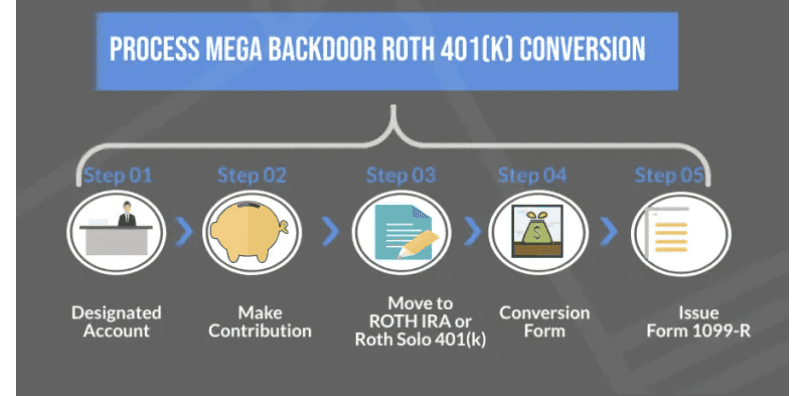
Mega Backdoor Roth 401k Strategy
The mega backdoor Roth self-directed 401k strategy represents one of the most powerful features of self-directed 401(k)s, enabling substantial after-tax contributions with immediate Roth conversion potential. This approach maximizes tax-free growth opportunities while maintaining investment flexibility.
Mega Backdoor Roth Implementation Steps
- Open the bank or brokerage account for making voluntary after-tax contributions
- Make voluntary after-tax contributions to the bank or brokerage account
- Process immediate Roth conversion
- Complete on-line conversion form
- Issue Form 1099-R
Key Benefits
- Tax-free growth potential
- No adjusted gross income restrictions
- Can convert to the Roth self-directed 401k or to a Roth IRA
- Estate planning advantages once the funds are in the self-directed Roth 401k or in the Roth IRA
Compliance Requirements
Maintaining a self-directed 401(k) requires careful attention to regulatory requirements and documentation. The plan’s qualified status depends on proper adherence to IRS guidelines and timely reporting of required information.
Annual Requirements
Form 5500-EZ filing becomes mandatory when plan assets exceed $250,000, requiring comprehensive documentation:
- Due July 31st following plan year
- Includes all participant accounts
- Reports total plan assets
- Details contribution types
Form 1099-R is required for distributions and conversions:
- Form 1099-R due by the following year after the distribution and/or conversion is processed
Mandatory plan document updates as required by the IRS
- Consist of full blown plan updates as well as interim updates based on changes in the law

Prohibited Transactions
Understanding and avoiding prohibited transactions is crucial for maintaining plan compliance:
- No self-dealing
- Restricted transactions with family
- No personal benefit from investments
- Clear separation of assets

QUESTION:
If an opportunity arises where I am offered a full time job with an employer sponsored 401(k), am I able to keep my self-directed 401(k) active or do I need to close it down?
ANSWER:
As long as you continue to perform some part-time self-employment activity, you can continue with the self-directed 401k.
QUESTION:
If I also take freelance work on the side, am I able to contribute to both a workplace 401(k) and a solo 401(k) in the same year?
ANSWER:
Yes, as the rules allow for contributions to both the self-directed 401k sponsored by your self-employed business (e.g., sole proprietorship, S-corp., etc.) as well as contributions to one’s day-time employer 401k. From a contribution perspective, certain rules apply when contributing to multiple 401k plans. For instance, employee contributions are aggregated between both 4o1k plans (the day-time employer 401k and the self-employed self-directed 401k). However, employer contributions are NOT aggregated between both 401k plans. Likewise voluntary after-tax contributions as part of the mega backdoor self-directed 401k strategy are also not subject to the contribution aggregation rules between both 401k plans.