
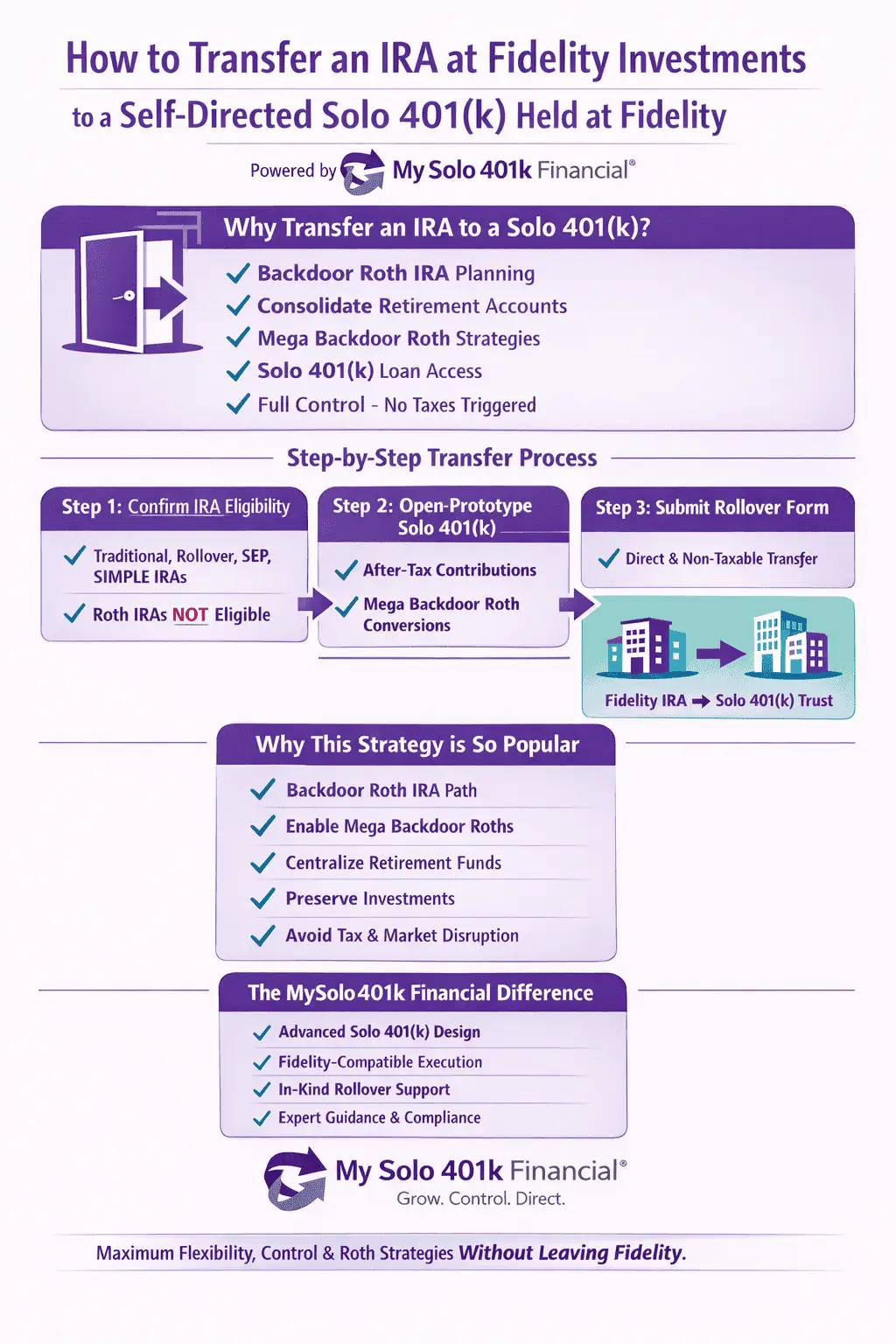
If you currently have a Traditional, Rollover, SEP, or SIMPLE IRA at Fidelity Investments and you are self-employed, there is a powerful planning opportunity available: transferring those IRA funds into a Self-Directed Solo 401(k) offered by MySolo401k Financial—while continuing to use Fidelity Investments to hold the assets.

Watch: This is how you transfer an IRA at Fidelity Investments to a sef-directed solo 401k
This strategy is widely used by business owners who want more flexibility, better tax planning options, and access to advanced Solo 401(k) features that are not available under Fidelity Investments basic Solo 401(k).
Why Transfer an IRA to a Solo 401(k)?

Rolling an IRA into a Solo 401(k) is commonly done to:
-
Eliminate pre-tax IRA balances for Backdoor Roth IRA planning
-
Consolidate retirement accounts into one plan
-
Unlock Mega Backdoor Roth Solo 401(k) strategies
-
Gain access to Solo 401(k) participant loans
-
Maintain full control without triggering taxes
-
Preserve existing investments without liquidation
Once IRA funds are moved into a Solo 401(k), they are no longer treated as IRA assets—they become qualified plan assets, opening the door to features IRAs simply do not allow.
Step 1: Confirm You Are Eligible for a Solo 401(k)

Before transferring an IRA, you must first confirm eligibility for a Solo 401(k).
You are eligible if:
-
You own a business and perform services for that business
-
You have no non-owner W-2 employees working 1,000+ hours per year
-
Contractors are allowed and do not affect eligibility
-
Employees under age 21 may be excluded
Eligible business structures include sole proprietors, single-member LLCs, partnerships, S-Corporations, and C-Corporations—as long as the eligibility rules above are met.
Step 2: Understand Why Fidelity’s Basic Solo 401(k) Is Not Enough
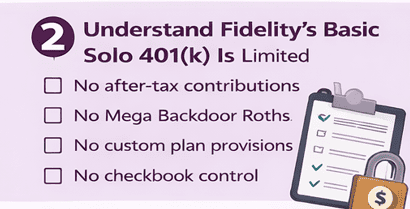
Fidelity offers a basic Solo 401(k), but that plan is limited. It does not support:
-
Voluntary after-tax contributions
-
Mega Backdoor Roth conversions
-
Custom plan provisions
-
Checkbook control
-
Advanced self-directed strategies
- Auto contribution tax credit
- Solo 401k participant loans
- Alternative Investments
However, Fidelity does allow non-prototype “investment-only” brokerage accounts for Solo 401(k) plans provided by third-party plan sponsors—such as MySolo401k Financial.
This means you can:
✔ Use a fully customized Solo 401(k) plan
✔ Still custody the assets at Fidelity
✔ Access advanced Solo 401(k) strategies
Step 3: Open the Correct Fidelity Brokerage Accounts

With a Solo 401(k) offered by MySolo401k Financial, Fidelity will open non-prototype investment-only brokerage accounts under the plan.
Typically, this includes separate holding accounts to track:
-
Pre-Tax Solo 401(k) assets
-
Roth Solo 401(k) assets
-
Voluntary After-Tax Solo 401(k) assets
These separate accounts are required for proper IRS source tracking and enable Mega Backdoor Roth conversions.
MySolo401k Financial guides you through the entire setup and brokerage account-opening process at Fidelity.
Step 4: Complete the Fidelity IRA Rollover Form
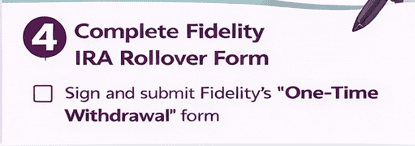
To move the IRA into the Solo 401(k), Fidelity requires a form commonly referred to as a “One-Time Withdrawal” form (despite the misleading name).
MySolo401k Financial will:
-
Prepare the Fidelity IRA rollover form for you
-
Ensure it is coded as a non-taxable direct rollover
-
List the Solo 401(k) trust as the receiving plan
-
Specify in-kind transfer (no liquidation of investments)
You simply sign the form and submit it directly to Fidelity.
Step 5: Transfer Assets In-Kind (No Liquidation Required)

One of the biggest advantages of transferring an IRA held at Fidelity into a Solo 401(k) also held at Fidelity is that assets can move in-kind.
This means:
-
Stocks, ETFs, and mutual funds are not sold
-
No time out of the market
-
No capital gains or losses triggered
-
Assets are simply re-registered under the Solo 401(k)
The funds never leave Fidelity—they are moved internally to the new Solo 401(k) brokerage accounts.
Step 6: Understand the Tax Reporting
The transfer is treated as a direct rollover, not a distribution.
-
Fidelity issues Form 1099-R showing a direct rollover
-
Box 7 should reflect Code G (non-taxable rollover)
-
No income tax and no early-withdrawal penalty applies
This is a reportable event—but not a taxable one.
Why This Strategy Is So Popular
When done correctly, transferring an IRA into a Solo 401(k):
-
Clears the way for annual Backdoor Roth IRA contributions
-
Enables Mega Backdoor Roth Solo 401(k) conversions
-
Consolidates retirement accounts
-
Preserves existing investments
-
Unlocks participant loans and self-directed investing
It is one of the cleanest and most efficient retirement planning strategies available to self-employed individuals.
How MySolo401k Financial Helps

MySolo401k Financial does more than provide plan documents. We:
-
Draft IRS-compliant Solo 401(k) plans with advanced features
-
Guide Fidelity non-prototype brokerage account setup
-
Prepare rollover and transfer paperwork
-
Support Mega Backdoor Roth conversions and reporting
-
Assist with Form 5500-EZ, Form 1099-R, and ongoing compliance
-
Design plans to qualify for the Auto-Contribution Tax Credit
Final Thoughts
If you already have an IRA at Fidelity Investments, you do not need to move your money elsewhere to gain advanced Solo 401(k) features. With the right plan structure, you can keep Fidelity as your custodian while dramatically expanding your retirement planning options.
When executed properly, an IRA-to-Solo 401(k) transfer is seamless, non-taxable, and incredibly powerful.