
A Self-Directed Solo 401(k) offers powerful flexibility for self-employed individuals who want to go beyond traditional stocks and mutual funds. One of the most common questions we receive is:
Can a Self-Directed Solo 401(k) invest in an LLC?
The short answer is yes — as long as the structure is done correctly and the LLC is used strictly for investment purposes.
This article explains who qualifies, what’s allowed (and what’s not), why some investors use a Solo 401(k)-owned LLC, and how the process works step by step.
Watch: Learn how a self-directed solo 401k can be the sole memeber of an LLC
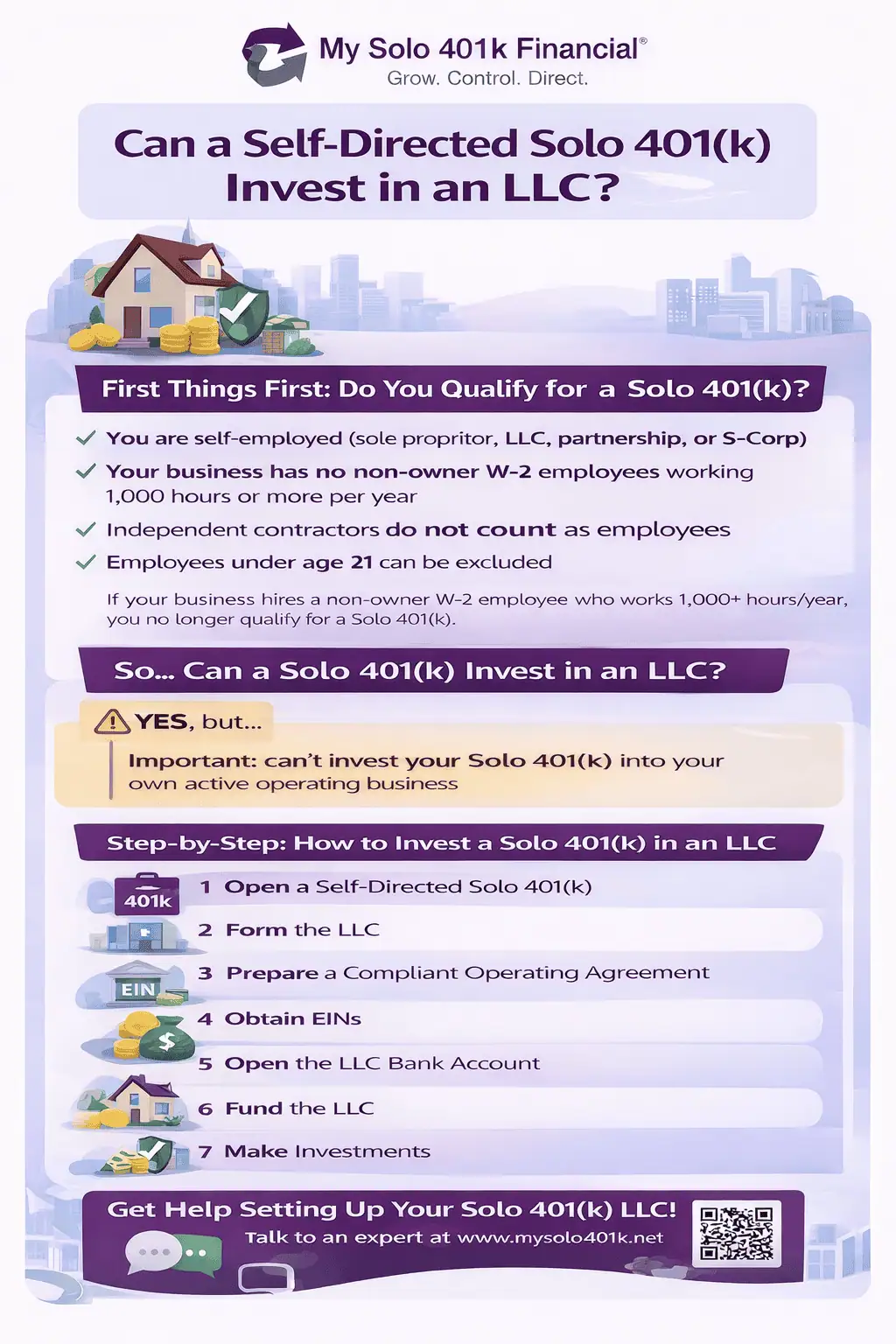
First Things First: Do You Qualify for a Solo 401(k)?
Before you can invest a Solo 401(k) in an LLC, you must first qualify to open a Solo 401(k) plan.
A Solo 401(k) is designed for owner-only businesses. You are eligible if:
-
You are self-employed (sole proprietor, LLC, partnership, or S-Corp)
-
Your business has no non-owner W-2 employees working 1,000 hours or more per year
-
Independent contractors do not count as employees
-
Employees under age 21 can be excluded
-
Owners of the business (including S-Corp owners paid via W-2) do not disqualify the plan
If your business hires a non-owner W-2 employee who works 1,000+ hours per year, you generally no longer qualify for a Solo 401(k).
So… Can a Solo 401(k) Invest in an LLC?
Yes. A Self-Directed Solo 401(k) can invest in an LLC for investment purposes only.
However, there is an important restriction:
You cannot invest your Solo 401(k) into your own active operating business.
If you own and actively work in an LLC, your Solo 401(k) cannot invest in that LLC. Doing so would be considered a prohibited transaction under IRS rules and could result in severe penalties.
To stay compliant, the LLC must be:
-
Used solely for passive or investment activity
-
Owned by the Solo 401(k) trust
-
Properly structured with compliant documentation
What Is a Solo 401(k)-Owned LLC?
When a Solo 401(k) invests in an LLC, the Solo 401(k) becomes the sole member of that LLC. This structure is often referred to as a Solo 401(k) LLC.
In this setup:
-
The Solo 401(k) owns 100% of the LLC
-
The LLC makes investments on behalf of the Solo 401(k)
-
All income and expenses flow back to the Solo 401(k)
Why Use an LLC If the Solo 401(k) Already Has Checkbook Control?
A Self-Directed Solo 401(k) already provides checkbook control, meaning you can write checks or send wires directly from the plan without custodian approval.
However, some investors still choose to use an LLC for additional reasons, including:
✔ Creditor Protection
Solo 401(k) creditor protection depends on state law. In some states, an LLC may offer stronger liability protection for real estate or other high-risk investments.
✔ Investment Structuring
Some investors prefer holding assets like real estate, private equity, or crypto inside an LLC for administrative or legal reasons.
✔ Asset Titling
Investments are titled in the name of the LLC rather than directly in the name of the Solo 401(k).
It’s important to note that speed is not the primary benefit, since a Solo 401(k) already allows fast execution without custodian delays.
Step-by-Step: How to Invest a Solo 401(k) in an LLC
Here is the typical process:
Step 1: Open a Self-Directed Solo 401(k)
You must have a self-directed Solo 401(k). Most brokerage or bank-sponsored Solo 401(k)s do not allow LLC investments.
Step 2: Form the LLC
A new LLC is registered with the state, listing the Solo 401(k) trust as the sole member.
Step 3: Prepare a Compliant Operating Agreement
The LLC operating agreement must include:
-
Solo 401(k) ownership language
-
IRS prohibited transaction provisions
-
Retirement plan compliance language
(Off-the-shelf agreements are not sufficient.)
Step 4: Obtain EINs
-
The Solo 401(k) trust has its own EIN
-
The LLC receives its own separate EIN
Step 5: Open the LLC Bank Account
The LLC opens a bank account using its EIN.
Step 6: Fund the LLC
Funds are transferred directly from the Solo 401(k) bank or brokerage account into the LLC bank account.
Step 7: Make Investments
The LLC now makes investments such as:
-
Residential or commercial real estate
-
Private equity
-
Promissory notes
-
Cryptocurrency
-
Tax liens
-
Precious metals
All assets are titled in the name of the LLC.
Important Compliance Reminders
-
The LLC cannot provide personal benefit to you or other disqualified persons
-
You cannot work for or receive compensation from the LLC
-
All expenses must be paid by the LLC
-
All income must return to the LLC
-
Prohibited transactions must be strictly avoided
How MySolo401k Financial Helps
MySolo401k Financial offers:
-
Self-Directed Solo 401(k) plan setup
-
Solo 401(k) LLC setup and facilitation
-
State LLC registration
-
IRS-compliant operating agreements
-
EIN acquisition
-
Guidance on opening LLC bank accounts
-
End-to-end support throughout the process
This ensures your Solo 401(k)-owned LLC is structured correctly and compliantly from day one.
Final Thoughts
A Self-Directed Solo 401(k) can invest in an LLC — but only when:
-
You qualify for a Solo 401(k)
-
The LLC is used strictly for investment purposes
-
The structure complies with IRS prohibited transaction rules
When done correctly, a Solo 401(k)-owned LLC can be a powerful tool for investing in alternative assets while maintaining tax-advantaged retirement growth.