
When it comes to protecting your hard-earned retirement savings, the law provides powerful safeguards—especially for funds held in employer-sponsored retirement plans. Whether you’re participating in a traditional 401(k), a solo 401(k), or another qualified plan, it’s important to understand how your savings are protected in the event of bankruptcy.
ERISA-Backed Protections
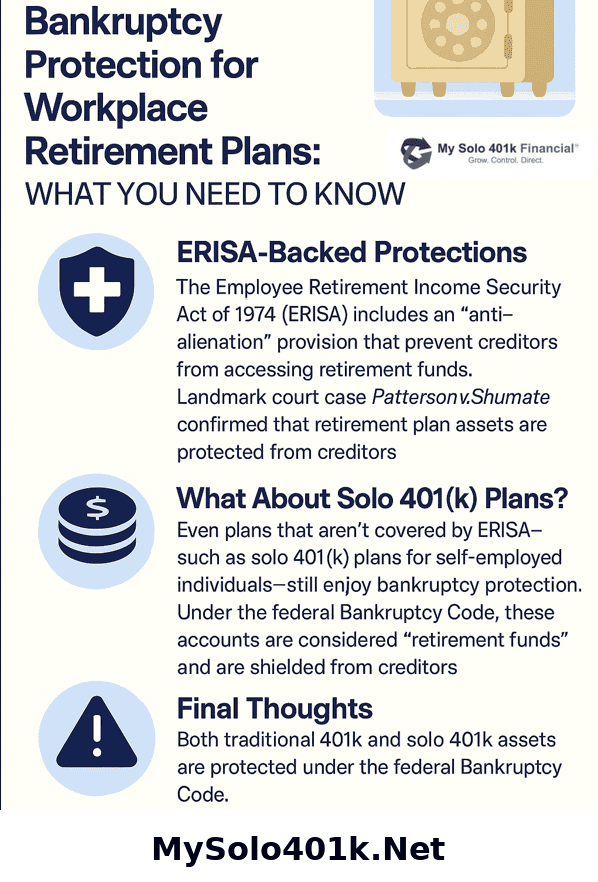
The primary source of protection for most workplace retirement plans comes from the Employee Retirement Income Security Act of 1974 (ERISA). ERISA includes an “anti-alienation” provision, which prevents creditors from accessing retirement funds held in ERISA-covered plans. This was upheld by the U.S. Supreme Court in the landmark case Patterson v. Shumate, 504 U.S. 753 (1992). In that ruling, the Court confirmed that retirement plan assets are excluded from a bankruptcy estate and are thus protected from creditors.
What About Solo 401(k) Plans?
Even plans that aren’t covered by ERISA—such as solo 401(k) plans for self-employed individuals—still enjoy bankruptcy protection. Under the federal Bankruptcy Code, these accounts are considered “retirement funds” and are shielded from creditors. This ensures that entrepreneurs and independent contractors receive similar protections as those in traditional employer-sponsored plans.
Inherited Retirement Plans and Bankruptcy
A more complex situation arises when a retirement plan is inherited. What happens if the beneficiary of a retirement plan files for bankruptcy?
A 2021 federal bankruptcy court case in North Carolina, In re Dockins (No. 20-10119, Bankr. W.D.N.C., June 4, 2021), tackled this issue. The court ruled that inherited ERISA plan funds are still protected from bankruptcy creditors—provided the funds remain in the plan at the time of the bankruptcy filing. While this ruling technically applies only to residents in the Western District of North Carolina, it aligns with the principles outlined in Patterson v. Shumate and reinforces the idea that the location and status of the funds matter.
Final Thoughts
Whether you’re an employee contributing to a company-sponsored plan or a business owner funding a solo 401(k), federal law offers robust bankruptcy protection for your retirement assets. However, maintaining that protection may depend on leaving the funds within the plan and adhering to qualification rules.
If you’re concerned about how bankruptcy could impact your retirement savings—or if you’re planning to leave a retirement account to a beneficiary—it’s wise to consult a qualified financial advisor or attorney to ensure your assets remain protected.