
Self-directed IRAs (SDIRAs) offer powerful investment flexibility. Unlike traditional IRAs limited to stocks, bonds, and mutual funds, a self-directed IRA allows you to invest in real estate, private lending, private equity, tax liens, and precious metals.
However, that flexibility comes with strict IRS rules.
The most important rule to understand? Prohibited transactions.
If you violate the prohibited transaction rules, your entire IRA can lose its tax-advantaged status — triggering immediate taxation of the full account value plus potential penalties.
Let’s break down what you need to know.
Watch: Complete breakdown of the self-directed IRA prohibited transactions
What Is a Prohibited Transaction?
A prohibited transaction occurs when your IRA engages in a transaction that directly or indirectly benefits:
-
You (the IRA owner)
-
Certain related individuals
-
Certain related entities
-
Or involves disqualified persons
The IRS designed these rules to ensure your IRA is used strictly for retirement purposes — not for current personal benefit.
The governing law is found under IRC Section 4975
Who Is a Disqualified Person?
Under Internal Revenue Code §4975, disqualified persons include the following:
-
You (the IRA holder)
-
Your spouse
-
Parents and grandparents
-
Children
-
Any fiduciary of the IRA
-
Any entity in which you own 50% or more
Your IRA cannot transact with these individuals or entities.
This rule also largely applies to self-directed Solo 401(k) plans.
Common Prohibited Transactions
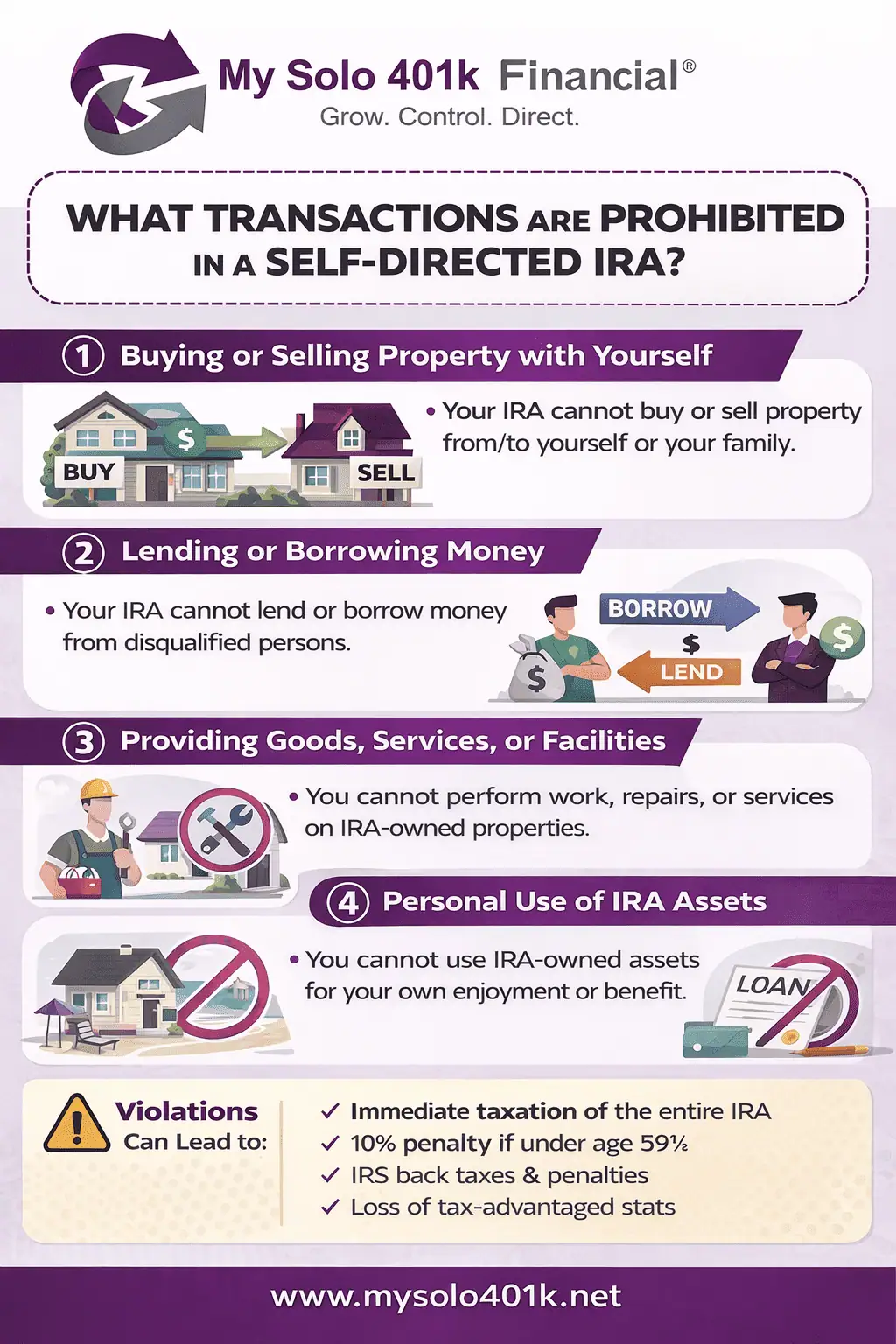
1️⃣ Buying or Selling Property with Yourself
Your IRA cannot:
-
Buy property from you
-
Sell property to you
-
Buy property from your child
-
Allow your child to live in an IRA-owned rental property — even at fair market rent.
The same restrictions apply to a self-directed Solo 401(k).
2️⃣ Lending or Borrowing Money
Your IRA cannot:
-
Lend money to you
-
Borrow money from you
-
Issue a promissory note to you
-
Personally lend money to your IRA
💡 Important distinction:
A Solo 401(k) can offer participant loans (up to 50% of the account balance, max $50,000). IRAs cannot.
3️⃣ Providing Goods, Services, or Facilities
If your IRA owns a rental property:
-
You cannot perform repairs (even unpaid)
-
You cannot hire your spouse to perform work
This is called sweat equity, and it is prohibited.
All services must be performed by unrelated third parties and paid from IRA funds.
4️⃣ Personal Use of IRA Assets
You cannot:
-
Stay in an IRA-owned vacation property
-
Build your primary residence on IRA-owned land
-
Use IRA-owned assets for personal enjoyment
Even if you pay fair market value — it’s still prohibited.
5️⃣ Loan Guarantees
Your IRA cannot guarantee a personal loan
You cannot use IRA funds as collateral for your personal mortgage or other borrowing.
Self-Dealing and Indirect Benefit
Even if no disqualified person is directly involved, you can still trigger a prohibited transaction through self-dealing.
Self-dealing occurs when you personally benefit from IRA assets outside proper retirement distributions.
Examples:
-
Performing unpaid renovations
-
Increasing property value through your labor
-
Temporarily using IRA funds for personal bills
Your IRA must operate like a completely independent entity.
Prohibited Investments (Collectibles)
While SDIRAs allow many alternative investments, most collectibles are prohibited.
❌ Disallowed Collectibles Include:
-
Artwork
-
Rugs
-
Antiques
-
Gems (diamonds, emeralds)
-
Stamps
-
Musical instruments
-
Alcohol (wine, liquor)
-
Certain foreign coins (e.g., South African Krugerrands)
✅ Allowed Precious Metals (With Requirements)
Certain metals are permitted if they meet IRS purity standards (typically 99.5%+).
Examples include:
-
American Eagle coins
-
Canadian Maple Leaf coins
-
U.S. Buffalo Gold coins (non-proof)
-
Certain bullion bars from accredited refiners
Always verify eligibility before purchasing metals inside your IRA.
What Happens If You Violate the Rules?
The consequences can be severe
-
The entire IRA may be treated as distributed
-
Immediate taxation of the full account value
-
Possible 10% early withdrawal penalty (if under 59½)
-
Amended tax returns
-
Back taxes and penalties
One mistake can eliminate decades of tax-deferred or tax-free growth.
How to Stay Compliant
To protect your IRA:
✔ Know who is disqualified
✔ Avoid personal benefit
✔ Keep all transactions at arm’s length
✔ Use unrelated third parties
✔ Seek professional guidance before investing
Treat your IRA like a completely separate legal entity.
Final Thoughts
A self-directed IRA offers tremendous flexibility and diversification potential. But with that flexibility comes responsibility.
The IRS prohibited transaction rules exist to ensure retirement accounts are used exclusively for retirement purposes.
By understanding:
-
Who is disqualified
-
What constitutes self-dealing
-
Which investments are prohibited
-
And how to structure transactions properly
You can confidently grow your retirement wealth — without jeopardizing your tax advantages.
If you’re considering alternative investments inside your self-directed IRA, make compliance your first priority.
Because one prohibited transaction can undo years of strategic planning.