
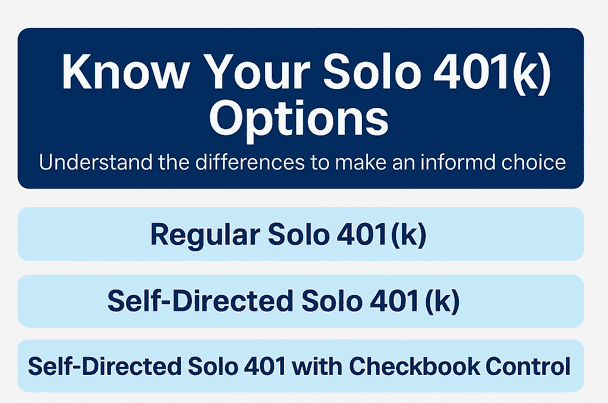
If you’re self-employed and considering a Solo 401(k), understanding your options is critical. There are multiple types of Solo 401(k) providers, and each offers a different level of flexibility, investment access, and administrative support. This post breaks down your primary Solo 401(k) choices to help you make an informed decision.
1. Traditional or “Vanilla” Solo 401(k) Plans
These Solo 401(k) plans are typically offered by large brokerages, banks, or insurance companies. Providers include Fidelity, Schwab, E-Trade, Wells Fargo, Bank of America, MassMutual, and others. These plans are often designed for investing in standard assets like mutual funds or annuities.
Offered by insurance companies, banks, and large brokerages like Fidelity, Schwab, and E-Trade, these plans are basic and come with limitations:
- ❌ No self-directed investments (e.g., real estate, metals)
- ❌ No Mega Backdoor Roth strategy support
- ❌ No loan option
These plans often focus on traditional stock and mutual fund investing, and some insurance companies design them specifically for annuity products.
These plans may be sufficient for individuals only interested in traditional investments but are limited in flexibility.
2. Self-Directed Solo 401(k) (Without Checkbook Control)
Self-directed Solo 401(k) plans offered by certain custodians allow for some alternative investments, but they still come with restrictions.
Some providers offer self-directed Solo 401(k) plans with limited access to alternative investments. However:
- You’re typically required to hold your funds and investments with a specific custodian
- ❌ May not support Mega Backdoor Roth conversions
- ❌ Limited autonomy over fund management
-
Funds and investments must typically be held with the designated custodian.
This option offers more flexibility than vanilla plans, but still lacks full control.
3. Fully Self-Directed Solo 401(k) with Checkbook Control
This is the most flexible and feature-rich version of a Solo 401(k) plan. Providers like My Solo 401k Financial offer plans that include:
- ✅ Alternative investments: real estate, promissory notes, precious metals, and more
- ✅ Participant loans: borrow up to $50,000 or 50% of the account balance
- ✅ Mega Backdoor Roth support: make voluntary after-tax contributions and convert to Roth
- ✅ Auto contribution tax credit: claim up to $1,500 in tax credits over three years
- ✅ Checkbook or wire control: choose where your funds are held (bank, credit union, brokerage)
- ✅ IRS compliance reporting: Forms 1099-R, 5500-EZ, and more at no extra charge
With this setup, you are the trustee of the plan, allowing you to control where the money is deposited and how it is invested — all within IRS rules.
This plan gives the account holder maximum autonomy while remaining compliant with IRS regulations.
Solo 401(k) Options Comparison Chart
| Feature | Traditional Plan | Self-Directed (No Checkbook) | Self-Directed with Checkbook Control |
|---|---|---|---|
| Alternative Investments Allowed | No | Some | Yes |
| Participant Loans | No | Maybe | Yes |
| Mega Backdoor Roth Support Allow | No | Rarely | Yes |
| Choose Custodian/Bank | No | No | Yes |
| IRS Reporting Services Included | Yes | Maybe | Yes |
| Auto Contribution Tax Credit Eligible | No | No | Yes |
Why Checkbook Control Matters
By choosing your own depository institution (instead of being locked into a custodian), you reduce concerns about fund safety and improve liquidity access. You can also react more quickly to investment opportunities without needing custodian approval.
Final Thoughts
Understanding your Solo 401(k) options — from vanilla plans to fully self-directed checkbook models — can make a major difference in how you grow and manage your retirement savings. If you want flexibility, tax strategy support, and full investment control, a self-directed Solo 401(k) with checkbook control is the top-tier choice.
Tip: Choose a provider that offers full IRS compliance services and lets you control how and where your plan funds are held.
Stay informed, stay empowered, and be sure to select the Solo 401(k) setup that best aligns with your business, income, and investment goals.