
Self-Directed IRA Prohibited Transactions: Why $100K in Wine Means a 1099-R
— As of this date, the prohibited transaction rules under IRC Section 4975(c) and the collectibles rule under IRC Section 408(m) are existing, enacted federal tax law that already applies to every self-directed IRA. Nothing described in this article is proposed legislation.
Key Takeaways
- IRC Section 4975(c) prohibits self-dealing between a self-directed IRA and disqualified persons, including the IRA owner, spouse, parents, grandparents, children, and service providers such as a CPA or custodian.
- A self-directed IRA can never hold a life insurance contract or S corporation stock, though it may hold C corporation stock.
- Collectibles — art, rugs, antiques, gems, stamps, coins, and alcoholic beverages — are disallowed investments under the collectibles rule tied to IRC Section 408(m).
- IRC Section 408(m) carves out an exception for certain gold, silver, platinum, and palladium bullion and coins, such as American Eagle and Canadian Maple Leaf coins.
- Buying a disallowed collectible triggers a deemed distribution of the amount invested, plus any gains, in the year of purchase, reported on Form 1099-R, plus a 10% early-distribution penalty if the owner is under age 59½.
- A true prohibited transaction, such as self-dealing or buying property from a disqualified person, disqualifies the entire self-directed IRA — not just the amount involved — in the year the violation occurs.
- Unlike a Solo 401k, which permits a participant loan of up to 50% of the account balance capped at $50,000, a self-directed IRA owner can never borrow from the IRA itself.
Webinar recording: Self-Directed IRA Prohibited Transactions, hosted by Mark Nolan, Founder/ Compliance Officer, My Solo 401k Financial.
What Investments and Transactions Are Prohibited in a Self-Directed IRA?
Self-Directed IRA prohibited transactions fall into two distinct categories that carry very different consequences: disallowed investments, which the IRA simply cannot own, and prohibited transactions, which are deals the IRA cannot do with certain people. A self-directed IRA, also called an SDIRA, can generally invest in alternative assets like real estate, precious metals, private equity, cryptocurrency, promissory notes, and tax liens, in addition to publicly traded stocks. But those broader powers come with two sets of rules the account owner has to follow.
“One of the biggest advantages of a self-directed IRA, also called an SDIRA, is the ability to invest in alternative investments like real estate, precious metals, private equity, cryptocurrency, promissory notes, tax liens — virtually any alternative investment out there.”
(1:30 in the webinar)
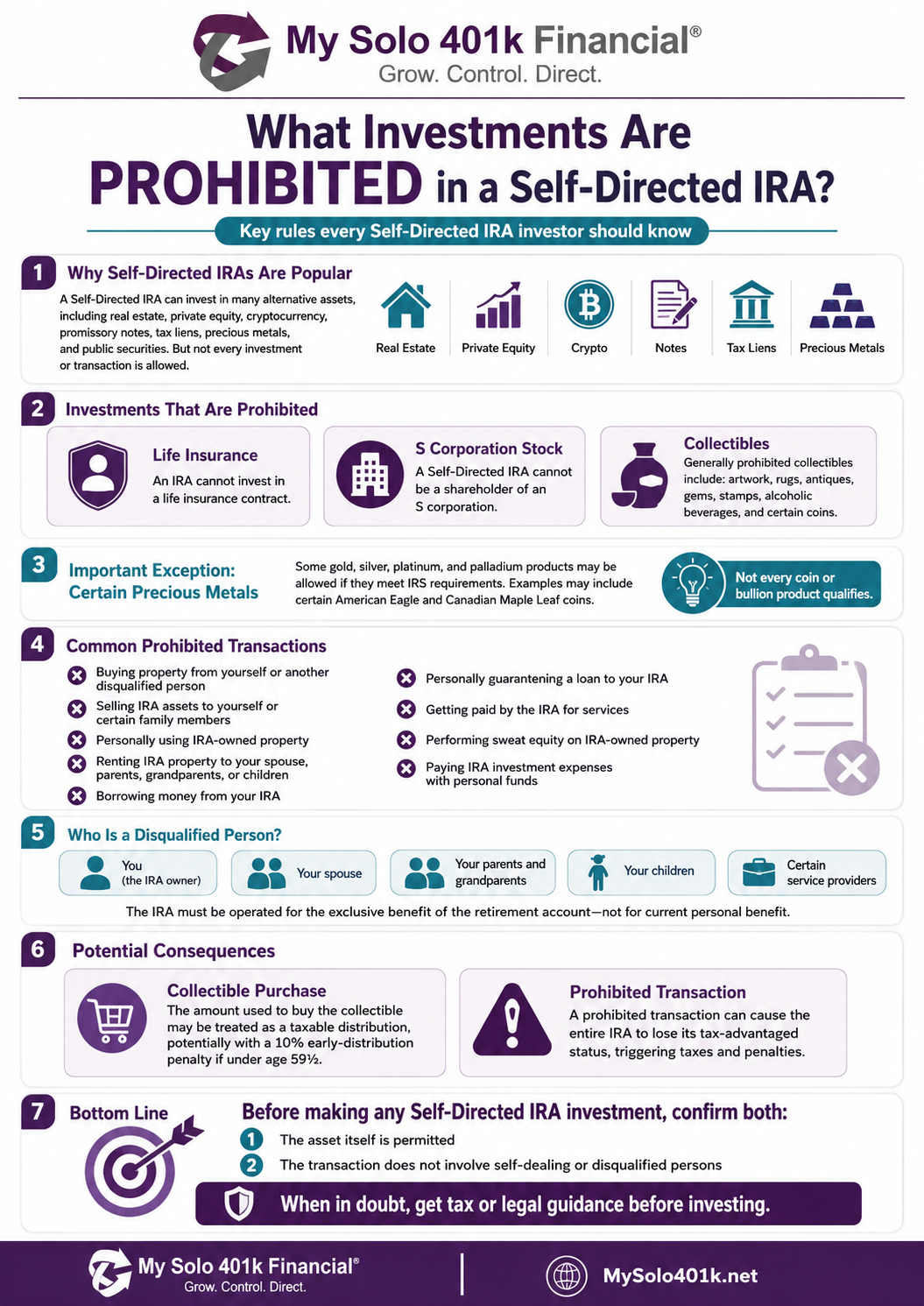
The self-directed IRA prohibited transaction rules are found at IRC Section 4975(c), and they exist to stop the account owner from self-dealing or personally benefiting, directly or indirectly, from an investment made by the IRA. Separately, a short list of non-permissible investments — collectibles, life insurance, and S corporation stock — are disallowed outright, regardless of who is involved in the transaction.
“Just because an IRA is self-directed, it doesn’t mean that anything goes. It’s not the Wild West.”
(2:30 in the webinar)
Two Investments an IRA Can Never Own
An IRA — including a self-directed IRA — can never own a life insurance contract. That prohibition is specific to IRAs; a Solo 401k is allowed to hold life insurance. An IRA is also barred from owning shares of an S corporation, because S corporation rules do not permit an IRA, which is technically a retirement trust, to be a shareholder. A self-directed IRA can, however, own shares of a C corporation.
Collectibles: Art, Wine, Coins, and Gems
Self-directed IRA regulations also block a category called collectibles. Examples include works of art, rugs, antiques, certain metals, gems, stamps, coins, and alcoholic beverages. Using self-directed IRA money to buy a rare painting is not permitted, and a self-directed IRA cannot buy a case of collectible wine or liquor either.
“Let’s say in 2026, your self-directed IRA bought a case of fine wine… that’s a disallowed investment, and it happened in 2026. Let’s say it was a $100,000 investment. So that $100,000, plus any gains from that investment, would be taxable in the year that it occurred.”
(6:00 in the webinar)
In this hypothetical, a $100,000 disallowed wine purchase made in 2026 would generate a Form 1099-R for that distribution amount in 2026, and the rest of the self-directed IRA would stay intact. Because it is treated as a deemed distribution from a disallowed investment, it is also subject to a 10% early-distribution penalty if the IRA owner is under age 59½, plus ordinary federal income tax and, depending on the owner’s state of residence, state tax.
Are Gold and Precious Metals Prohibited in a Self-Directed IRA?
Self-directed IRA precious metals investing is not automatically prohibited, even though metals fall within the general collectibles category on the surface. IRC Section 408(m) provides a specific exception for certain qualifying coins and precious metals bars. As long as the self-directed IRA custodian and structure allow for alternative investments, the IRA can hold gold, silver, platinum, and palladium — but not every gold coin or precious metals product qualifies.
“Even though, on the surface, metals fall within the general collectible rules… IRC Section 408(m) provides an exception for certain qualifying coins and precious metals.”
(7:50 in the webinar )
Approved precious metals include Canadian Maple Leaf coins and American Eagle coins. The self-directed IRA must still satisfy applicable IRS purity and custody requirements for the specific bar or coin to qualify under IRC Section 408(m).
Can a Self-Directed IRA Own Real Estate?
A self-directed IRA can own real estate, and investing in property is not itself a prohibited transaction. Allowed self-directed IRA real estate types include single-family homes, multi-family properties, commercial real estate, raw land, and farmland. The restriction is on who the property comes from, not the property type.
“A self-directed IRA cannot purchase a property that you already personally own, your parents own, or your kids own, because those are examples of disqualified parties.”
(9:20 in the webinar )
Can a Self-Directed IRA Invest in Private Equity?
A self-directed IRA can invest in private companies — a private C corporation, an LLC, a partnership, or a venture fund. But the self-directed IRA cannot invest in a private entity where the IRA owner, or certain family members, personally work, because the IRS treats that as an indirect personal benefit. As a general rule, the IRA owner also cannot own 50% or more of that private entity when personal funds, Solo 401k funds, and self-directed IRA funds are combined.
Who Is a Disqualified Person Under IRC Section 4975?
Self-directed IRA prohibited transaction rules under IRC Section 4975 restrict transactions between the IRA and certain related parties called disqualified persons. Disqualified persons include the IRA owner, the owner’s spouse, parents, grandparents, and children, and anyone who provides services to the self-directed IRA, such as the owner’s CPA or the IRA custodian.
“The prohibited transactions are put in place to make sure that you’re not self-dealing or benefiting indirectly, personally, from investments made by your self-directed IRA.”
(3:50 in the webinar )
What Common Actions Trigger a Self-Directed IRA Prohibited Transaction?
Even when the underlying asset is allowed, such as real estate, a self-directed IRA transaction can still be prohibited because of who is involved or how the asset is used. Common triggers include:
- Selling, exchanging, or depositing personal property into a self-directed IRA, or buying property from a disqualified person such as a parent or child.
- Using property owned by the self-directed IRA for personal or business use — including renting it to yourself or a disqualified party, even at fair market rent (for example, buying a house near a child’s college for that child to rent).
- Borrowing money from a self-directed IRA.
- Personally guaranteeing a loan made to a self-directed IRA, or using self-directed IRA funds as security for a personal loan.
- Paying yourself from self-directed IRA funds for services performed for the IRA, such as finding properties for it to buy.
- Performing “sweat equity” work — such as repairs — on property owned by the self-directed IRA.
- Paying property expenses (taxes, utilities) connected to a self-directed IRA investment with personal funds instead of IRA funds.
“Clients often ask, well, I want to fix a leaky toilet for a property owned by a self-directed IRA. I think I’m very handy and can just fix it myself… Well, that’s great — you’re handy, Handy Andy — but no, you can’t do that.”
(11:00 in the webinar )
Instead of doing the repair personally, the self-directed IRA has to pay an unrelated contractor, and that contractor has to be paid with self-directed IRA funds — never personal funds. The same rule applies to every expense connected to a self-directed IRA investment, from property taxes to utility bills.
Can You Borrow Money From a Self-Directed IRA?
A self-directed IRA owner can never borrow money directly from the IRA. That is different from the Solo 401k, which permits a participant loan of up to 50% of the total account balance, not to exceed $50,000 — a feature self-directed IRAs do not have.
A self-directed IRA also cannot be used as collateral in either direction. The owner cannot personally guarantee a loan made to the self-directed IRA, though the IRA can obtain a non-recourse loan in its own name for a real estate purchase. Likewise, IRA funds cannot secure a loan the owner takes out personally, such as financing for their own home or a personal investment property. Techniques such as a Mega Backdoor Roth using a Solo 401k plan operate under separate Solo 401k rules and do not change any of these self-directed IRA borrowing restrictions.
What Happens If You Trigger a Self-Directed IRA Prohibited Transaction?
A self-directed IRA prohibited transaction has far more severe consequences than buying a single disallowed investment. Instead of only the amount involved being taxed, the entire self-directed IRA — including any other holdings or cash in the account — becomes subject to taxes and penalties in the year the prohibited transaction occurred.
“The prohibited transaction results in the entire self-directed IRA being subject to taxes… that entire IRA will be subject to taxes and penalties in the year that that prohibited transaction occurred.”
(13:00 in the webinar )
If the prohibited transaction happened in a prior year, the owner does not have to amend every intervening year’s tax return — taxes and penalties apply as of the year the prohibited transaction occurred. The bottom line: any self-directed IRA investment or expense must be made for the benefit of the IRA itself, never for the owner’s direct or indirect personal benefit.
In short: a disallowed investment taxes only what was invested, while a prohibited transaction taxes the entire self-directed IRA.
In short: a Solo 401k allows a participant loan up to $50,000; a self-directed IRA does not allow participant loans at all.
Frequently Asked Questions
What investments are prohibited in a self-directed IRA?
A self-directed IRA can never hold life insurance contracts, S corporation stock, or collectibles such as art, rugs, antiques, gems, stamps, coins, and alcoholic beverages. Beyond those outright bans, IRC Section 4975(c) also prohibits transactions between the IRA and disqualified persons, such as the owner, spouse, parents, or children, even when the underlying asset type is otherwise allowed.
Are gold and precious metals prohibited in a self-directed IRA?
Not necessarily. Metals generally fall under the collectibles ban, but IRC Section 408(m) creates an exception for certain qualifying gold, silver, platinum, and palladium bars and coins, such as American Eagle and Canadian Maple Leaf coins. Not every gold coin or precious metals product qualifies for the exception.
Does the collectibles rule apply the same way as a prohibited transaction?
No. Buying a disallowed collectible triggers a distribution of just the amount invested, plus gains, in the year of purchase, reported on Form 1099-R. A prohibited transaction under IRC Section 4975(c), such as self-dealing with a disqualified person, disqualifies the entire self-directed IRA for that year instead.
Can a self-directed IRA own physical real estate?
Yes. A self-directed IRA can own single-family homes, multi-family properties, commercial real estate, raw land, and farmland. The property just cannot be bought from, sold to, or used by a disqualified person, including the owner, their parents, or their children, even at fair market rent.
Who counts as a disqualified person for a self-directed IRA?
Under IRC Section 4975, disqualified persons include the IRA owner, the owner’s spouse, parents, grandparents, and children, and anyone providing services to the IRA, such as its CPA or custodian. Transactions between the self-directed IRA and any of these people can trigger a prohibited transaction.
Can I borrow money from my self-directed IRA?
No. Borrowing from a self-directed IRA is treated as a taxable distribution. This differs from a Solo 401k, which allows a participant loan of up to 50% of the account balance, capped at $50,000. The 60-day IRA rollover rule is a separate mechanism, not a loan.
Can a self-directed IRA invest in a private company?
Yes, a self-directed IRA can invest in a private C corporation, LLC, partnership, or venture fund. It cannot invest in a private entity where the owner or certain family members personally work, and the owner generally cannot own 50% or more of that entity when combining personal, Solo 401k, and IRA funds.
What happens if I engage in a self-directed IRA prohibited transaction?
The entire self-directed IRA — not just the asset involved — becomes subject to income tax and, if applicable, the 10% early-distribution penalty in the year the prohibited transaction occurred. If the violation happened in a prior year, tax and penalties apply as of that year rather than requiring amended returns for every year since.
Glossary of Self-Directed IRA Terms
- Self-Directed IRA (SDIRA)
- An individual retirement account that lets the account holder invest beyond publicly traded stocks and bonds, in assets such as real estate, precious metals, and private equity, subject to IRS rules.
- Disqualified Person
- Under IRC Section 4975, a person or entity — including the IRA owner, spouse, parents, children, grandparents, and certain service providers such as a CPA or custodian — who cannot transact directly or indirectly with the self-directed IRA.
- Prohibited Transaction
- A transaction between a self-directed IRA and a disqualified person, such as self-dealing or an improper sale, that disqualifies the entire IRA’s tax-advantaged status under IRC Section 4975(c).
- Collectible
- A disallowed IRA investment category defined under IRC Section 408(m), including works of art, rugs, antiques, gems, stamps, coins, and alcoholic beverages.
- Non-Recourse Loan
- A loan made directly to a self-directed IRA, rather than to the IRA owner personally, where the lender’s only recourse in default is the property itself.
- Form 1099-R
- The IRS form an IRA custodian issues to report a distribution from an IRA, including a deemed distribution caused by a disallowed investment or a prohibited transaction.
Ready to invest with confidence?
Learn how to structure your account correctly from the start and avoid the self-directed IRA prohibited transaction pitfalls covered above.
This article is based on the August 11, 2026 live webinar hosted by My Solo 401k Financial. Analysis by Mark Nolan, Founder/ Compliance Officer, My Solo 401k Financial.