
If you’re self-employed and don’t have any full-time employees (other than a spouse), opening a Solo 401(k) plan could be one of the smartest financial decisions you make. This powerful retirement plan is designed for solopreneurs, consultants, freelancers, and small business owners who want to maximize their retirement savings while reducing taxable income.
In this article, we’ll walk through how self-employed individuals can open a Solo 401(k) plan, what the process looks like, and why this type of plan offers unmatched flexibility and benefits.
Watch: Learn how to open a solo 401k and how you can still contribute to your day time employer 401k
Who Qualifies for a Solo 401(k) Plan?
A Solo 401(k) is available to self-employed individuals or small business owners with no full-time W-2 employees. You may qualify even if you’re just getting started, as long as you’re actively pursuing self-employment. Spouses who work in the business may also participate in the plan.
-
Be self-employed or own a business with no full-time W-2 employees (other than your spouse).
-
Not be part of a controlled group where another business you own employs full-time workers.
-
Engage in some form of income-generating self-employment activity, even if your business is new.
💡 Even if your business just started this year, you’re eligible—as long as you’re actively pursuing self-employment.
However, if you hire full-time W-2 employees (working 1,000 hours or more per year), or if you own another business that does, you may no longer be eligible. The IRS considers all businesses under your control as part of a single group when determining eligibility.
Why Choose a Solo 401(k)?
There are several compelling reasons to choose a Solo 401(k) over other retirement plans:
-
High Contribution Limits: For tax year 2025, you can contribute up to $70,000, or $77,500 if you are age 50 or older.
-
Multiple Contribution Types: The plan allows for pre-tax, Roth, and voluntary after-tax contributions. This opens the door to advanced strategies like the Mega Backdoor Roth.
-
Self-Directed Investment Options: Unlike traditional 401(k)s, a self-directed Solo 401(k) allows you to invest in a wide variety of assets including real estate, precious metals, private equity, promissory notes, cryptocurrency, as well as equities (e.g., stocks and ETFs).
-
Participant Loans: You can borrow up to $50,000 or 50% of your plan balance (whichever is less) and repay yourself with interest.
-
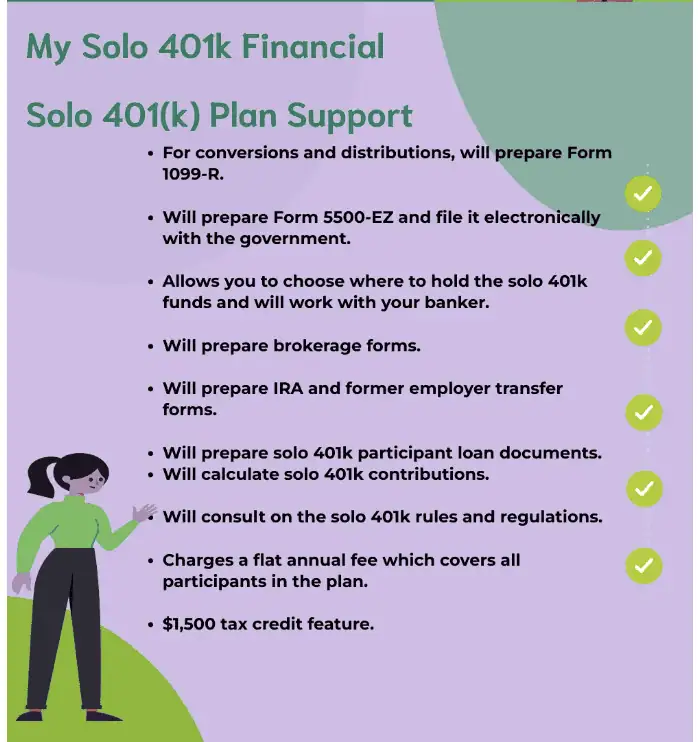
$1,500 Tax Credit: New Solo 401(k) plans with automatic enrollment features may qualify for a $500 annual credit for three consecutive years, thanks to SECURE Act 2.0.
Bonus: $1,500 Tax Credit for Auto-Enrollment Feature
Thanks to the SECURE Act 2.0, new Solo 401(k) plans with an auto-enrollment feature may qualify for a $500/year tax credit for 3 years—totaling $1,500. Even if you don’t make contributions, you can still qualify, provided your plan documents include the right language.
What You Need to Open a Solo 401(k)
The process to open a Solo 401(k) is straightforward, especially when working with a provider that offers self-directed plans. Here’s what you’ll need:
-
Business Information: Whether you’re a sole proprietor, LLC, or other business entity, you’ll need to provide details about your business.
-
Employer Identification Number (EIN): The Solo 401(k) is a separate legal entity and requires its own EIN, not your business EIN or Social Security number.
-
Plan Document: This outlines the terms of the plan.
-
Custodian or Brokerage Account: You choose where to hold the funds. Many people use Fidelity, Schwab, or a local bank.
Once your provider drafts the plan documents, you’ll review and sign them, receive your EIN, and open your Solo 401(k) bank or brokerage accounts with the assistance from your solo 401k provider. If you’re using a self-directed plan, you may open multiple accounts — one for each type of contribution (pre-tax, Roth, and after-tax).
Funding and Managing the Plan
You can fund your Solo 401(k) by making new contributions, rolling over funds from IRAs or former employer plans, or both. Contributions are not required annually, but you must remain self-employed to keep the plan active.
If you plan to make after-tax contributions and convert them to Roth (the Mega Backdoor Roth strategy), it’s best to do so promptly to avoid taxation on any earnings.
You’ll also be responsible for annual IRS reporting, such as Form 5500-EZ once your plan balance exceeds $250,000, and Form 1099-R for distributions or Roth conversions. As the provider of the solo 401k My Solo 401k Financial includes these compliance services in their annual fee for those who timely request it.
Common Questions About Opening a Solo 401(k)
Can I open a Solo 401(k) if I already have a 401(k) at my day job?
Yes. Many professionals use a Solo 401(k) for their self-employment income in addition to a 401(k) from a W-2 employer. Just keep in mind that employee deferral limits apply across both plans, while employer and after-tax contributions are calculated separately.
What if I hire an employee in the future?
If you hire a full-time W-2 employee or meet certain part-time employee rules, you may need to terminate your Solo 401(k) and transition to a traditional 401(k) plan.
Can I invest in real estate or cryptocurrency?
Yes. A self-directed Solo 401(k) allows you to invest in alternative assets. If you’re investing in real estate with leverage, your Solo 401(k) can avoid UDFI tax — a major advantage over IRAs.
Do I need a separate account for Roth, pre-tax, and after-tax funds?
Yes. Each type of contribution must be tracked separately, which means separate sub-accounts within the Solo 401(k) structure.

Final Thoughts
A Solo 401(k) offers unmatched advantages for self-employed individuals looking to maximize retirement savings and gain control over their investments. With high contribution limits, tax-saving strategies like the Mega Backdoor Roth, and the ability to invest in a wide range of assets, it’s a versatile tool that fits the unique needs of solopreneurs.
If you’re ready to open a Solo 401(k) or need help transferring your existing retirement accounts, be sure to work with a provider who understands the complexity of self-directed plans and can support you with ongoing compliance.