
Solo 401k Tax-Free? Only the Roth Side Qualifies After 5 Years and Age 59½
Live webinar: “Is a Solo 401k Tax-Free?” hosted by My Solo 401k Financial
Key Takeaways
- Pre-tax Solo 401k contributions are tax-deductible in the year you make them and grow tax-deferred, but the full distribution amount is taxed as ordinary income at retirement.
- For tax year 2026, the employee contribution limit to a Solo 401k is $24,500, and the overall limit across all contribution sources is $72,000.
- A Roth Solo 401k distribution is tax-free only if it is a “qualified” distribution — the account must be open at least 5 years and the owner must be at least age 59½.
- Voluntary after-tax contributions, used for the Mega Backdoor Roth strategy, let a self-employed owner contribute up to the full $72,000 overall 2026 limit and convert it to Roth.
- Required minimum distributions apply to pre-tax Solo 401k funds starting at age 73, and the “still working” exception available to traditional employer 401k plans does not apply to Solo 401k owners.
- Investment gains inside a Solo 401k, such as stock sales, are not subject to annual capital gains tax because the plan is a tax-sheltered vehicle.
- A Solo 401k that makes an equity investment in an active business rather than investing passively can trigger Unrelated Business Income Tax (UBIT) on gains above the first $1,000.
Is a Solo 401k Tax-Free?
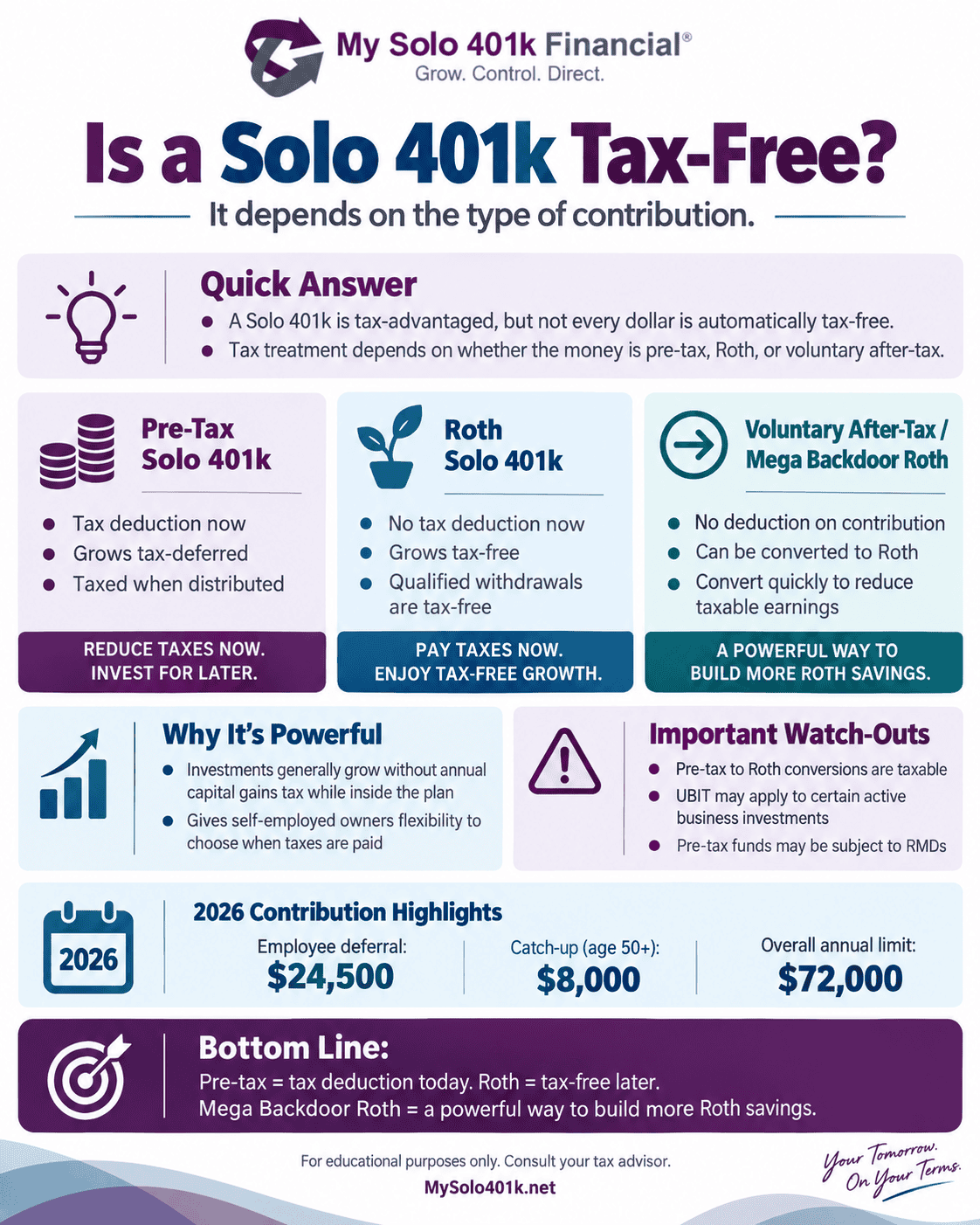
A Solo 401k’s tax treatment is not one-size-fits-all. Solo 401k plans allow several contribution sources — pre-tax, Roth, and, depending on the provider, voluntary after-tax contributions used for the Mega Backdoor Roth — and each source is taxed differently.
“One of the biggest advantages of a Solo 401k is it’s powerful tax benefits, but is a Solo 401k really tax free? It depends on which type of Solo 401k contribution you are making.”
(watch the webinar)
What Is a Solo 401k?
A Solo 401k is a qualified defined contribution retirement plan for a self-employed, owner-only business. The IRS refers to these as “one-participant 401k” plans; other names in the industry include solo K, single K, and individual K. A business disqualifies itself from a Solo 401k if it employs a non-owner, full-time common-law W-2 employee — generally someone who works 1,000 hours or more in a full calendar year.
Because the owner acts as both the employee and the employer, a Solo 401k allows both employee and employer contributions, just as a traditional employer-sponsored 401k does. Contribution limits are the same between the two structures; the difference is in how the contributions are taxed.
How Are Pre-Tax Solo 401k Contributions Taxed?
Pre-tax Solo 401k contributions reduce taxable income in the year they’re made, then grow tax-deferred rather than tax-free. For tax year 2026, the employee contribution limit is $24,500. Distributions of pre-tax funds, including all investment growth, are fully taxable as ordinary income when withdrawn, generally at retirement.
“The overall limit for an employee contribution to a Solo 401k is twenty four thousand five hundred dollars for tax year twenty twenty six.”
(watch the webinar)
How Are Roth Solo 401k Contributions Taxed?
Roth Solo 401k employee contributions use the same contribution limits as pre-tax contributions, but they are not tax-deductible. In exchange, the funds grow tax-free, and qualified Roth Solo 401k distributions are also tax-free. A distribution only qualifies as tax-free if two conditions are both met.
“You have to have had a Roth Solo 401k for five years, and you must be over age fifty nine and a half when you make the distribution. So you have to satisfy both of those requirements, not just one, but both.”
(watch the webinar)
What Is the Mega Backdoor Roth Solo 401k Strategy?
The Mega Backdoor Roth uses voluntary after-tax Solo 401k contributions, which are not deductible but can be converted to Roth. Depending on the plan provider, an owner can direct up to the entire overall annual limit — known by its code section as the 415(c) overall limit — into voluntary after-tax contributions and then convert them.
“For tax year twenty twenty six, the overall contribution limit to a Solo 401k plan is seventy two thousand dollars.”
(watch the webinar)
A question raised live addressed exactly this timing issue: if contributions sit unconverted, are the resulting gains taxed later? Mark Nolan’s answer: gains that accrue before conversion become taxable at the time of conversion, while the original contribution amount (the basis) is never taxed again, since it was already after-tax money.
Can You Convert Pre-Tax Solo 401k Funds to Roth?
Yes. This is called an in-plan conversion, and it is fully taxable in the year of conversion because pre-tax funds have never been taxed. The converted amount is treated as earned income for that tax year, which can push the owner into a higher tax bracket, and the resulting tax bill must be paid from outside funds — not from the Solo 401k itself. In-plan conversions cannot be reversed or recharacterized once processed.
Are Solo 401k Investment Gains Tax-Free Each Year?
Gains inside a Solo 401k are not taxed annually — there’s no yearly capital gains bill the way there would be in a personal brokerage account, because the plan itself is a tax-sheltered vehicle. That said, this shelter has one notable exception: unrelated business income tax.
What Is Unrelated Business Income Tax (UBIT) in a Solo 401k?
Unrelated Business Income Tax (UBIT) applies when a Solo 401k makes an active investment — for example, an equity stake in a private business that sells goods or services — rather than a passive investment. The first $1,000 of such income is exempt; amounts above that are taxed, and the tax is paid by the Solo 401k itself, not the owner personally.
“Solo 401k plans were created by Congress to invest passively. They weren’t created for active investing, meaning investing in a business that offers goods or services. That’s why it would trigger unrelated business income tax.”
(watch the webinar)
Do Solo 401k Owners Have to Take Required Minimum Distributions?
Yes. Pre-tax Solo 401k funds are subject to Required Minimum Distributions (RMDs) starting at age 73 under current regulations. The “still working” exception, which lets employees delay RMDs from a traditional employer 401k if they remain employed, does not apply to Solo 401k plans, because opening one requires being self-employed and an owner of the business.
“You have to take require minimum distributions from that pre-tax Solo 401k once you reach age seventy three.”
(watch the webinar)
Pre-Tax vs. Roth vs. Voluntary After-Tax: Comparison
In short: pre-tax defers tax to retirement, Roth eliminates tax on qualified distributions, and voluntary after-tax is a bridge into Roth via conversion.
Glossary
- Solo 401k
- A qualified defined contribution retirement plan for a self-employed, owner-only business with no non-owner full-time W-2 employees; also called a one-participant 401k, solo K, single K, or individual K.
- Mega Backdoor Roth
- A strategy using voluntary after-tax Solo 401k contributions, converted to Roth, to get more money into Roth status than the standard Roth contribution limit allows.
- Qualified Roth Distribution
- A Roth Solo 401k distribution that is entirely tax-free because the account has been open at least 5 years and the owner is at least age 59½ at the time of distribution.
- Required Minimum Distribution (RMD)
- A mandatory withdrawal from pre-tax retirement funds beginning at age 73 under current regulations; applies to pre-tax Solo 401k funds with no “still working” exception available.
- Unrelated Business Income Tax (UBIT)
- A tax owed by the Solo 401k itself when the plan makes an active investment, such as equity in a business selling goods or services, rather than a passive investment.
- In-Plan Roth Conversion
- Converting pre-tax Solo 401k funds to Roth Solo 401k status inside the same plan; taxable in the year of conversion and cannot be reversed.
Frequently Asked Questions
Is a Solo 401k tax-free?
Not automatically. A Solo 401k’s tax treatment depends on contribution type: pre-tax contributions are tax-deductible now but taxed at distribution, while Roth contributions are taxed now but grow and distribute tax-free once the distribution is “qualified” — the account is at least 5 years old and the owner is at least 59½.
What is the Solo 401k contribution limit for 2026?
For tax year 2026, the employee contribution limit is $24,500, and the overall limit combining employee, employer, and voluntary after-tax contributions is $72,000. The overall figure is based on the 415(c) limit set by the IRS.
When are Roth Solo 401k distributions tax-free?
Roth Solo 401k distributions are tax-free only when they’re “qualified” — meaning both that the Roth account has been open at least 5 years and that the owner is at least age 59½ at the time of the distribution. Both conditions must be met, not just one.
Does a Solo 401k avoid capital gains tax?
Yes, on ordinary investment activity. Because the Solo 401k is a tax-sheltered vehicle, selling an investment for a gain inside the plan does not trigger annual capital gains tax the way it would in a personal brokerage account. The exception is unrelated business income tax on active business investments.
Do Solo 401k owners have to take required minimum distributions?
Yes, for pre-tax funds, starting at age 73. Unlike traditional employer 401k plans, the “still working” exception does not apply to Solo 401k owners, since a Solo 401k requires the participant to be a self-employed business owner. Roth Solo 401k funds are not subject to RMDs during the owner’s lifetime.
If I don’t immediately convert after-tax contributions to Roth, are the unconverted funds later taxed?
The original after-tax contribution amount is never taxed again. However, any investment gains that accumulate in the voluntary after-tax holding account before conversion become taxable once converted. Converting promptly, before gains build up, keeps that taxable portion small.
Can I convert pre-tax Solo 401k funds to Roth?
Yes, through an in-plan conversion. The full converted amount is taxable as income in the year of conversion, is treated as earned income that could raise your tax bracket, and must be paid for with funds from outside the Solo 401k. The conversion cannot be reversed once processed.
What is unrelated business income tax (UBIT) in a Solo 401k?
UBIT applies when a Solo 401k invests actively — for example, taking an equity stake in a private business that sells goods or services — rather than investing passively. The first $1,000 of such income is exempt from UBIT; the Solo 401k itself pays tax on amounts above that.
This article is based on the My Solo 401k Financial live webinar “Is a Solo 401k Tax-Free?” . Analysis by Mark Nolan, Founder/ Compliance Officer, My Solo 401k Financial.
Learn how to open a Solo 401k account →