
Does a Solo 401k Require a Plan Document?
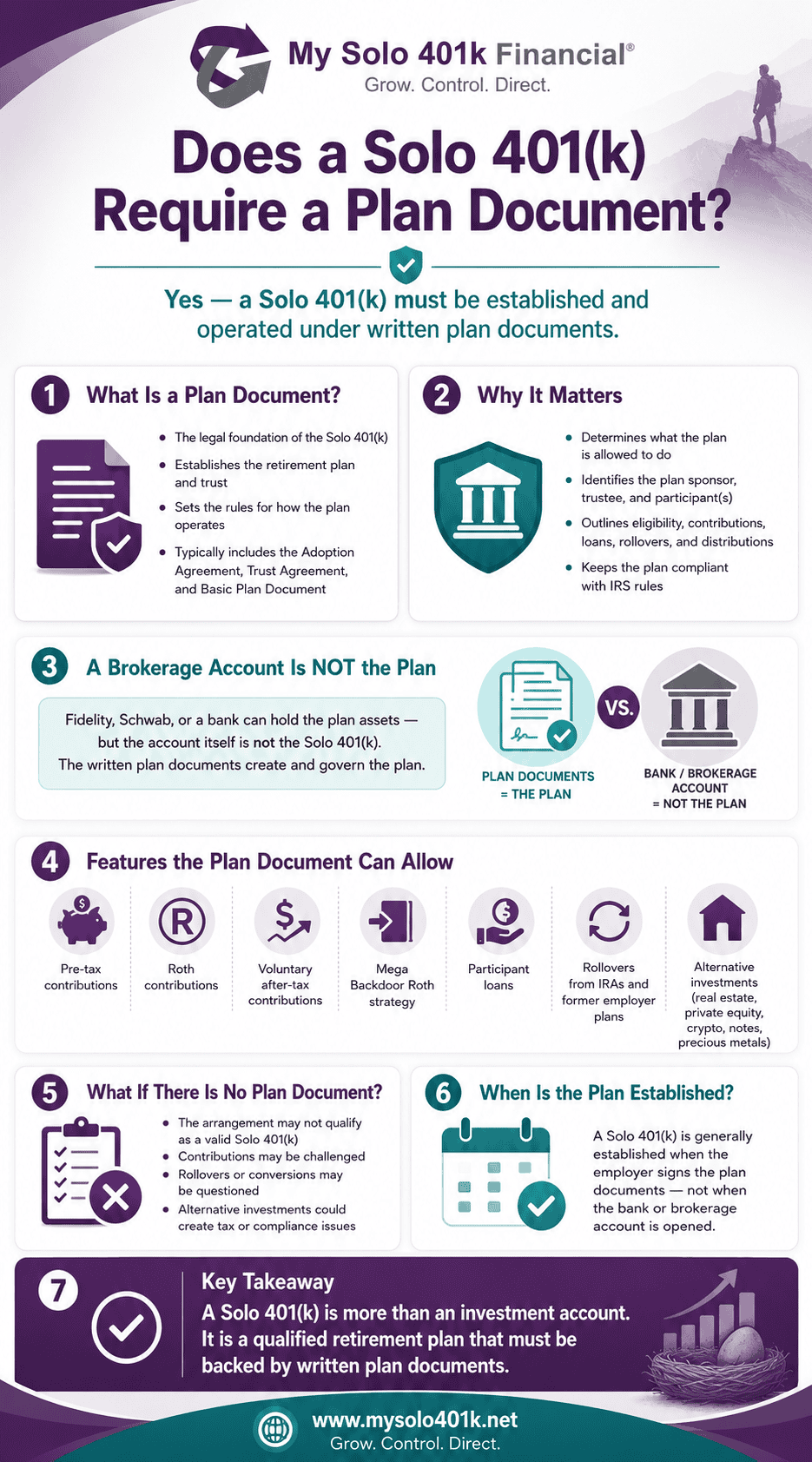
The Solo 401k is one of the most powerful retirement plans available to self-employed individuals and owner-only businesses — offering high contribution limits, Roth options, the Mega Backdoor Roth strategy, participant loans, and the ability to invest in real estate, cryptocurrency, precious metals, and more. But here is the critical foundation that many people overlook: a Solo 401k is not simply a bank or brokerage account. It is a qualified retirement plan — and like all qualified retirement plans, it must be established and operated under formal written plan documents. The short answer is yes: a Solo 401k absolutely requires a plan document.
Watch: My Solo 401k Financial explains why a Solo 401k requires a plan document — and why the plan document determines every feature your plan can offer
📋 What Is a Solo 401k Plan Document?
My Solo 401k Financial explains that the Solo 401k plan document is the written legal document that creates and governs the Solo 401k plan — which is legally structured as a retirement trust, a separate legal entity from both the participant and the business. The plan document is the legal foundation of the plan. It defines what the plan is, how it operates, and what features it makes available to participants.
The plan document is not a single page. It is a set of formal legal documents, each serving a specific purpose:
📌 The Plan Document Answers One Core Question: My Solo 401k Financial explains that the simplest way to understand the plan document is this: it answers the question “What is the Solo 401k allowed to do?” — including what contribution types are permitted, what investment options are available, whether participant loans are allowed, and what the distribution and conversion rules are. Every feature the plan has — or lacks — flows directly from what the plan document contains.
📄 What the Solo 401k Plan Document Contains
A properly drafted Solo 401k plan document covers every material aspect of how the plan is structured and operated. My Solo 401k Financial drafts plan documents for maximum flexibility under IRS regulations — enabling all contribution types and advanced features from day one. Here is what the plan document typically addresses:
🚫 Common Misconception — A Brokerage Account Is NOT the Plan
My Solo 401k Financial identifies this as one of the most pervasive misconceptions in the Solo 401k space: opening a Solo 401k account at a brokerage firm does not automatically create a complete, legally valid Solo 401k plan. A brokerage account at Fidelity, Schwab, or any other financial institution simply holds the funds — it is not the plan itself.

The Solo 401k has two separate and distinct components that must both exist for the plan to be legitimate:
My Solo 401k Financial explains that the business owner must first sign the plan documents — which establishes the retirement trust and makes the plan legally effective — before opening holding accounts, making contributions, processing rollovers, executing conversions, or making any investments. The signature date on the plan documents determines when the plan legally exists.
⚠️ Important — The Plan Document Must Come First: Without a valid signed plan document, there is no qualified Solo 401k plan — regardless of how many accounts have been opened at a brokerage firm. My Solo 401k Financial emphasizes that participants who open brokerage accounts and begin making contributions without first signing a plan document have not actually established a qualified Solo 401k. All contributions made before plan adoption may not be qualified, and IRS compliance could be at risk.
📋 Example: How a Solo 401k at Fidelity Actually Works A self-employed consultant establishes a Solo 401k with My Solo 401k Financial. The plan documents are signed — establishing the retirement trust and making the plan legally effective. The participant then opens three separate brokerage accounts at Fidelity (non-prototype investment only accounts) in the name of the plan — one for pre-tax funds, one for Roth funds, and one for voluntary after-tax contributions.
In this structure: My Solo 401k Financial provides the plan document and ongoing compliance support. Fidelity simply holds the funds in the brokerage accounts. The participant has full checkbook control as trustee — and can invest at Fidelity, or hold alternative investments at a different custodian, all under the same plan document.
⚖️ Basic Solo 401k vs. Self-Directed Solo 401k — Why the Plan Document Determines Everything
Not all Solo 401k plans are the same — and the difference comes down entirely to the plan document. My Solo 401k Financial explains that many brokerage firms offer what is known as a basic Solo 401k — a simplified, limited plan document that covers only the most fundamental features. A self-directed Solo 401k from My Solo 401k Financial is drafted for maximum flexibility under the Internal Revenue Code, unlocking every feature the law permits.
📌 Your Plan, Your Money, Your Choice of Custodian: One of the key distinctions of My Solo 401k Financial’s approach is that the participant chooses where to hold plan funds — whether at Fidelity Investments, Charles Schwab, a local bank or credit union, or any other financial institution. My Solo 401k Financial never has access to client funds. The plan provider handles plan documents, compliance, and reporting — the participant controls their own money entirely. This is what “checkbook control” means in practice.
✍️ The Adoption Agreement — The Employer’s Selections
Within the plan document set, the adoption agreement is the document where the employer (business owner) formally selects the features they want to activate for their Solo 401k plan. My Solo 401k Financial drafts the adoption agreement for maximum flexibility under the law — meaning all optional features are already included from the start, without requiring the participant to navigate complex selection choices.
The adoption agreement records the employer’s elections, including:
- The name and entity type of the sponsoring business
- Contribution types enabled — pre-tax, Roth Solo 401k, and voluntary after-tax
- Whether participant loans are permitted and the applicable terms
- Whether the auto contribution credit feature is included
- Investment flexibility — equities only, or also alternative investments
- Named trustee(s) — the participant and any co-trustees, such as a spouse
⚠️ Not All Adoption Agreements Are Equal: An adoption agreement from a basic brokerage plan typically locks participants into a limited set of options — frequently without voluntary after-tax contributions, participant loans, or alternative investment capability. Even if those features are theoretically permitted under the IRS code, they are only available if the adoption agreement and plan document specifically include them. My Solo 401k Financial pre-populates the adoption agreement for maximum legal flexibility so no features are inadvertently left out.
🔄 The IRS Six-Year Restatement Cycle — Plan Documents Must Be Updated
My Solo 401k Financial emphasizes that the plan document is not a document you sign once and forget. It is part of the plan’s permanent compliance file and must be updated periodically to remain legally effective. There are two categories of updates that apply to Solo 401k plan documents:
1. IRS Mandatory Restatement Cycle — Every Six Years
The IRS requires all qualified retirement plans — including Solo 401k plans — to be restated (updated with new plan documents) on a periodic cycle, typically every six years. This is known as the IRS six-year restatement cycle. Each cycle is assigned a “cycle” number (Cycle 1, Cycle 2, etc.), and the IRS provides a window during which plans must be restated under the updated IRS-approved document.
My Solo 401k Financial notes that a new cycle restatement is approaching — meaning all plan participants will be required to sign updated plan documents in the coming period. My Solo 401k Financial handles this process for its clients — providing the updated documents for signature at no additional charge as part of the ongoing plan relationship.
2. Plan-Specific Updates — Triggered by Changes in Circumstances
📌 When You Will Need the Plan Document: My Solo 401k Financial notes that plan documents are not just a one-time formality. Participants will need to produce them in several situations:
- When opening bank or brokerage holding accounts — the financial institution may require a copy of the plan document
- When transferring IRAs or former employer plans into the Solo 401k — the releasing institution may need the plan document to confirm the plan’s legitimacy
- In the event of an IRS inquiry or audit — the plan document, all amendments, and all updates must be produced as part of the plan’s permanent compliance file
- When applying for a non-recourse loan for plan-owned real estate — lenders typically require the plan document and trust agreement
🎯 The $1,500 Auto Contribution Credit — Only Available in the Right Plan Document
My Solo 401k Financial was the first Solo 401k provider in the industry to offer the auto contribution credit — a dollar-for-dollar tax credit worth $500 per year for three consecutive years ($1,500 total) — made available under the SECURE Act. This credit reduces actual tax owed, not just taxable income, and is claimed by filing Form 8881.
This credit is only available if the plan document specifically includes the auto contribution credit feature. Plans at Fidelity, Schwab, Invesco, ADP, Ascensus, or local banks and credit unions that offer basic Solo 401k plans do not include this feature.
📌 How to Access the Credit if You Already Have a Solo 401k: If you already have an existing Solo 401k at Fidelity, Schwab, Invesco, ADP, or any other provider, you can restate that plan to a My Solo 401k Financial self-directed Solo 401k — updating the plan document to include the auto contribution credit and all other advanced features. Anyone who opens a new plan or restates an existing plan to My Solo 401k Financial in 2026 begins qualifying for the $500 credit in tax year 2026, continuing through 2027 and 2028, for a total of $1,500. Existing My Solo 401k Financial clients can have the credit added to their plan by submitting a support ticket through the Forms tab of the website.
🔄 Can You Transfer Existing Holdings Into a Solo 401k Without Liquidating?
My Solo 401k Financial clarifies an important question that frequently arises: whether existing assets — stocks, Bitcoin, real estate, or other investments — can be transferred into a Solo 401k without cashing them out first.
Two Different Scenarios
🏦 Setting Up Holding Accounts — Fidelity, Schwab, and Beyond
Once the Solo 401k plan document is signed and the plan is legally established, the participant opens holding accounts at the custodian of their choice. For a plan that supports all three contribution types (pre-tax, Roth, and voluntary after-tax), three separate accounts are required — one for each source of funds.
At Fidelity Investments, these accounts are called non-prototype investment only brokerage accounts. At Charles Schwab, they are referred to as Company Retirement Brokerage Accounts. My Solo 401k Financial assists clients in opening these accounts and provides step-by-step instructions for each custodian.
⚠️ Caution — E-Trade Account Opening: My Solo 401k Financial notes that since E-Trade merged with Morgan Stanley, opening brokerage accounts for a self-directed Solo 401k offered by an outside provider has become significantly more difficult — with timelines sometimes exceeding six months and repeated form submissions required. My Solo 401k Financial generally recommends Fidelity Investments or Charles Schwab as the preferred custodians for Solo 401k brokerage accounts due to their reliability, accessibility, and established processes for non-prototype accounts.
🗂️ Key Takeaways — Everything You Need to Know About the Solo 401k Plan Document
Ready to Establish a Properly Documented Self-Directed Solo 401k?
My Solo 401k Financial provides fully drafted Solo 401k plan documents for maximum flexibility under IRS regulations — including pre-tax, Roth, and voluntary after-tax contributions, the Mega Backdoor Roth Solo 401k strategy, participant loans, alternative investments, checkbook control, and the $1,500 auto contribution credit. If you already have a basic Solo 401k at Fidelity, Schwab, Invesco, or another provider, you can restate it to a My Solo 401k Financial plan — without liquidating existing holdings.
Next Steps:
Open a Solo 401k Account Today |
Contact Our Team |
Read More Articles