


Many married business owners ask us: “Can both my spouse and I participate in the same Solo 401(k)?” The quick answer is yes—provided certain requirements are met. When structured properly, this can be one of the most powerful retirement strategies available to entrepreneurial couples.
Watch: Learn How Both Spouse’s Can Participate in the Same Solo 401k
Eligibility Rules
A Solo 401(k) is designed for self-employed individuals who have no full-time W-2 employees (other than a spouse). To qualify:
-
You must be self-employed (sole proprietor, LLC, S-Corp, or partnership).
-
Your spouse must work in the same business. Ownership is not required, but active participation in the business is.
If both spouses are working in the same self-employed business, they can both be participants in one shared Solo 401(k) plan.
One Plan, Two Participants

It’s important to note that there will only be one Solo 401(k) plan sponsored by the business. However, each spouse will have separate “holding accounts” (bank or brokerage) under that plan to track their respective contributions.
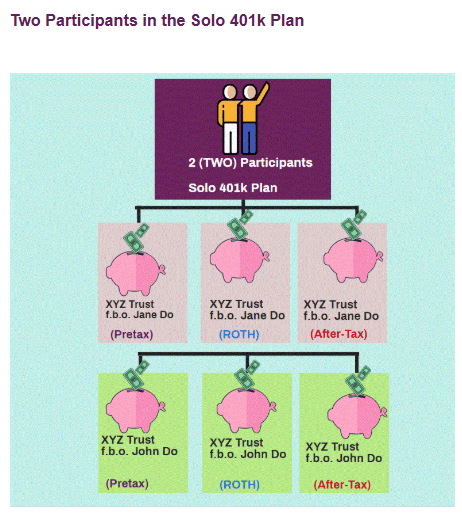
For example, Nate and Sally operate an LLC taxed as an S-Corp. Their business sponsors one Solo 401(k) plan, but each spouse maintains separate accounts for pre-tax, Roth, and after-tax contributions. This ensures compliance and accurate reporting, while avoiding the IRS headaches that come with incorrectly opening two separate plans.
Contribution Opportunities

For 2025, the total Solo 401(k) contribution limit is:
-
$70,000 if under age 50
-
$76,500 with catch-up (age 50+)
-
$81,250 with “super” catch-up (ages 60–63)
When both spouses are eligible, they can effectively double these limits. For example, each could contribute up to $70,000, for a combined $140,000 of retirement savings in one year.
-
Pre-tax contributions – reduce taxable income now.
-
Roth contributions – grow tax-free for retirement.
-
Voluntary after-tax contributions – enable the powerful Mega Backdoor Roth strategy.
Compliance Matters

Because the plan is tied to the sponsoring business:
-
Both spouses must receive earned income (W-2 wages or net self-employment income) from the business.
-
Contributions are based on each spouse’s own compensation—not the other’s.
-
Only one Form 5500-EZ is filed once the plan assets exceed $250,000, since it’s a single plan, not two.
Some providers mistakenly set up two separate Solo 401(k)s, which not only doubles fees but can create IRS compliance issues. The correct approach is one plan, multiple participants.
Bonus: SECURE Act 2.0 Credit
A properly structured Solo 401(k) may also qualify for the auto-contribution tax credit—a $500 annual credit for three years, totaling $1,500. This credit helps offset setup and administration costs, making the plan even more attractive.

Why It Matters

Allowing both spouses to participate means:
-
Doubling contributions – up to $140,000 (2025 limits) for retirement savings.
-
Maximizing tax benefits – greater ability to shift income into pre-tax or Roth buckets.
-
Estate & legacy planning advantages – each spouse builds their own retirement wealth.
For entrepreneurial couples, a Solo 401(k) is not just a retirement plan—it’s a powerful family wealth-building tool.




