

If you are self-employed and looking to build retirement wealth, you may be wondering:
Can a Solo 401(k) invest in stocks?
The answer is yes. In fact, investing in stocks is one of the most common uses of a Solo 401(k). A Solo 401(k) can invest in individual stocks, ETFs, mutual funds, index funds, CDs, bonds, and other traditional securities.
However, the type of Solo 401(k)plan you establish determines what investments are available beyond traditional equities. Understanding the difference between a basic brokerage Solo 401(k) and a self-directed Solo 401(k) is key to unlocking the full potential of this retirement plan.
Watch: Learn how a solo 401k can invest in stocks as well as alternative investments
What Is a Solo 401(k)?
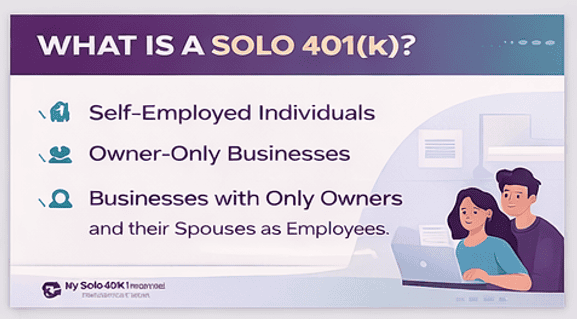
A Solo 401(k)—also called a one-participant 401(k)—is a retirement plan designed for self-employed individuals and owner-only businesses.
You may qualify if:
-
You operate a business with no full-time non-owner employees
-
The only employees are owners and their spouses
-
Any non-owner employees work less than 1,000 hours per year
Independent contractors and workers under age 21 can generally be excluded from participation as well.
The Solo 401(k) follows the same IRS rules as traditional employer 401(k) plans but is specifically structured for self-employed business owners.
Can a Solo 401(k) Invest in Stocks?

Yes. A Solo 401(k) can invest in a wide range of traditional market investments, including:
-
Individual stocks
-
Exchange-traded funds (ETFs)
-
Mutual funds
-
Index funds
-
Bonds
-
Treasury securities
-
Certificates of deposit (CDs)
These investments are commonly available through brokerage platforms such as Fidelity, Charles Schwab, or E-Trade.
For many investors, this level of investment access is sufficient.
However, some self-employed investors want more flexibility than a standard brokerage plan provides.
Basic Solo 401(k) vs Self-Directed Solo 401(k)

There are generally two types of Solo 401(k) structures.
Basic Brokerage Solo 401(k)
A basic Solo 401(k) offered directly by a brokerage firm typically allows investment only in traditional securities such as:
-
Stocks
-
ETFs
-
Mutual funds
-
Bonds
-
CDs
While these plans are easy to open, they usually limit investments to Wall Street products.
Self-Directed Solo 401(k)

A self-directed Solo 401(k) provides much broader investment flexibility.
With a properly structured self-directed plan, you can invest in:
Traditional investments:
-
Stocks
-
ETFs
-
Mutual funds
-
Index funds
-
Bonds
And alternative investments such as:
-
Real estate
-
Private equity
-
Promissory notes
-
Cryptocurrency
-
Tax liens
-
Precious metals like gold and silver
This flexibility is made possible because the plan document grants the business owner trustee authority over plan investments.
With a self-directed plan, you can still hold investments at major brokerages like Fidelity or Schwab while maintaining the ability to invest in alternative assets.
Why Many Entrepreneurs Choose a Self-Directed Solo 401(k)
A self-directed Solo 401(k) offers several advantages:
Broader Investment Diversification
You can combine:
-
Stock market investments
-
Real estate
-
Private deals
-
Alternative assets
This allows you to build a more diversified retirement portfolio.
Tax-Advantaged Growth
Solo 401(k) investments benefit from powerful tax advantages:
-
Traditional contributions grow tax-deferred
-
Roth contributions grow tax-free
This allows your investments—whether stocks or alternative assets—to compound efficiently over time.
Participant Loan Access
Unlike IRAs, a Solo 401(k) may allow participant loans.
Under IRS rules, participants can borrow:
-
50% of their account balance
-
Up to $50,000 maximum
If both spouses participate in the plan, each spouse may have their own loan limit based on their account balance.
This feature provides additional liquidity if needed.
Example: Stock Investing Inside a Solo 401(k)
A self-employed consultant opens a self-directed Solo 401(k).
They choose to:
-
Invest $100,000 in index funds and ETFs
-
Allocate $50,000 to rental real estate
-
Hold $25,000 in private equity investments
All of these investments grow within the tax-advantaged Solo 401(k) structure.
This flexibility is what makes the Solo 401(k) one of the most powerful retirement tools available to entrepreneurs.
Final Takeaway
Yes, a Solo 401(k) can invest in stocks.
But the real advantage comes from choosing a self-directed Solo 401(k) that allows you to invest in:
-
Stocks
-
ETFs
-
Mutual funds
-
Real estate
-
Cryptocurrency
-
Private investments
-
Precious metals
-
And more
With the right plan structure, you can build a fully diversified retirement portfolio inside a tax-advantaged Solo 401(k).
MySolo401k Financial specializes in self-directed Solo 401(k) plans designed to give entrepreneurs maximum investment flexibility, checkbook control, and advanced Roth strategies such as the Mega Backdoor Roth.